


Wydawcy
Katalog tematyczny
- Archeologia (109)
- Ekonomia, finanse, business (13704)
- Filozofia (1445)
- Historia (3040)
- Języki i językoznawstwo (2356)
- Lifestyle, hobby i rozrywka (475)
- Medycyna (9704)
- Nauki humanistyczne (4)
- Nauki o Ziemi i środowisku (2638)
- Nauki ścisłe (20412)
- Astronomia (294)
- Biologia (5119)
- Chemia (6540)
- Fizyka (3309)
- Matematyka (4574)
- Algebra (171)
- Analiza matematyczna (902)
- Filozofia matematyki (1)
- Geometria (237)
- Historia matematyki (57)
- Kombinatoryka, teoria grafów (67)
- Matematyka dyskretna (35)
- Matematyka stosowana (555)
- Optymalizacja (104)
- Podstawy matematyki (129)
- Statystyka, prawdopodobieństwo (296)
- Teoria grup (63)
- Teoria liczb (77)
- Topologia (66)
- Nauki ścisłe, ogólnie (503)
- Nauki społeczne (8486)
- Nauki techniczne (13450)
- Prawo (1696)
- Publikacje informacyjne i interdyscyplinarne (1288)
- Religia i wierzenia (917)
- Technika komputerowa (4067)
- Zdrowie, relacje międzyludzkie i rozwój osobisty (657)





Informacje szczegółowe o książce
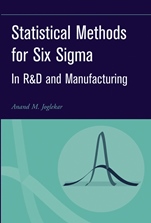
Statistical Methods for Six Sigma: In R&D and Manufacturing
ISBN 9780471203421
Autor: Anand M. Joglekar
Wydawca: Wiley
Dostępność: 3-6 tygodni
Cena: 746,55 zł
Przed złożeniem zamówienia prosimy o kontakt mailowy celem potwierdzenia ceny.
ISBN13: |
9780471203421 |
ISBN10: |
0471203424 |
Autor: |
Anand M. Joglekar |
Oprawa: |
Hardback |
Rok Wydania: |
2003-10-07 |
Ilość stron: |
344 |
Wymiary: |
266x186 |
Tematy: |
PB |
A guide to achieving business successes through statistical methods
Statistical methods are a key ingredient in providing data–based guidance to research and development as well as to manufacturing. Understanding the concepts and specific steps involved in each statistical method is critical for achieving consistent and on–target performance.
Written by a recognized educator in the field, Statistical Methods for Six Sigma: In R&D and Manufacturing is specifically geared to engineers, scientists, technical managers, and other technical professionals in industry. Emphasizing practical learning, applications, and performance improvement, Dr. Joglekar’s text shows today’s industry professionals how to:Summarize and interpret data to make decisions Determine the amount of data to collectCompare product and process designsBuild equations relating inputs and outputsEstablish specifications and validate processesReduce risk and cost–of–process controlQuantify and reduce economic loss due to variabilityEstimate process capability and plan process improvementsIdentify key causes and their contributions to variabilityAnalyze and improve measurement systems
This long–awaited guide for students and professionals in research, development, quality, and manufacturing does not presume any prior knowledge of statistics. It covers a large number of useful statistical methods compactly, in a language and depth necessary to make successful applications. Statistical methods in this book include: variance components analysis, variance transmission analysis, risk–based control charts, capability and performance indices, quality planning, regression analysis, comparative experiments, descriptive statistics, sample size determination, confidence intervals, tolerance intervals, and measurement systems analysis. The book also contain
s a wealth of case studies and examples, and features a unique test to evaluate the reader’s understanding of the subject.
Spis treści:
1. Introduction.
2. Basic Statistics.
2.1 Descriptive Statistics.
2.2 Statistical Distributions.
2.3 Confidence Intervals.
2.4 Sample Size.
2.5 Tolerance Intervals.
2.6 Normality, Independence and Homoscedasticity.
3. Comparative Experiments and Regression Analysis.
3.1 Hypothesis Testing Framework.
3.2 Comparing Single Population.
3.3 Comparing Two Populations.
3.4 Comparing Multiple Populations.
3.5 Correlation.
3.6 Regression Analysis.
4. Control Charts.
4.1 Role of Control Charts.
4.2 Logic of Control Limits.
4.3 Variable Control Charts.
4.4 Attribute Control Charts.
4.5 Interpreting Control Charts.
4.6 Key Success Factors.
5. Process Capability.
5.1 Capability and Performance Indices.
5.2 E stimating Capability and Performance Indices.
5.3 Six–Sigma Goal.
5.4 Planning for Improvement.
6. Other Useful Charts.
6.1 Risk–based Control Ch arts.
6.2 Modified Control Limit Chart.
6.3 Moving Average Control Chart.
6.4 Short Run Control Charts
6.5 Charts for Non–Normal Distributions.
7. Variance Components Analysis.
7.1 Chart (Random Factor).
7.2 One–way Classification (Fixed Factor).
7.3 Structured Studies and Variance Components.
8. Quality Planning with Variance Components.
8.1 Typical Manufacturing Application.
8.2 Economic Loss Functions.
8.3 Planning for Quality Improvement.
8.4 Application to Multi–Lane Manufacturing Process.
8.5 Variance Transmission Analysis.
8.6 Application to a Factorial Design.
8.7 Variance Components and Specifications.
9. Measurement Systems Analysis.
9.1 Statistical Properties of Measurement Systems.
9.2 Acceptance Criteria.
9.3 Calibration Study.
9.4 Stability and Bias Stu
dy.
9.5 Repeatability and Reproducibility (R&R) Study.
9.6 Robustness and Intermediate Precision Studies.
9.7 Linearity Study.
9.8 Method Transfer Study.
9.9 Calculating Significant Figures.
10. What Color is Your Belt?
10.1 Test.
10.2 Answers.
Appendix A: Tail Area of Unit Normal Distribution.
Appendix B: Probability Points of the t Distribution with v Degrees of Freedom.
Appendix C: Probability Points of the x2 Distribution with v Degrees of Freedom.
Appendix D1.k Values for Two–Sided Normal Tolerance Limits.
Appendix D2.k Values for One–Sided Normal Tolerance Limits.
Appendix E1: Percentage Points of the F Distribution: Upper 5% Points.
Appendix E2: Percentage Points of the F Distribution: Upper 2.5% Points.
Appendix F: Critical Values of Hartley′s Maximum F Ratio Test for Homogeneity of Variances.
Appendix G: Table of Control Chart Constants.
Glossary Of Symbols.
References.
Index.
Nota biograficzna:
ANAND M. JOGLEKAR, PhD, is the President of Joglekar Associates, Inc., which provides education, consulting, and software to help companies achieve business successes through the application of statistical methods. He received his PhD in engineering with extensive statistics education from the University of Wisconsin, Madison. As a practicing engineer–statistician he has implemented statistical methods in various functions within a company to accelerate development, achieve high quality, and reduce cost. He has taught statistical methods to thousands of industry participants through in–house seminars or seminars sponsored by industry associations such as the Institute of Food Technologists. His clients include major companies in automotive, biotechnology, computer, defense, food, medical device, mining, packaging, pharmaceutical, semiconductor, and many other industries.
Okładka tylna:
A guide to achieving business successes through statistical methods
Statistical methods are a key ingredient in providing data–based guidance to research and development as well as to manufacturing. Understanding the concepts and specific steps involved in each statistical method is critical for achieving consistent and on–target performance.
Written by a recognized educator in the field, Statistical Methods for Six Sigma: In R&D and Manufacturing is specifically geared to engineers, scientists, technical managers, and other technical professionals in industry. Emphasizing practical learning, applications, and performance improvement, Dr. Joglekar’s text shows today’s industry professionals how to:Summarize and interpret data to make decisions Determine the amount of data to collectCompare product and process designsBuild equations relating inputs and outputsEstablish specifications and validate processesReduce risk and cost–of–process controlQuantify and reduce economic loss due to variabilityEstimate process capability and plan process improvementsIdentify key causes and their contributions to variabilityAnalyze and improve measurement systems
This long–awaited guide for students and professionals in research, development, quality, and manufacturing does not presume any prior knowledge of statistics. It covers a large number of useful statistical methods compactly, in a language and depth necessary to make successful applications. Statistical methods in this book include: variance components analysis, variance transmission analysis, risk–based control charts, capability and performance indices, quality planning, regression analysis, comparative experiments, descriptive statistics, sample size determination, confidence intervals, tolerance intervals, and measurement syste
Koszyk
Książek w koszyku: 0 szt.
Wartość zakupów: 0,00 zł
Informacje


Kontakt
Gambit
Centrum Oprogramowania
i Szkoleń Sp. z o.o.
Al. Pokoju 29b/22-24
31-564 Kraków
Siedziba Księgarni
ul. Kordylewskiego 1
31-542 Kraków
+48 12 410 5991
+48 12 410 5987
+48 12 410 5989
Subskrypcje
Administratorem danych osobowych jest firma Gambit COiS Sp. z o.o. Na podany adres będzie wysyłany wyłącznie biuletyn informacyjny.
Autoryzacja płatności

Informacje na temat autoryzacji płatności poprzez PayU.

© Copyright 2012: GAMBIT COiS Sp. z o.o. Wszelkie prawa zastrzeżone.
Projekt i wykonanie: Alchemia Studio Reklamy