


Wydawcy
Katalog tematyczny
- Archeologia (109)
- Ekonomia, finanse, business (13704)
- Filozofia (1445)
- Historia (3040)
- Języki i językoznawstwo (2356)
- Lifestyle, hobby i rozrywka (475)
- Medycyna (9704)
- Nauki humanistyczne (4)
- Nauki o Ziemi i środowisku (2638)
- Nauki ścisłe (20412)
- Astronomia (294)
- Biologia (5119)
- Chemia (6540)
- Fizyka (3309)
- Matematyka (4574)
- Algebra (171)
- Analiza matematyczna (902)
- Filozofia matematyki (1)
- Geometria (237)
- Historia matematyki (57)
- Kombinatoryka, teoria grafów (67)
- Matematyka dyskretna (35)
- Matematyka stosowana (555)
- Optymalizacja (104)
- Podstawy matematyki (129)
- Statystyka, prawdopodobieństwo (296)
- Teoria grup (63)
- Teoria liczb (77)
- Topologia (66)
- Nauki ścisłe, ogólnie (503)
- Nauki społeczne (8486)
- Nauki techniczne (13450)
- Prawo (1696)
- Publikacje informacyjne i interdyscyplinarne (1288)
- Religia i wierzenia (917)
- Technika komputerowa (4067)
- Zdrowie, relacje międzyludzkie i rozwój osobisty (657)





Informacje szczegółowe o książce
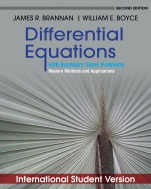
Differential Equations with Boundary Value Problems: Modern Methods and Applications
ISBN 9780470902141
Autor: James R. Brannan, William E. Boyce
Wydawca: Wiley
Dostępność: 3-6 tygodni
Cena: 336,00 zł
Przed złożeniem zamówienia prosimy o kontakt mailowy celem potwierdzenia ceny.
ISBN13: |
9780470902141 |
ISBN10: |
0470902140 |
Autor: |
James R. Brannan, William E. Boyce |
Oprawa: |
Paperback |
Rok Wydania: |
2011-03-18 |
Numer Wydania: |
2nd Edition International Student Version |
Ilość stron: |
992 |
Wymiary: |
253x205 |
Tematy: |
PB |
Unlike other books in the market, this second edition presents differential equations consistent with the way scientists and engineers use modern methods in their work. Technology is used freely, with more emphasis on modeling, graphical representation, qualitative concepts, and geometric intuition than on theoretical issues. It also refers to larger–scale computations that computer algebra systems and DE solvers make possible. And more exercises and examples involving working with data and devising the model provide scientists and engineers with the tools needed to model complex real–world situations.
Spis treści:
1 Introduction.
1.1 Mathematical Models, Solutions, and Direction Fields.
1.2 Linear Equations: Method of Integrating Factors.
1.3 Numerical Approximations: Euler’s Method.
1.4 Classification of Differential Equations.
2 First Order Differential Equations.
2.1 Separable Equations.
2.2 Modeling with First Order Equations.
2.3 Differences Between Linear and Nonlinear Equations.
2.4 Autonomous Equations and Population Dynamics.
2.5 Exact Equations and Integrating Factors.
2.6 Accuracy of Numerical Methods.
2.7 Improved Euler and Runge–Kutta Methods.
Projects.
2.P.1 Harvesting a Renewable Resource.
2.P.2 Designing a Drip Dispenser for a Hydrology Experiment.
2.P.3 A Mathematical Model of a Groundwater Contaminant Source.
2.P.4 Monte Carlo Option Pricing: Pricing Financial Options by Flipping a Coin.
3 Systems of Two First Order Equations.
3.1 Systems of Two Linear Algebraic Equations.
3.2 Systems of Two First Order Linear Differential Equations.
3.3 Homogeneous Linear Systems with Constant Coefficients.
3.4 Complex Eigenvalues.
3.5 Repeated Eigenvalues.
3.6 A Brief Introduction to Nonlinear Systems.
3.7 Numerical Methods for Systems of First Order Equations.
Projects.
3.P.1 Eigenvalue–Placemen
t Design of a Satellite Attitude Control System.
3.P.2 Estimating Rate Constants for an Open Two–Compartment Model.
3.P.3 The Ray Theory of Wave Propagation.
3.P.4 A Blood–Brain Pharmacokinetic Model.
4 Second Order Linear Equations.
4.1 Definitions and Examples.
4.2 Theory of Second Order Linear Homogeneous Equations.
4.3 Linear Homogeneous Equations with Constant Coefficients.
4.4 Mechanical and Electrical Vibrations.
4.5 Nonhomogeneous Equations; Method of Undetermined Coefficients.
4.6 Forced Vibrations, Frequency Response, and Resonance.
4.7 Variation of Parameters.
Projects.
4.P.1 A Vibration Insulation Problem.
4.P.2 Linearization of a Nonlinear Mechanical System.
4.P.3 A Spring–Mass Event Problem.
4.P.4 Uniformly Distributing Points on a Sphere.
4.P.5 Euler–Lagrange Equations.
5 The Laplace Transform.
5.1 Definition of the Laplace Transform.
5.2 Properties of the Laplace Transform.
5.3 The Inverse Laplace Transform.
5.4 Solving Differential Equations with Laplace Transforms.
5.5 Discontinuous Functions and Periodic Functions.
5.6 Differential Equations with Discontinuous Forcing Functions.
5.7 Impulse Functions.
5.8 Convolution Integrals and Their Applications.
5.9 Linear Systems and Feedback Control.
Projects.
5.P.1 An Electric Circuit Problem.
5.P.2 Effects of Pole Locations on Step Responses of Second Order Systems.
5.P.3 The Watt Governor, Feedback Control, and Stability.
6 Systems of First Order Linear Equations.
6.1 Definitions and Examples.
6.2 Basic Theory of First Order Linear Systems.
6.3 Homogeneous Linear Systems with Constant Coefficients.
6.4 Nondefective Matrices with Complex Eigenvalues.
6.5 Fundamental Matrices and the Exponential of a Matrix.
6.6 Nonhomogeneous Linear Systems.
6.7 Defective Matrices.
Projects.
6.P.1 A Compartment Model of Heat Flow in a
Rod.
6.P.2 Earthquakes and Tall Buildings.
6.P.3 Controlling a Spring–Mass System to Equilibrium.
7 Nonlinear Differential Equations and Stability.
7.1 Autonomous Systems and Stability.
7.2 Almost Linear Systems.
7.3 Competing Species.
7.4 Predator–Prey Equations.
7.5 Periodic Solutions and Limit Cycles.
7.6 Chaos and Strange Attractors: The Lorenz Equations.
Projects.
7.P.1 Modeling of Epidemics.
7.P.2 Harvesting in a Competitive Environment.
7.P.3 The Ro¨ ssler System.
8 Series Solutions of Second Order Linear Equations.
8.1 Review of Power Series.
8.2 Series Solutions Near an Ordinary Point, Part I.
8.3 Series Solutions Near an Ordinary Point, Part II.
8.4 Regular Singular Points.
8.5 Series Solutions Near a Regular Singular Point, Part I.
8.6 Series Solutions Near a Regular Singular Point, Part II.
8.7 Bessel’s Equation.
Projects.
8.P.1 Diffraction Through a Circular Aperture.
8.P.2 Hermite Polynomials and the Quantum Mechanical Harmonic Oscillator.
8.P.3 Perturbation Methods.
9 Partial Differential Equations and Fourier Series.
9.1 Two–Point Boundary Value Problems.
9.2 Fourier Series.
9.3 The Fourier Convergence Theorem.
9.4 Even and Odd Functions.
9.5 Separation of Variables; Heat Conduction in a Rod.
9.6 Other Heat Conduction Problems.
9.7 The Wave Equation: Vibrations of an Elastic String.
9.8 Laplace’s Equation.
Appendixes.
9.A Derivation of the Heat Equation.
9.B Derivation of the Wave Equation.
Projects.
9.P.1 Estimating the Diffusion Coefficient in the Heat Equation.
9.P.2 The Transmission Line Problem.
9.P.3 Solving Poisson’s Equation by Finite Differences.
10 Boundary Value Problems and Sturm–Liouville Theory.
10.1 The Occurrence of Two–Point Boundary Value Problems.
10.2 Sturm–Liouville Boundary Value Problems.
10.3 Nonhomogeneous Boundary Value Problems.
10.4 Singular Sturm–Liouville Problems.
10.5 Further Remarks on the Method of Separation of Variables: A Bessel Series Expansion.
10.6 Series of Orthogonal Functions: Mean Convergence.
Projects.
10.P.1 Dynamic Behavior of a Hanging Cable.
10.P.2 Advection Dispersion: A Model for Solute Transport in Saturated Porous Media.
10.P.3 Fisher’s Equation for Population Growth and Dispersion.
A Matrices and Linear Algebra.
A.1 Matrices.
A.2 Systems of Linear Algebraic Equations, Linear Independence, and Rank.
A.3 Determinants and Inverses.
A.4 The Eigenvalue Problem.
B Complex Variables.
ANSWERS TO SELECTED PROBLEMS.
REFERENCES.
PHOTO CREDITS.
INDEX.
Koszyk
Książek w koszyku: 0 szt.
Wartość zakupów: 0,00 zł
Informacje


Kontakt
Gambit
Centrum Oprogramowania
i Szkoleń Sp. z o.o.
Al. Pokoju 29b/22-24
31-564 Kraków
Siedziba Księgarni
ul. Kordylewskiego 1
31-542 Kraków
+48 12 410 5991
+48 12 410 5987
+48 12 410 5989
Subskrypcje
Administratorem danych osobowych jest firma Gambit COiS Sp. z o.o. Na podany adres będzie wysyłany wyłącznie biuletyn informacyjny.
Autoryzacja płatności

Informacje na temat autoryzacji płatności poprzez PayU.

© Copyright 2012: GAMBIT COiS Sp. z o.o. Wszelkie prawa zastrzeżone.
Projekt i wykonanie: Alchemia Studio Reklamy