


Wydawcy
Katalog tematyczny
- Archeologia (109)
- Ekonomia, finanse, business (13704)
- Filozofia (1445)
- Historia (3040)
- Języki i językoznawstwo (2356)
- Lifestyle, hobby i rozrywka (475)
- Medycyna (9704)
- Nauki humanistyczne (4)
- Nauki o Ziemi i środowisku (2638)
- Nauki ścisłe (20412)
- Astronomia (294)
- Biologia (5119)
- Chemia (6540)
- Fizyka (3309)
- Matematyka (4574)
- Algebra (171)
- Analiza matematyczna (902)
- Filozofia matematyki (1)
- Geometria (237)
- Historia matematyki (57)
- Kombinatoryka, teoria grafów (67)
- Matematyka dyskretna (35)
- Matematyka stosowana (555)
- Optymalizacja (104)
- Podstawy matematyki (129)
- Statystyka, prawdopodobieństwo (296)
- Teoria grup (63)
- Teoria liczb (77)
- Topologia (66)
- Nauki ścisłe, ogólnie (503)
- Nauki społeczne (8486)
- Nauki techniczne (13450)
- Prawo (1696)
- Publikacje informacyjne i interdyscyplinarne (1288)
- Religia i wierzenia (917)
- Technika komputerowa (4067)
- Zdrowie, relacje międzyludzkie i rozwój osobisty (657)





Informacje szczegółowe o książce
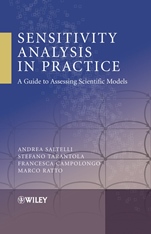
Sensitivity Analysis in Practice: A Guide to Assessing Scientific Models
ISBN 9780470870938
Autor: Andrea Saltelli, Stefano Tarantola, Francesca Campolongo, Marco Ratto
Wydawca: Wiley
Dostępność: 3-6 tygodni
Cena: 431,55 zł
Przed złożeniem zamówienia prosimy o kontakt mailowy celem potwierdzenia ceny.
ISBN13: |
9780470870938 |
ISBN10: |
0470870931 |
Autor: |
Andrea Saltelli, Stefano Tarantola, Francesca Campolongo, Marco Ratto |
Oprawa: |
Hardback |
Rok Wydania: |
2004-02-24 |
Ilość stron: |
232 |
Wymiary: |
229x152 |
Tematy: |
PB |
Sensitivity analysis is the study of how variation in the output of a statistical model can be apportioned, qualitatively or quantitatively, to different sources of variation. It should be considered a pre–requisite for statistical model building in any scientific discipline where modelling takes place. Choosing the most appropriate method of sensitivity analysis for a particular model can be complex, and depends on a number of factors.
Sensitivity Analysis in Practice guides applied scientists through their modelling problem enabling them to choose and apply the most appropriate sensitivity analysis method. It offers a review of the state–of–the–art in sensitivity analysis, and is suitable for a wide range of practitioners. It includes discussion of implementation of the methods using SIMLAB – freely available sensitivity analysis software.Provides an accessible overview of the most widely used sensitivity analysis methods.Covers a range of methodologies, including variance–based methods, Bayesian uncertainty estimation, selected screening methods and Monte Carlo filtering.Opens with a detailed worked example to explain the motivation behind methods described.Includes a range of further worked examples to illustrate the practical applications.Discusses implementation of the methods using SIMLAB – freely available sensitivity analysis software.Contains a large number of references to sources for further reading.Supported by a Website featuring a SIMLAB download, data sets and additional material.
Sensitivity Analysis in Practice is primarily aimed at researchers and practitioners working in scientific modelling from statistics, mathematics, medicine, and environmental science. The book is suitable for applied scientists working with statistical models in virtually any discipline, including economics, biology, chemistry and engineering, as well as graduate students of
statistical modelling.
Spis treści:
PREFACE.
1. A WORKED EXAMPLE.
1.1 A simple model.
1.2 Modulus version of the simple model.
1.3 Six–factor version of the simple model.
1.4 The simple model ‘by groups’.
1.5 The (less) simple correlated–input model.
1.6 Conclusions.
2. GLOBAL SENSITIVITY ANALYSIS FOR IMPORTANCE ASSESSMENT.
2.1 Examples at a glance.
2.2 What is sensitivity analysis?
2.3 Properties of an ideal sensitivity analysis method.
2.4 Defensible settings for sensitivity analysis.
2.5 Caveats.
3. TEST CASES.
3.1 The jumping man. Applying variance–based methods.
3.2 Handling the risk of a financial portfolio: the problem of hedging. Applying Monte Carlo filtering and variance–based methods.
3.3 A model of fish population dynamics. Applying the method of Morris.
3.4 The Level E model. Radionuclide migration in the geosphere. Applying variance–based methods and Monte Carlo filtering.
3.5 Two spheres. Applying variance based methods in estimation/calibration problems.
3.6 A chemical experiment. Applying variance based methods in estimation/calibration problems.
3.7 An analytical example. Applying the method of Morris.
4. THE SCREENING EXERCISE.
4.1 Introduction.
4.2 The method of Morris.
4.3 Implementing the method.
4.4 Putting the method to work: an analytical example.
4.5 Putting the method to work: sensitivity analysis of a fish population model.
4.6 Conclusions.
5. METHODS BASED ON DECOMPOSING THE VARIANCE OF THE OUTPUT.
5.1 The settings.
5.2 Factors Prioritisation Setting.
5.3 First–order effects and interactions.
5.4 Application of Si to Setting ‘Factors Prioritisation’.
5.5 More on variance decompositions.
5.6 Factors Fixing (FF) Setting.
5.7 Variance Cutting (VC) Setting.
5.8 Properties of the variance based methods.<
br>5.9 How to compute the sensitivity indices: the case of orthogonal input.
5.9.1 A digression on the Fourier Amplitude Sensitivity Test (FAST).
5.10 How to compute the sensitivity indices: the case of non–orthogonal input.
5.11 Putting the method to work: the Level E model.
5.11.1 Case of orthogonal input factors.
5.11.2 Case of correlated input factors.
5.12 Putting the method to work: the bungee jumping model.
5.13 Caveats.
6. SENSITIVITY ANALYSIS IN DIAGNOSTIC MODELLING: MONTE CARLO FILTERING AND REGIONALISED SENSITIVITY ANALYSIS, BAYESIAN UNCERTAINTY ESTIMATION AND GLOBAL SENSITIVITY ANALYSIS.
6.1 Model calibration and Factors Mapping Setting.
6.2 Monte Carlo filtering and regionalised sensitivity analysis.
6.2.1 Caveats.
6.3 Putting MC filtering and RSA to work: the problem of hedging a financial portfolio.
6.4 Putting MC filtering and RSA to work: the Level E test case.
6.5 Bayesian uncertainty estimation and global sensitivity analysis.
6.5.1 Bayesian uncertainty estimation.
6.5.2 The GLUE case.
6.5.3 Using global sensitivity analysis in the Bayesian uncertainty estimation.
6.5.4 Implementation of the method.
6.6 Putting Bayesian analysis and global SA to work: two spheres.
6.7 Putting Bayesian analysis and global SA to work: a chemical experiment.
6.7.1 Bayesian uncertainty analysis (GLUE case).
6.7.2 Global sensitivity analysis.
6.7.3 Correlation analysis.
6.7.4 Further analysis by varying temperature in the data set: fewer interactions in the model.
6.8 Caveats.
7. HOW TO USE SIMLAB.
7.1 Introduction.
7.2 How to obtain and install SIMLAB.
7.3 SIMLAB main panel.
7.4 Sample generation.
7.4.1 FAST.
7.4.2 Fixed sampling.
7.4.3 Latin hypercube sampling (LHS).
7.4.4 The method of Morris.
7.4.5 Quasi–Random LpTau.
7.4.6 Random.
7.4.7 Replicated Latin Hypercube (r–LHS).
7.4.8 The method of Sobol’.
7.4.9 How t
o induce dependencies in the input factors.
7.5 How to execute models.
7.6 Sensitivity analysis.
8. FAMOUS QUOTES: SENSITIVITY ANALYSIS IN THE SCIENTIFIC DISCOURSE.
REFERENCES.
INDEX.
Okładka tylna:
Sensitivity analysis is the study of how variation in the output of a statistical model can be apportioned, qualitatively or quantitatively, to different sources of variation. It should be considered a pre–requisite for statistical model building in any scientific discipline where modelling takes place. Choosing the most appropriate method of sensitivity analysis for a particular model can be complex, and depends on a number of factors.
Sensitivity Analysis in Practice guides applied scientists through their modelling problem enabling them to choose and apply the most appropriate sensitivity analysis method. It offers a review of the state–of–the–art in sensitivity analysis, and is suitable for a wide range of practitioners. It includes discussion of implementation of the methods using SIMLAB – freely available sensitivity analysis software.Provides an accessible overview of the most widely used sensitivity analysis methods.Covers a range of methodologies, including variance–based methods, Bayesian uncertainty estimation, selected screening methods and Monte Carlo filtering.Opens with a detailed worked example to explain the motivation behind methods described.Includes a range of further worked examples to illustrate the practical applications.Discusses implementation of the methods using SIMLAB – freely available sensitivity analysis software.Contains a large number of references to sources for further reading.Supported by a Website featuring a SIMLAB download, data sets and additional material.
Sensitivity Analysis in Practice is primarily aimed at researchers and practitioners working in scientific modelling from statistics, m
Koszyk
Książek w koszyku: 0 szt.
Wartość zakupów: 0,00 zł
Informacje


Kontakt
Gambit
Centrum Oprogramowania
i Szkoleń Sp. z o.o.
Al. Pokoju 29b/22-24
31-564 Kraków
Siedziba Księgarni
ul. Kordylewskiego 1
31-542 Kraków
+48 12 410 5991
+48 12 410 5987
+48 12 410 5989
Subskrypcje
Administratorem danych osobowych jest firma Gambit COiS Sp. z o.o. Na podany adres będzie wysyłany wyłącznie biuletyn informacyjny.
Autoryzacja płatności

Informacje na temat autoryzacji płatności poprzez PayU.

© Copyright 2012: GAMBIT COiS Sp. z o.o. Wszelkie prawa zastrzeżone.
Projekt i wykonanie: Alchemia Studio Reklamy