


Wydawcy
Katalog tematyczny
- Archeologia (109)
- Ekonomia, finanse, business (13704)
- Filozofia (1445)
- Historia (3040)
- Języki i językoznawstwo (2356)
- Lifestyle, hobby i rozrywka (475)
- Medycyna (9704)
- Nauki humanistyczne (4)
- Nauki o Ziemi i środowisku (2638)
- Nauki ścisłe (20412)
- Astronomia (294)
- Biologia (5119)
- Chemia (6540)
- Fizyka (3309)
- Matematyka (4574)
- Algebra (171)
- Analiza matematyczna (902)
- Filozofia matematyki (1)
- Geometria (237)
- Historia matematyki (57)
- Kombinatoryka, teoria grafów (67)
- Matematyka dyskretna (35)
- Matematyka stosowana (555)
- Optymalizacja (104)
- Podstawy matematyki (129)
- Statystyka, prawdopodobieństwo (296)
- Teoria grup (63)
- Teoria liczb (77)
- Topologia (66)
- Nauki ścisłe, ogólnie (503)
- Nauki społeczne (8486)
- Nauki techniczne (13450)
- Prawo (1696)
- Publikacje informacyjne i interdyscyplinarne (1288)
- Religia i wierzenia (917)
- Technika komputerowa (4067)
- Zdrowie, relacje międzyludzkie i rozwój osobisty (657)





Informacje szczegółowe o książce
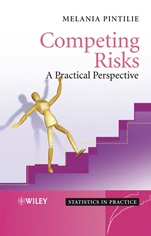
Competing Risks: A Practical Perspective
ISBN 9780470870686
Autor: Melania Pintilie
Wydawca: Wiley
Dostępność: 3-6 tygodni
Cena: 457,80 zł
Przed złożeniem zamówienia prosimy o kontakt mailowy celem potwierdzenia ceny.
ISBN13: |
9780470870686 |
ISBN10: |
0470870680 |
Autor: |
Melania Pintilie |
Oprawa: |
Hardback |
Rok Wydania: |
2006-08-25 |
Ilość stron: |
242 |
Wymiary: |
236x169 |
Tematy: |
PB |
Competing Risks
A Practical Perspective.
The term ′competing risks′ refers to the situation when more than one type of failure can occur, and the observation of one type of failure hinders the observation of another. The need to understand, interpret and analyse competing risk data is key to the development of numerous areas of science. There are many research examples in which a specific type of failure is of interest, but practical issues make it extremely difficult to observe the time to the event of interest. Analyzing time to failure data in the presence of competing risks requires special Statistical tools. Competing Risks adopts a practical approach, with exercises and detailed examples throughout, using real data from cancer research.Provides a comprehensive overview of he interpretation and analysis of competing risks.Covers the main stages of a statistical analysis: planning and sample size calculation, analysis and interpretation.Compares and contrasts both methods for analysing competing risks: cause specific hazard and hazard of subdistribution.Presents the software available to perform the analysis in R, and includes macros for analysis in SAS.Supplemented by a website featuring data sets,software and further material.Competing Risks provides a practical guide to the area. The book is ideal for statisticians working in medical research, the pharmaceutical industry or public health. It will also prove invaluable for graduate students in applied statistics and biostatistics, as well as researchers in the medical field. The examples are chose from the medical field, however the methodology can be extended to any other research area where competing risks appear,such as sociology, economics and engineering.
STATISTICS IN PRACTICE
A series of practical books outlining the use of statistical techniques in a wide range of applications areas:HUMAN AND BIOLOGICAL SCIENCESEARTH AND ENVIRONMENTAL SCIENCESINDUSTRY, COMMERCE AND FINANCE
Spis treści:
Preface.
Acknowledgements.
1. Introduction.
1.1 Historical notes.
1.2 Defining competing risks.
1.3 Use of the Kaplan–Meier method in the presence of competing risks.
1.4 Testing in the competing risk framework.
1.5 Sample size calculation.
1.6 Examples.
1.6.1 Tamoxifen trial.
1.6.2 Hypoxia study.
1.6.3 Follicular cell lymphoma study.
1.6.4 Bone marrow transplant study.
1.6.5 Hodgkin’s disease study.
2. Survival – basic concepts.
2.1 Introduction.
2.2 Definitions and background formulae.
2.2.1 Introduction.
2.2.2 Basic mathematical formulae.
2.2.3 Common parametric distributions.
2.2.4 Censoring and assumptions.
2.3 Estimation and hypothesis testing.
2.3.1 Estimating the hazard and survivor functions.
2.3.2 Nonparametric testing: log–rank and Wilcoxon tests.
2.3.3 Proportional hazards model.
2.4 Software for survival analysis.
2.5 Closing remarks.
3. Competing risks – definitions.
3.1 Recognizing competing risks.
3.1.1 Practical approaches.
3.1.2 Common endpoints in medical research.
3.2 Two mathematical definitions.
3.2.1 Competing risks as bivariate random variable.
3.2.2 Competing risks as latent failure times.
3.3 Fundamental concepts.
3.3.1 Competing risks as bivariate random variable.
3.3.2 Competing risks as latent failure times.
3.3.3 Discussion of the two approaches.
3.4 Closing remarks.
4. Descriptive methods for competing risks data.
4.1 Product–limit estimator and competing risks.
4.2 Cumulative incidence function.
4.2.1 Heuristic estimation of the CIF.
4.2.2 Nonparametric maximum likelihood estimation of the CIF.
4.2.3 Calculating the CIF estimator.
4.2.4 Variance and confidence interval for the CIF estimator.
4.3 Software and ex
amples.
4.3.1 Using R.
4.3.2 Using SAS.
4.4 Closing remarks.
5. Testing a covariate.
5.1 Introduction.
5.2 Testing a covariate.
5.2.1 Gray’s method.
5.2.2 Pepe and Mori’s method.
5.3 Software and examples.
5.3.1 Using R.
5.3.2 Using SAS.
5.4 Closing remarks.
6. Modelling in the presence of competing risks.
6.1 Introduction.
6.2 Modelling the hazard of the cumulative incidence function.
6.2.1 Theoretical details.
6.2.2 Model–based estimation of the CIF.
6.2.3 Using R.
6.3 Cox model and competing risks.
6.4 Checking the model assumptions.
6.4.1 Proportionality of the cause–specific hazards.
6.4.2 Proportionality of the hazards of the CIF.
6.4.3 Linearity assumption.
6.5 Closing remarks.
7. Calculating the power in the presence of competing risks.
7.1 Introduction.
7.2 Sample size calculation when competing risks are not present.
7.3 Calculating power in the presence of competing risks.
7.3.1 General formulae.
7.3.2 Comparing cause–specific hazards.
7.3.3 Comparing hazards of the subdistributions.
7.3.4 Probability of event when the exponential distribution is not a valid assumption.
7.4 Examples.
7.4.1 Introduction.
7.4.2 Comparing the cause–specific hazard.
7.4.3 Comparing the hazard of the subdistribution.
7.5 Closing remarks.
8. Other issues in competing risks.
8.1 Conditional probability function.
8.1.1 Introduction.
8.1.2 Nonparametric estimation of the CP function.
8.1.3 Variance of the CP function estimator.
8.1.4 Testing a covariate.
8.1.5 Using R.
8.1.6 Using SAS.
8.2 Comparing two types of risk in the same population.
8.2.1 Theoretical background.
8.2.2 Using R.
8.2.3 Discussion.
8.3 Identifiability and testing independence.
8.4 Parametric modelling.
8.4.1 Introduction.
8.4.2 Modelling the marginal distribution.
8.4.3 Modelling the Wei
bull distribution.
9. Food for thought.
Problem 1: Estimation of the probability of the event of interest.
Problem 2: Testing a covariate.
Problem 3: Comparing the event of interest between two groups when the competing risks are different for each group.
Problem 4: Information needed for sample size calculations.
Problem 5: The effect of the size of the incidence of competing risks on the coefficient obtained in the model.
Problem 6: The KLY test and the non–proportionality of hazards.
Problem 7: The KLY and Wilcoxon tests.
A: Theoretical background.
B: Analysing competing risks data using R and SAS.
References.
Index.
Okładka tylna:
Competing Risks
A Practical Perspective.
The term ′competing risks′ refers to the situation when more than one type of failure can occur, and the observation of one type of failure hinders the observation of another. The need to understand, interpret and analyse competing risk data is key to the development of numerous areas of science. There are many research examples in which a specific type of failure is of interest, but practical issues make it extremely difficult to observe the time to the event of interest. Analyzing time to failure data in the presence of competing risks requires special Statistical tools. Competing Risks adopts a practical approach, with exercises and detailed examples throughout, using real data from cancer research.Provides a comprehensive overview of he interpretation and analysis of competing risks.Covers the main stages of a statistical analysis: planning and sample size calculation, analysis and interpretation.Compares and contrasts both methods for analysing competing risks: cause specific hazard and hazard of subdistribution.Presents the software available to perform the analysis in R, and includes macros for analysis in SAS.Supplemented by a website featuring dat
Koszyk
Książek w koszyku: 0 szt.
Wartość zakupów: 0,00 zł
Informacje


Kontakt
Gambit
Centrum Oprogramowania
i Szkoleń Sp. z o.o.
Al. Pokoju 29b/22-24
31-564 Kraków
Siedziba Księgarni
ul. Kordylewskiego 1
31-542 Kraków
+48 12 410 5991
+48 12 410 5987
+48 12 410 5989
Subskrypcje
Administratorem danych osobowych jest firma Gambit COiS Sp. z o.o. Na podany adres będzie wysyłany wyłącznie biuletyn informacyjny.
Autoryzacja płatności

Informacje na temat autoryzacji płatności poprzez PayU.

© Copyright 2012: GAMBIT COiS Sp. z o.o. Wszelkie prawa zastrzeżone.
Projekt i wykonanie: Alchemia Studio Reklamy