


Wydawcy
Katalog tematyczny
- Archeologia (109)
- Ekonomia, finanse, business (13704)
- Filozofia (1445)
- Historia (3040)
- Języki i językoznawstwo (2356)
- Lifestyle, hobby i rozrywka (475)
- Medycyna (9704)
- Nauki humanistyczne (4)
- Nauki o Ziemi i środowisku (2638)
- Nauki ścisłe (20412)
- Astronomia (294)
- Biologia (5119)
- Chemia (6540)
- Fizyka (3309)
- Matematyka (4574)
- Algebra (171)
- Analiza matematyczna (902)
- Filozofia matematyki (1)
- Geometria (237)
- Historia matematyki (57)
- Kombinatoryka, teoria grafów (67)
- Matematyka dyskretna (35)
- Matematyka stosowana (555)
- Optymalizacja (104)
- Podstawy matematyki (129)
- Statystyka, prawdopodobieństwo (296)
- Teoria grup (63)
- Teoria liczb (77)
- Topologia (66)
- Nauki ścisłe, ogólnie (503)
- Nauki społeczne (8486)
- Nauki techniczne (13450)
- Prawo (1696)
- Publikacje informacyjne i interdyscyplinarne (1288)
- Religia i wierzenia (917)
- Technika komputerowa (4067)
- Zdrowie, relacje międzyludzkie i rozwój osobisty (657)





Informacje szczegółowe o książce
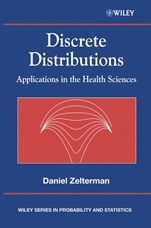
Discrete Distributions: Applications in the Health Sciences
ISBN 9780470868881
Autor: Daniel Zelterman
Wydawca: Wiley
Dostępność: 3-6 tygodni
Cena: 554,40 zł
Przed złożeniem zamówienia prosimy o kontakt mailowy celem potwierdzenia ceny.
ISBN13: |
9780470868881 |
ISBN10: |
0470868880 |
Autor: |
Daniel Zelterman |
Oprawa: |
Hardback |
Rok Wydania: |
2004-05-25 |
Ilość stron: |
306 |
Wymiary: |
234x158 |
Tematy: |
PB |
There have been many advances in the theory and applications of discrete distributions in recent years. They can be applied to a wide range of problems, particularly in the health sciences. Discrete Distributions: Applications in the Health Sciences describes a number of new discrete distributions that arise in the statistical examination of real examples. For each example, an understanding of the issues surrounding the data provides the motivation for the subsequent development of the statistical models. Provides an overview of discrete distributions and their applications in the health sciences. Focuses on real examples, giving readers an insight into the utility of the models.Describes the properties of each distribution, and the methods that led to their development.Presents a range of examples from the health sciences, including cancer, epidemiology, and demography.Features discussion of software implementation – in SAS, Fortran and R – enabling readers to apply the methods to their own problems.Written in an accessible style, suitable for applied statisticians and numerate health scientists.Software and data sets are made available on the Web.Discrete Distributions: Applications in the Health Sciences provides a practical introduction to these powerful statistical tools and their applications, suitable for researchers and graduate students from statistics and biostatistics. The focus on applications, and the accessible style of the book, make it an excellent practical reference source for practitioners from the health sciences.
Spis treści:
Preface.
Acknowledgements.
About the Author.
1 Introduction.
1.1 Discrete Distributions in General.
1.2 Multivariate Discrete Distributions.
1.3 Binomial Distribution.
1.4 The Multinomial Distribution.
1.5 Poisson Distribution.
1.6 Negative Binomial Distribution.
1.7 Hypergeometric
Distribution.
1.7.1 Negative hypergeometric distribution.
1.7.2 Extended hypergeometric distribution.
1.8 Stirling’s Approximation.
2 Maximum Negative Binomial Distribution.
2.1 Introduction.
2.1.1 Outfitting the ark.
2.1.2 Medical screening application.
2.2 Elementary Properties.
2.2.1 Shapes of the distribution.
2.2.2 Moments of the distribution.
2.2.3 Modes of the distribution.
2.3 Asymptotic Approximations.
2.3.1 Large values of c and p ≠ 1/2.
2.3.2 Large values of c and p ≠ 1/2.
2.3.3 Extreme values of p.
2.4 Estimation of p.
2.4.1 The likelihood function.
2.4.2 The EM estimate.
2.4.3 A Bayesian estimate of p.
2.5 Programs and Numerical Results.
2.6 Appendix: The Likelihood Kernel.
3 The Maximum Negative Hypergeometric Distribution.
3.1 Introduction.
3.2 The Distribution.
3.3 Properties and Approximations.
3.3.1 Modes of the distribution.
3.3.2 A gamma approximation.
3.3.3 A half–normal approximation.
3.3.4 A normal approximation.
3.4 Estimation.
3.5 Appendix.
3.5.1 The half–normal approximation.
3.5.2 The normal approximate distribution.
4 Univariate Discrete Distributions for Use with Twins.
4.1 Introduction.
4.2 The Univariate Twins Distribution.
4.3 Measures of Association in Twins.
4.4 The Danish Twin Registry.
4.4.1 Estimate of the effect.
4.4.2 Approximations.
4.5 Appendix.
4.5.1 The univariate twins distribution.
4.5.2 Approximating distributions.
4.6 Programs for the Univariate Twins Distribution .
5 Multivariate Distributions for Twins.
5.1 Introduction.
5.2 Conditional Distributions.
5.2.1 Univariate conditional distribution.
5.2.2 Conditional association measure.
5.3 Conditional inference for the Danish twins.
5.4 Simultaneous Multivariate Distributions.
5.5 Multivariate Examination of
the Twins.
5.6 Infinitesimal Multivariate Methods.
5.6.1 Models with no dependence.
5.6.2 Models for dependence.
5.6.3 The infinitesimal data.
5.7 Computer Programs.
5.7.1 Conditional distribution and association models in SAS.
5.7.2 Fortran program for multivariate inference.
6 Frequency Models for Family Disease Clusters.
6.1 Introduction.
6.1.1 Examples.
6.1.2 Sampling methods employed.
6.1.3 Incidence and clustering.
6.2 Exact Inference Under Homogeneous Risk.
6.2.1 Enumeration algorithm.
6.2.2 Ascertainment sampling.
6.3 Numerical Examples.
6.3.1 IPF in COPD families.
6.3.2 Childhood cancer syndrome.
6.3.3 Childhood mortality in Brazil.
6.3.4 Household T. cruzi infections.
6.4 Conclusions.
6.5 Appendix: Mathematical Details.
6.5.1 The distribution of family frequencies.
6.5.2 A model for covariates.
6.5.3 Ascertainment sampling.
6.6 Program for Exact Test of Homogeneity.
7 Sums of Dependent Bernoulli’s and Disease Clusters.
7.1 Introduction.
7.2 Conditional Models.
7.2.1 General results for conditional models.
7.2.2 Family history model.
7.2.3 Incremental risk model.
7.2.4 The exchangeable, beta–binomial distribution.
7.2.5 Application to IPF example.
7.3 Exchangeable Models.
7.3.1 Exchangeable family history.
7.3.2 Exchangeable incremental risk model.
7.4 Applications.
7.5 Appendix: Proof of Exchangeable Distribution.
8 Weighted Binomial Distributions and Disease Clusters.
8.1 Weighted Models and Clustering.
8.2 The Altham Distribution.
8.3 Application to Childhood Mortality Data.
8.4 A Log–linear Weighted Distribution.
8.5 Quadratic Weighted Distributions.
8.6 Weighted Distributions in General.
8.7 Family History Log–linear Model.
8.8 Summary Measures and IPF Example.
8.9 SAS Program for Clustered Family Data.
9 Applications to Teratology Experiments.<
br>9.1 Introduction.
9.2 Dominant Lethal Assay.
9.3 Shell Toxicology Experiment.
9.4 Toxicology of 2,4,5 T.
Complements.
References.
Index.
Nota biograficzna:
Daniel Zelterman, PhD, is Professor of Epidemiology and Public Health, Division of Biostatistics, at Yale University. His application areas include work in AIDS and cancer. Before moving to Yale in 1995, he was on the faculty of the University of Minnesota and of the State University of New York at Albany. He is an elected Fellow of the American Statistical Association and is an Associate Editor of Biometrics and several other statistical journals. In his spare time, he plays the bassoon in several amateur chamber and orchestral groups in the New Haven area.
Okładka tylna:
There have been many advances in the theory and applications of discrete distributions in recent years. They can be applied to a wide range of problems, particularly in the health sciences. Discrete Distributions: Applications in the Health Sciences describes a number of new discrete distributions that arise in the statistical examination of real examples. For each example, an understanding of the issues surrounding the data provides the motivation for the subsequent development of the statistical models. Provides an overview of discrete distributions and their applications in the health sciences. Focuses on real examples, giving readers an insight into the utility of the models.Describes the properties of each distribution, and the methods that led to their development.Presents a range of examples from the health sciences, including cancer, epidemiology, and demography.Features discussion of software implementation – in SAS, Fortran and R – enabling readers to apply the methods to their own problems.Written in an accessible style, suitable for applied statisticians and numerate health scientists.Sof
Koszyk
Książek w koszyku: 0 szt.
Wartość zakupów: 0,00 zł
Informacje


Kontakt
Gambit
Centrum Oprogramowania
i Szkoleń Sp. z o.o.
Al. Pokoju 29b/22-24
31-564 Kraków
Siedziba Księgarni
ul. Kordylewskiego 1
31-542 Kraków
+48 12 410 5991
+48 12 410 5987
+48 12 410 5989
Subskrypcje
Administratorem danych osobowych jest firma Gambit COiS Sp. z o.o. Na podany adres będzie wysyłany wyłącznie biuletyn informacyjny.
Autoryzacja płatności

Informacje na temat autoryzacji płatności poprzez PayU.

© Copyright 2012: GAMBIT COiS Sp. z o.o. Wszelkie prawa zastrzeżone.
Projekt i wykonanie: Alchemia Studio Reklamy