


Wydawcy
Katalog tematyczny
- Archeologia (109)
- Ekonomia, finanse, business (13704)
- Filozofia (1445)
- Historia (3040)
- Języki i językoznawstwo (2356)
- Lifestyle, hobby i rozrywka (475)
- Medycyna (9704)
- Nauki humanistyczne (4)
- Nauki o Ziemi i środowisku (2638)
- Nauki ścisłe (20412)
- Astronomia (294)
- Biologia (5119)
- Chemia (6540)
- Fizyka (3309)
- Matematyka (4574)
- Algebra (171)
- Analiza matematyczna (902)
- Filozofia matematyki (1)
- Geometria (237)
- Historia matematyki (57)
- Kombinatoryka, teoria grafów (67)
- Matematyka dyskretna (35)
- Matematyka stosowana (555)
- Optymalizacja (104)
- Podstawy matematyki (129)
- Statystyka, prawdopodobieństwo (296)
- Teoria grup (63)
- Teoria liczb (77)
- Topologia (66)
- Nauki ścisłe, ogólnie (503)
- Nauki społeczne (8486)
- Nauki techniczne (13450)
- Prawo (1696)
- Publikacje informacyjne i interdyscyplinarne (1288)
- Religia i wierzenia (917)
- Technika komputerowa (4067)
- Zdrowie, relacje międzyludzkie i rozwój osobisty (657)





Informacje szczegółowe o książce
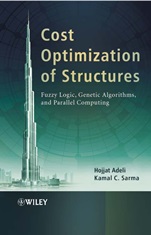
Cost Optimization of Structures: Fuzzy Logic, Genetic Algorithms, and Parallel Computing
ISBN 9780470867334
Autor: Hojjat Adeli, Kamal C Sarma
Wydawca: Wiley
Dostępność: 3-6 tygodni
Cena: 519,75 zł
Przed złożeniem zamówienia prosimy o kontakt mailowy celem potwierdzenia ceny.
ISBN13: |
9780470867334 |
ISBN10: |
0470867337 |
Autor: |
Hojjat Adeli, Kamal C Sarma |
Oprawa: |
Hardback |
Rok Wydania: |
2006-08-25 |
Ilość stron: |
222 |
Wymiary: |
236x162 |
Tematy: |
PB |
Cost Optimization of Structures
With the weight of a structure constitutes a significant part of the cost, a minimum weight design is not necessarily the minimum cost design. Little attention in structural optimization has been paid to the cost optimization problem, particularly of realistic three–dimensional structures. Cost optimization is becoming a priority in all civil engineering projects, and the concept of Life–Cycle costing is penetrating design, manufacturing and construction organizations.
In this groundbreaking book the authors present novel computational models for cost optimization of large scale, realistic structures, subjected to the actual constraints of commonly used design codes.
As the first book on the subject this book:Contains detailed step–by–step algorithmsFocuses on novel computing techniques such as genetic algorithms, fuzzy logic, and parallel computingCovers both Allowable Stress Design (ASD) and Load and Resistance Factor Design (LRFD) codesIncludes realistic design examples covering large–scale, high–rise building structuresPresents computational models that enable substantial cost savings in the design of structures
Full automated structural design and cost optimization is where large–scale design technology is heading, thus Cost Optimization of Structures: Fuzzy Logic, Genetic Algorithms, and Parallel Computing will be of great interest to civil and structural engineers, mechanical engineers, structural design software developers, and architectural engineers involved in the design of structures and life–cycle cost optimization. It is also a pioneering text for graduate students and researchers working in building design and structural optimization.
Spis treści:
Preface.
Acknowledgments.
About the Authors.
Introduction.
1.1 The Case for Cost Optimization.
1.2 Cost Optimization of Concrete Structures.
1.3 Cost Optimization of Steel Structures.
2 Evolutionary Computing and Genetic Algorithm.
2.1 Overview and Basic Operations.
2.2 Coding and Decoding.
2.3 Basic Operations in Genetic Algorithm.
2.4 GA with Penalty Function Method.
2.5 Augmented LaGrange Method.
2.6 GA with Augmented Lagrangian Method.
3 Cost Optimization of Composite Floors.
3.1 Introduction.
3.2 Minimum Cost Design of Composite Beams.
3.3 Solution by Floating–Point Genetic Algorithm.
3.4 Solution by Neural Dynamics Method.
3.5 Counter Propagation Neural (CPN) Network.
For Function Approximation.
3.6Examples.
4 Fuzzy Genetic Algorithm for Optimization of Steel Structures.
4.1 Introduction.
4.2 Fuzzy Set Theory and Structural Optimization.
4.3 Minimum Weight Design of Axially Loaded Space Structures.
4.4 Fuzzy Membership Functions.
4.5 Fuzzy Augmented Lagrangian Genetic Algorithm.
4.6 Implementation and Examples.
4.7 Conclusion.
5 Fuzzy Discrete Multi–criteria Cost Optimization of Steel Structures.
5.1 Cost of a Steel Structure.
5.2 Cost of a Steel Structure and the Primary Contributing Factors.
5.3 Fuzzy Discrete Multi–criteria Cost Optimization.
5.4 Membership Functions.
5.5 Fuzzy Membership Functions for Criteria with Unequal Importance.
5.6 Pareto Optimality.
5.7 Selection of Commercially Available Discrete Shapes.
5.8 Implementation and Parametric Study.
5.9 Application to High–rise Steel Structures.
5.10 Concluding Comments.
6 Parallel Computing.
6.1 Multiprocessor Computing Environment.
6.2 Parallel Processing Implementation Environment.
6.3 Performance Optimization of Parallel Programs.
7 Parallel Fuzzy Genetic Algorithm for Cost Optimization of Large Steel Structures.
7.1 Genetic Algorithm and Parallel Processing.
7.2 Cost Optimization of Moment–Resisting Steel Space Structures.
7.3 Data Parallel Fuzzy Genetic Algorithm for Optimization
of Steel Structures Using OpenMP.
7.4 Distributed Parallel Fuzzy Genetic Algorithm for Optimization of Steel Structures Using MPI.
7.5 Bi–level Parallel Fuzzy GA for Optimization of Steel Structures Using OpenMP and MPI.
7.6 Application to High–rise Building Steel Structures.
7.7 Parallel Processing Performance Evaluation.
7.8 Concluding Comments.
8. Life Cycle Cost Optimization of Steel Structures.
8.1 Introduction.
8.2 Life Cycle Cost of a Steel Structure and the Primary Contributing Factors.
8.3 Formulation of Total Life Cycle Cost.
8.4 Fuzzy Discrete Multi–criteria Life Cycle Cost Optimization.
8.5 Application to a High–rise Building Steel Structure.
Appendix A.
Cross–sectional areas, perimeter, and costs in US dollars for different W–shapes used for axially loaded members.
Appendix B.
Cross–sectional areas, perimeter, and costs in US dollars for different W–shapes used for laterally loaded members.
References.
Index.
Nota biograficzna:
Hojjat Adeli is Professor of Civil and Environmental Engineering and Geodetic Science and Lichtenstein Professor in Infrastructure Engineering at The Ohio State University. A contributor to 70 different scholarly journals, he has authored over 400 research and scientific publications in diverse areas of engineering, computer science, and applied mathematics since he received his PhD from Stanford University in 1976 at the age of 26. He has authored/co–authored eleven pioneering books such as Machine Learning – Neural Networks, Genetic Algorithms, and Fuzzy Systems, John Wiley & Sons, Ltd, 1995; Neurocomputing for Design Automation, CRC Press, 1998; Distributed Computer–Aided Engineering, CRC Press, 1999; High–Performance Computing in Structural Engineering, CRC Press, 1999; Control, Optimization, and Smart Structures – High&#
8211;Performance Bridges and Buildings of the Future, John Wiley & Sons, Ltd, 1999; Construction Scheduling, Cost Optimization, and Management – A New Model Based on Neurocomputing and Object Technologies, Spon Press, 2001; and Wavelets in Intelligent Transportation Systems, John Wiley & Sons, Ltd, 2005. He has also edited 12 books including Intelligent Information Systems, IEEE Computer Society, 1997. He is the Editor–in–Chief of two research journals, Computer–Aided Civil and Infrastructure Engineering, which he founded in 1986, and Integrated Computer–Aided Engineering, which he founded in 1993. He has been a Keynote/Plenary Lecturer at 56 international conferences held in 33 different countries and has served on the advisory/editorial/organizing board of 262 national and international conferences held in 55 different countries. On September 29, 1998, he was awarded a patent for a ‘Method and apparatus for efficient design automation and optimization, and structures produced thereby’ (United States Patent Number (5,815,394) (with a former PhD student). He is the recipient of numerous academic, research, and leadership awards, honors, and recognition. In 1998, he was awarded the University Distinguished Scholar Award by The Ohio State University ‘in recognition of extraordinary accomplishment in research and scholarship’ and the Senate of the General Assembly of the State of Ohio passed a resolution honoring him as an ‘Outstanding Ohioan’. He is the quadruple winner of The Ohio State University College of Engineering Lumley Outstanding Research Award. In 2005 he was elected an Honorary Member of the American Society of Civil Engineers ‘for wide–ranging, exceptional, and pioneering contributions to computing in many civil engineering disciplines and extraordinary leadership in advancing the u
Koszyk
Książek w koszyku: 0 szt.
Wartość zakupów: 0,00 zł
Informacje


Kontakt
Gambit
Centrum Oprogramowania
i Szkoleń Sp. z o.o.
Al. Pokoju 29b/22-24
31-564 Kraków
Siedziba Księgarni
ul. Kordylewskiego 1
31-542 Kraków
+48 12 410 5991
+48 12 410 5987
+48 12 410 5989
Subskrypcje
Administratorem danych osobowych jest firma Gambit COiS Sp. z o.o. Na podany adres będzie wysyłany wyłącznie biuletyn informacyjny.
Autoryzacja płatności

Informacje na temat autoryzacji płatności poprzez PayU.

© Copyright 2012: GAMBIT COiS Sp. z o.o. Wszelkie prawa zastrzeżone.
Projekt i wykonanie: Alchemia Studio Reklamy