


Wydawcy
Katalog tematyczny
- Archeologia (109)
- Ekonomia, finanse, business (13704)
- Filozofia (1445)
- Historia (3040)
- Języki i językoznawstwo (2356)
- Lifestyle, hobby i rozrywka (475)
- Medycyna (9704)
- Nauki humanistyczne (4)
- Nauki o Ziemi i środowisku (2638)
- Nauki ścisłe (20412)
- Astronomia (294)
- Biologia (5119)
- Chemia (6540)
- Fizyka (3309)
- Matematyka (4574)
- Algebra (171)
- Analiza matematyczna (902)
- Filozofia matematyki (1)
- Geometria (237)
- Historia matematyki (57)
- Kombinatoryka, teoria grafów (67)
- Matematyka dyskretna (35)
- Matematyka stosowana (555)
- Optymalizacja (104)
- Podstawy matematyki (129)
- Statystyka, prawdopodobieństwo (296)
- Teoria grup (63)
- Teoria liczb (77)
- Topologia (66)
- Nauki ścisłe, ogólnie (503)
- Nauki społeczne (8486)
- Nauki techniczne (13450)
- Prawo (1696)
- Publikacje informacyjne i interdyscyplinarne (1288)
- Religia i wierzenia (917)
- Technika komputerowa (4067)
- Zdrowie, relacje międzyludzkie i rozwój osobisty (657)





Informacje szczegółowe o książce
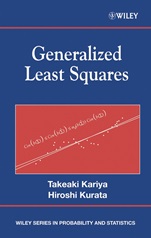
Generalized Least Squares
ISBN 9780470866979
Autor: Takeaki Kariya, Hiroshi Kurata
Wydawca: Wiley
Dostępność: 3-6 tygodni
Cena: 733,95 zł
Przed złożeniem zamówienia prosimy o kontakt mailowy celem potwierdzenia ceny.
ISBN13: |
9780470866979 |
ISBN10: |
0470866977 |
Autor: |
Takeaki Kariya, Hiroshi Kurata |
Oprawa: |
Hardback |
Rok Wydania: |
2004-06-22 |
Ilość stron: |
312 |
Wymiary: |
231x163 |
Tematy: |
PB |
Regression analysis has been one of the most widely used statistical tools for many years, and continues to be developed and applied to new applications. Generalized least squares estimation (GLSE) based on Gauss–Markov theory plays a key role in understanding theoretical and practical aspects of statistical inference in general linear regression models. GLSE can be applied to problems encountered in many disciplines, particularly statistics, econometrics, and biometrics. Provides a self–contained introduction to GLSE.
Includes detailed coverage of the ′lower and upper bounds′ approach, pioneered by the authors.
Adopts a concise yet mathematically rigorous approach.
Includes applications to statistics, econometrics, and biometrics.
Contains exercises at the end of each chapter, enabling use as a course text or for self–study.
Includes a comprehensive bibliography.Generalized Least Squares provides an accessible introduction to GLSE suitable for researchers and graduate students from statistics, econometrics, and biometrics. It provides an excellent source of reference, can be used as a course text, and will help to stimulate further research into this flourishing topic.
Spis treści:
Preface.
1 Preliminaries.
1.1 Overview.
1.2 Multivariate Normal and Wishart Distributions.
1.3 Elliptically Symmetric Distributions.
1.4 Group Invariance.
1.5 Problems.
2 Generalized Least Squares Estimators.
2.1 Overview.
2.2 General Linear Regression Model.
2.3 Generalized Least Squares Estimators.
2.4 Finiteness of Moments and Typical GLSEs.
2.5 Empirical Example: CO2 Emission Data.
2.6 Empirical Example: Bond Price Data.
2.7 Problems.
3 Nonlinear Versions of the Gauss–Markov Theorem.
3.1 Overview.
3.2 Generalized Least Squares Predictors.
3.3 A Nonlinear Version of the Gauss–Markov Theorem in
Prediction.
3.4 A Nonlinear Version of the Gauss–Markov Theorem in Estimation.
3.5 An Application to GLSEs with Iterated Residuals.
3.6 Problems.
4 SUR and Heteroscedastic Models.
4.1 Overview.
4.2 GLSEs with a Simple Covariance Structure.
4.3 Upper Bound for the Covariance Matrix of a GLSE.
4.4 Upper Bound Problem for the UZE in an SUR Model.
4.5 Upper Bound Problems for a GLSE in a Heteroscedastic Model.
4.6 Empirical Example: CO2 Emission Data.
4.7 Problems.
5 Serial Correlation Model.
5.1 Overview.
5.2 Upper Bound for the Risk Matrix of a GLSE.
5.3 Upper Bound Problem for a GLSE in the Anderson Model.
5.4 Upper Bound Problem for a GLSE in a Two–equation Heteroscedastic Model.
5.5 Empirical Example: Automobile Data.
5.6 Problems.
6 Normal Approximation.
6.1 Overview.
6.2 Uniform Bounds for Normal Approximations to the Probability Density Functions.
6.3 Uniform Bounds for Normal Approximations to the Cumulative Distribution Functions.
6.4 Problems.
7 Extension of Gauss–Markov Theorem.
7.1 Overview.
7.2 An Equivalence Relation on S(n).
7.3 A Maximal Extension of the Gauss–Markov Theorem.
7.4 Nonlinear Versions of the Gauss–Markov Theorem.
7.5 Problems.
8 Some Further Extensions.
8.1 Overview.
8.2 Concentration Inequalities for the Gauss–Markov Estimator.
8.3 Efficiency of GLSEs under Elliptical Symmetry.
8.4 Degeneracy of the Distributions of GLSEs.
8.5 Problems.
9 Growth Curve Model and GLSEs.
9.1 Overview.
9.2 Condition for the Identical Equality between the GME and the OLSE.
9.3 GLSEs and Nonlinear Version of the Gauss–Markov Theorem .
9.4 Analysis Based on a Canonical Form.
9.5 Efficiency of GLSEs.
9.6 Problems.
A. Appendix.
A.1 Asymptotic Equivalence of the Estimators of θ in the AR(1) Error Model and Anderson Mod
el.
Bibliography.
Index.
Okładka tylna:
Regression analysis has been one of the most widely used statistical tools for many years, and continues to be developed and applied to new applications. Generalized least squares estimation (GLSE) based on Gauss–Markov theory plays a key role in understanding theoretical and practical aspects of statistical inference in general linear regression models. GLSE can be applied to problems encountered in many disciplines, particularly statistics, econometrics, and biometrics. Provides a self–contained introduction to GLSE.
Includes detailed coverage of the ′lower and upper bounds′ approach, pioneered by the authors.
Adopts a concise yet mathematically rigorous approach.
Includes applications to statistics, econometrics, and biometrics.
Contains exercises at the end of each chapter, enabling use as a course text or for self–study.
Includes a comprehensive bibliography.Generalized Least Squares provides an accessible introduction to GLSE suitable for researchers and graduate students from statistics, econometrics, and biometrics. It provides an excellent source of reference, can be used as a course text, and will help to stimulate further research into this flourishing topic.
Koszyk
Książek w koszyku: 0 szt.
Wartość zakupów: 0,00 zł
Informacje


Kontakt
Gambit
Centrum Oprogramowania
i Szkoleń Sp. z o.o.
Al. Pokoju 29b/22-24
31-564 Kraków
Siedziba Księgarni
ul. Kordylewskiego 1
31-542 Kraków
+48 12 410 5991
+48 12 410 5987
+48 12 410 5989
Subskrypcje
Administratorem danych osobowych jest firma Gambit COiS Sp. z o.o. Na podany adres będzie wysyłany wyłącznie biuletyn informacyjny.
Autoryzacja płatności

Informacje na temat autoryzacji płatności poprzez PayU.

© Copyright 2012: GAMBIT COiS Sp. z o.o. Wszelkie prawa zastrzeżone.
Projekt i wykonanie: Alchemia Studio Reklamy