


Wydawcy
Katalog tematyczny
- Archeologia (109)
- Ekonomia, finanse, business (13704)
- Filozofia (1445)
- Historia (3040)
- Języki i językoznawstwo (2356)
- Lifestyle, hobby i rozrywka (475)
- Medycyna (9704)
- Nauki humanistyczne (4)
- Nauki o Ziemi i środowisku (2638)
- Nauki ścisłe (20412)
- Astronomia (294)
- Biologia (5119)
- Chemia (6540)
- Fizyka (3309)
- Matematyka (4574)
- Algebra (171)
- Analiza matematyczna (902)
- Filozofia matematyki (1)
- Geometria (237)
- Historia matematyki (57)
- Kombinatoryka, teoria grafów (67)
- Matematyka dyskretna (35)
- Matematyka stosowana (555)
- Optymalizacja (104)
- Podstawy matematyki (129)
- Statystyka, prawdopodobieństwo (296)
- Teoria grup (63)
- Teoria liczb (77)
- Topologia (66)
- Nauki ścisłe, ogólnie (503)
- Nauki społeczne (8486)
- Nauki techniczne (13450)
- Prawo (1696)
- Publikacje informacyjne i interdyscyplinarne (1288)
- Religia i wierzenia (917)
- Technika komputerowa (4067)
- Zdrowie, relacje międzyludzkie i rozwój osobisty (657)





Informacje szczegółowe o książce
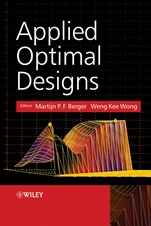
Applied Optimal Designs
ISBN 9780470856970
Autor: Martijn P.F. Berger, Weng–Kee Wong
Wydawca: Wiley
Dostępność: 3-6 tygodni
Cena: 625,80 zł
Przed złożeniem zamówienia prosimy o kontakt mailowy celem potwierdzenia ceny.
ISBN13: |
9780470856970 |
ISBN10: |
0470856971 |
Autor: |
Martijn P.F. Berger, Weng–Kee Wong |
Oprawa: |
Hardback |
Rok Wydania: |
2005-01-26 |
Ilość stron: |
312 |
Wymiary: |
240x158 |
Tematy: |
PB |
There is an increasing need to rein in the cost of scientific study without sacrificing accuracy in statistical inference. Optimal design is the judicious allocation of resources to achieve the objectives of studies using minimal cost via careful statistical planning. Researchers and practitioners in various fields of applied science are now beginning to recognize the advantages and potential of optimal experimental design. Applied Optimal Designs is the first book to catalogue the application of optimal design to real problems, documenting its widespread use across disciplines as diverse as drug development, education and ground water modelling.
Includes contributions covering:Bayesian design for measuring cerebral blood–flowOptimal designs for biological modelsComputer adaptive testingGround water modellingEpidemiological studies and pharmacological models
Applied Optimal Designs bridges the gap between theory and practice, drawing together a selection of incisive articles from reputed collaborators. Broad in scope and inter–disciplinary in appeal, this book highlights the variety of opportunities available through the use of optimal design. The wide range of applications presented here should appeal to statisticians working with optimal designs, and to practitioners new to the theory and concepts involved.
Spis treści:
List of Contributors.
Editors’ Foreword.
1 Optimal Design in Educational Testing (Steven Buyske).
1.1 Introduction.
1.2 Test Design .
1.3 Sampling Design.
1.4 Future Directions.
2 Optimal On–line Calibration of Testlets (Douglas H. Jones and Mikhail S. Nediak).
2.1 Introduction.
2.2 Background.
2.3 Solution for Optimal Designs.
2.4 Simulation Results.
2.5 Discussion.
3 On the Empirical Relevance of Optimal Designs for the Measurement of Preferences (Heiko Großmann, Heinz Holling, Michaela B
rocke, Ulrike Graßhoff and Rainer Schwabe).
3.1 Introduction.
3.2 Conjoint Analysis.
3.3 Paired Comparison Models in Conjoint Analysis.
3.4 Design Issues.
3.5 Experiments.
3.6 Discussion.
4 Designing Optimal Two–stage Epidemiological Studies (Marie Reilly and Agus Salim).
4.1 Introduction.
4.2 Illustrative Examples.
4.3 Meanscore.
4.4 Optimal Design and Meanscore.
4.5 Deriving Optimal Designs in Practice.
4.6 Summary.
4.7 Appendix 1 Brief Description of Software Used.
4.8 Appendix 2 The Optimal Sampling Package.
4.9 Appendix 3 Using the Optimal Package in R.
4.10 Appendix 4 Using the Optimal Package in S–Plus.
4.11 Appendix 5 Using the Optimal Package in STATA.
5 Response–Driven Designs in Drug Development (Valerii V. Fedorov and Sergei L. Leonov).
5.1 Introduction.
5.2 Motivating Example: Quantal Models for Dose Response.
5.3 Continuous Models.
5.4 Variance Depending on Unknown Parameters and Multi–response Models.
5.5 Optimal Designs with Cost Constraints
5.6 Adaptive Designs
5.7 Discussion
6 Design of Experiments for Microbiological Models (Holger Dette, Viatcheslav B. Melas and Nikolay Strigul).
6.1 Introduction.
6.2 Experimental Design for Nonlinear Models.
6.3 Applications of Optimal Experimental Design in Microbiology.
6.4 Bayesian Methods for Regression Models.
6.5 Conclusions.
7 Selected Issues in the Design of Studies of Interrater Agreement (Allan Donner and Mekibib Altaye).
7.1 Introduction.
7.2 The Choice between a Continuous or Dichotomous Variable.
7.3 The Choice between a Polychotomous or Dichotomous Outcome Variable.
7.4 Incorporation of Cost Considerations.
7.5 Final Comments.
8 Restricted Optimal Design in the Measurement of Cerebral Blood Flow Using the Kety–Schmidt Technique (J.N.S. Matthews and P.W. James).
8.1 Introduction.
8.2 The Kety–Schmidt Me
thod.
8.3 The Statistical Model and Optimality Criteria.
8.4 Locally Optimal Designs.
8.5 Bayesian Designs and Prior Distributions.
8.6 Optimal Bayesian Designs.
8.7 Practical Designs.
8.8 Concluding Remarks.
9 Optimal Experimental Design for Parameter Estimation and Contaminant Plume Characterization in Groundwater Modelling (James McPhee and William W–G. Yeh).
9.1 Introduction.
9.2 Groundwater Flow and Mass Transport in Porous Media: Modelling Issues.
9.3 Problem Formulation.
9.4 Solution Algorithms.
9.5 Case Studies.
9.6 Summary and Conclusions.
10 The Optimal Design of Blocked Experiments in Industry (Peter Goos, Lieven Tack and Martina Vandebroek).
10.1 Introduction.
10.2 The Pastry Dough Mixing Experiment.
10.3 The Problem.
10.4 Fixed Block Effects Model.
10.5 Random Block Effects Model.
10.6 The Pastry Dough Mixing Experiment Revisited.
10.7 Time Trends and Cost Considerations.
10.8 Optimal Run Orders for Blocked Experiments.
10.9 A Time Trend in the Pastry Dough Mixing Experiment.
10.10 Summary.
Index.
Nota biograficzna:
Martijn P.F. Berger, Department of Methodology and Statistics, University of Maastricht, the Netherlands, and Weng Kee Wong, Department of Biostatistics, School of Public Health, UCLA, USA.
Okładka tylna:
There is an increasing need to rein in the cost of scientific study without sacrificing accuracy in statistical inference. Optimal design is the judicious allocation of resources to achieve the objectives of studies using minimal cost via careful statistical planning. Researchers and practitioners in various fields of applied science are now beginning to recognize the advantages and potential of optimal experimental design. Applied Optimal Designs is the first book to catalogue the application of optimal design to real problems, documenting its widespread use across disciplines as divers
e as drug development, education and ground water modelling.
Includes contributions covering:Bayesian design for measuring cerebral blood–flowOptimal designs for biological modelsComputer adaptive testingGround water modellingEpidemiological studies and pharmacological models
Applied Optimal Designs bridges the gap between theory and practice, drawing together a selection of incisive articles from reputed collaborators. Broad in scope and inter–disciplinary in appeal, this book highlights the variety of opportunities available through the use of optimal design. The wide range of applications presented here should appeal to statisticians working with optimal designs, and to practitioners new to the theory and concepts involved.
Koszyk
Książek w koszyku: 0 szt.
Wartość zakupów: 0,00 zł
Informacje


Kontakt
Gambit
Centrum Oprogramowania
i Szkoleń Sp. z o.o.
Al. Pokoju 29b/22-24
31-564 Kraków
Siedziba Księgarni
ul. Kordylewskiego 1
31-542 Kraków
+48 12 410 5991
+48 12 410 5987
+48 12 410 5989
Subskrypcje
Administratorem danych osobowych jest firma Gambit COiS Sp. z o.o. Na podany adres będzie wysyłany wyłącznie biuletyn informacyjny.
Autoryzacja płatności

Informacje na temat autoryzacji płatności poprzez PayU.

© Copyright 2012: GAMBIT COiS Sp. z o.o. Wszelkie prawa zastrzeżone.
Projekt i wykonanie: Alchemia Studio Reklamy