


Wydawcy
Katalog tematyczny
- Archeologia (109)
- Ekonomia, finanse, business (13704)
- Filozofia (1445)
- Historia (3040)
- Języki i językoznawstwo (2356)
- Lifestyle, hobby i rozrywka (475)
- Medycyna (9704)
- Nauki humanistyczne (4)
- Nauki o Ziemi i środowisku (2638)
- Nauki ścisłe (20412)
- Nauki społeczne (8486)
- Nauki techniczne (13450)
- Prawo (1696)
- Publikacje informacyjne i interdyscyplinarne (1288)
- Religia i wierzenia (917)
- Technika komputerowa (4067)
- Bazy danych (75)
- Bezpieczeństwo komputerowe (454)
- Certyfikacja komputerowa (1)
- Grafika i media cyfrowe (32)
- Informatyka (779)
- Komputery, ogólnie (74)
- Programowanie (351)
- Programy komercyjne (49)
- Sieci komputerowe (350)
- Sprzęt komputerowy (4)
- Systemy operacyjne (32)
- Technika cyfrowa na co dzień (7)
- Zdrowie, relacje międzyludzkie i rozwój osobisty (657)





Informacje szczegółowe o książce
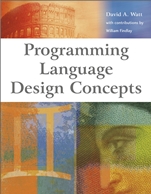
Programming Language Design Concepts
ISBN 9780470853207
Autor: David A. Watt
Wydawca: Wiley
Dostępność: 3-6 tygodni
Cena: 323,40 zł
Przed złożeniem zamówienia prosimy o kontakt mailowy celem potwierdzenia ceny.
ISBN13: |
9780470853207 |
ISBN10: |
0470853204 |
Autor: |
David A. Watt |
Oprawa: |
Paperback |
Rok Wydania: |
2004-03-26 |
Ilość stron: |
492 |
Wymiary: |
240x187 |
Tematy: |
UP |
Programming languages exist to communicate with computers and also with people. A good language, like a good mathematical notation, helps us to formulate and communicate ideas more quickly. Yet there are many programming languages and many features to understand in each.
Reflecting current trends where object–oriented (OO) programming has taken over from imperative programming as the dominant paradigm, this book gives greatest prominence to the OO paradigm using Java and C++ as the main exemplar languages. Similarly, since the Web has revolutionized the computing industry, the need for examination of scripting languages, such as Perl and Python, has risen. With additional case study languages including Python, Haskell, Prolog and Ada, Programming Language Design Concepts deepens study by examining the motivation of programming languages rather than just their features.,P.All programmers, not just language specialists, need a thorough understanding of language concepts in order to get the best of these most fundamental tools. This book explains the basic concepts that underpin all programming languages, and shows how these concepts are synthesized in the major paradigms: imperative, object–oriented, concurrent, functional, logic and scripting.
Written in a clear, approachable style, ideal for classroom and self–study, the book includes numerous examples, case studies of several major programming languages, and end–of–chapter exercises. Sample solutions to exercises are available on the companion website.Companion website: www.dcs.gla.ac.uk/∼daw/books/PLDC/
Spis treści:
Preface.
PART I: INTRODUCTION.
1. Programming Languages.
1.1 Programming linguistics.
1.1.1 Concepts and paradigms.
1.1.2 Syntax, semantics, and pragmatics.
1.1.3 Language processors.
1.2 Historical development.
Summary.
Further reading.
Exercises.
PART II: BASIC CONCEPTS
2. Values and Types.
2.1 Types.
2.2 Primitive types.
2.2.1 Built–in primitive types.
2.2.2 Defined primitive types.
2.2.3 Discrete primitive types.
2.3 Composite types.
2.3.1 Cartesian products, structures, and records.
2.3.2 Mappings, arrays, and functions.
2.3.3 Disjoint unions, discriminated records, and objects.
2.4 Recursive types.
2.4.1 Lists.
2.4.2 Strings.
2.4.3 Recursive types in general.
2.5 Type systems.
2.5.1 Static vs dynamic typing.
2.5.2 Type equivalence.
2.5.3 The Type Completeness Principle.
2.6 Expressions.
2.6.1 Literals.
2. 6.2 Constructions.
2.6.3 Function calls.
2.6.4 Conditional expressions.
2.6.5 Iterative expressions.
2.6.6 Constant and variable accesses.
2.7 Implementation notes.
2.7.1 Representation of primitive types.
2.7.2 Representation of Cartesian products.
2.7.3 Representation of arrays.
2.7.4 Representation of disjoint unions.
2.7.5 Representation of recursive types.
Summary.
Further reading.
Exercises.
3. Variables and Storage.
3.1 Variables and storage.
3.2 Simple variables.
3.3 Composite variables.
3.3.1 Total vs selective update.
3.3.2 Static vs dynamic vs flexible arrays.
3.4 Copy semantics vs reference semantics.
3.5 Lifetime.
3.5.1 Global and local variables.
3.5.2 Heap variables.
3.5.3 Persistent variables.
3.6 Pointers.
3.6.1 Pointers and recursive types.
3.6.2 Dangling pointers.
3.7 Commands.
3.7.1 Skips.
3.7.2 Assignments.
3.7.3 Procedure calls.
3.7.4 Sequential commands.
3.7.5 Collateral commands.
3.7.6 Conditional commands.
3.7.7 Iterative commands.
3.8 Expressions with side effects.
3.8.1 Command expressions.
3.8.2 Expression–oriented languages.
3.9 Implementation notes
3.9.1 Storage for global and local variables.
3.9.2 Storage for heap variables.
Summary.
Further reading.
Exercises.
4. Bindings and Scope.
4.1 Bindings and environment
s.
4.2 Scope.
4.2.1 Block structure.
4.2.2 Scope and visibility.
4.2.3 Static vs dynamic scoping.
4.3 Declarations.
4.3.1 Type declarations.
4.3.2 Constant declarations.
4.3.3 Variable declarations.
4.3.4 Procedure definitions.
4.3.5 Collateral declarations.
4.3.6 Sequential declarations.
4.3.6 Recursive declarations.
4.3.8 Scopes of declarations.
4.4 Blocks.
4.4.1 Block commands.
4.4.2 Block expressions.
4.4.3 The Qualification Principle.
Summary.
Further reading.
Exercises.
5. Procedural Abstraction.
5.1 Function procedures and proper procedures.
5.1.1 Function procedures.
5.1.2 Proper procedures
5.1.3 The Abstraction Principle.
5.2 Parameters and arguments.
5.2.1 Copy parameter mechanisms.
5.2.2 Reference parameter mechanisms.
5.2.3 The Correspondence Principle.
5.3 Implementation notes
5.3.1 Implementation of procedure calls.
5.3.1 Implementation of parameter passing.
Summary.
Further reading.
Exercises.
PART III: ADVANCED CONCEPTS.
6. Data Abstraction.
6.1 Program units, packages, and encapsulation.
6.1.1 Packages.
6.1.2 Encapsulation.
6.2 Abstract types.
6.3 Objects and classes.
6.3.1 Classes.
6.3.2 Subclasses and inheritance.
6.3.3 Abstract classes.
6.3.4. Single vs multiple inheritance.
6.3.5 Interfaces.
6.4 Implementation notes.
6.4.1 Representation of objects
6.4.2 Implementation of method calls.
Summary.
Further reading
Exercises.
7. Generic Abstraction.
7.1 Generic units and instantiation.
7.1.1 Generic packages in ADA.
7.1.2 Generic classes in C++.
7.2 Type and class parameters.
7.2.1 Type parameters in ADA.
7.2.2 Type parameters in C++.
7.2.3 Class parameters in JAVA.
7.3 Implementation notes
7.3.1 Implementation of ADA generic units.
7.3.2 Implementation of C++ generic units.
7.3.3 Implementation of JAVA generic units.
Summary.
Further reading.
Exercises
8. Type Systems.
8.1 Inclusion polymorphism.
8.1.1 Types and subtypes.
8.1.2 Classes and subclasses.
8.2 Parametric polymorphism.
8.2.1 Polymorphic procedures.
8.2.2 Parameterized types.
8.2.3 Type inference.
8.3 Overloading.
8.4 Type conversions.
8.5 Implementation notes
8.5.1 Implementation of polymorphic procedures.
Summary.
Further reading.
Exercises.
9. Control Flow.
9.1 Sequencers.
9.2 Jumps.
9.3 Escapes.
9.4 Exceptions.
9.5 Implementation notes
9.5.1 Implementation of jumps and escapes.
9.5.2 Implementation of exceptions.
Summary.
Further reading.
Exercises.
10. Concurrency (by William Findlay).
10.1 Why concurrency?.
10.2 Programs and processes.
10.3 Problems with concurrency.
10.3.1 Nondeterminism.
10.3.2 Speed dependence.
10.3.3 Deadlock.
10.3.4 Starvation.
10.4 Process interactions.
10.4.1 Independent processes.
10.4.2 Competing processes.
10.4.3 Communicating processes.
10.5 Concurrency primitives.
10.5.1 Process creation and control.
10.5.2 Interrupts.
10.5.3 Spin locks and wait–free algorithms.
10.5.4 Events.
10.5.5 Semaphores.
10.5.6 Messages.
10.5.7 Remote procedure calls.
10.6 Concurrent control abstractions.
10.6.1 Conditional critical regions.
10.6.2 Monitors.
10.6.3 Rendezvous.
Summary.
Further reading.
Exercises.
PART IV: PARADIGMS
11. Imperative Programming.
11.1 Key concepts.
11.2 Pragmatics.
11.2.1 A simple spellchecker.
11.3 Case study: C.
11.3.1 Values and types.
11.3.2 Variables, storage, and control.
11.3.3 Bindings and scope.
11.3.4 Procedural abstraction.
11.3.5 Independent compilation.
11.3.6 Preprocessor directives.
11.3.7 Function library.
11.3.8 A simple spellchecker.
11.4 Case study: ADA.
11.4.1 Values and types.
11.4.2 Variables, storage, and control.
11.4.3 Bindings and scope.
11.4.4 Procedural abstra
Koszyk
Książek w koszyku: 0 szt.
Wartość zakupów: 0,00 zł
Informacje


Kontakt
Gambit
Centrum Oprogramowania
i Szkoleń Sp. z o.o.
Al. Pokoju 29b/22-24
31-564 Kraków
Siedziba Księgarni
ul. Kordylewskiego 1
31-542 Kraków
+48 12 410 5991
+48 12 410 5987
+48 12 410 5989
Subskrypcje
Administratorem danych osobowych jest firma Gambit COiS Sp. z o.o. Na podany adres będzie wysyłany wyłącznie biuletyn informacyjny.
Autoryzacja płatności

Informacje na temat autoryzacji płatności poprzez PayU.

© Copyright 2012: GAMBIT COiS Sp. z o.o. Wszelkie prawa zastrzeżone.
Projekt i wykonanie: Alchemia Studio Reklamy