


Wydawcy
Katalog tematyczny
- Archeologia (109)
- Ekonomia, finanse, business (13704)
- Filozofia (1445)
- Historia (3040)
- Języki i językoznawstwo (2356)
- Lifestyle, hobby i rozrywka (475)
- Medycyna (9704)
- Nauki humanistyczne (4)
- Nauki o Ziemi i środowisku (2638)
- Nauki ścisłe (20412)
- Astronomia (294)
- Biologia (5119)
- Chemia (6540)
- Fizyka (3309)
- Matematyka (4574)
- Algebra (171)
- Analiza matematyczna (902)
- Filozofia matematyki (1)
- Geometria (237)
- Historia matematyki (57)
- Kombinatoryka, teoria grafów (67)
- Matematyka dyskretna (35)
- Matematyka stosowana (555)
- Optymalizacja (104)
- Podstawy matematyki (129)
- Statystyka, prawdopodobieństwo (296)
- Teoria grup (63)
- Teoria liczb (77)
- Topologia (66)
- Nauki ścisłe, ogólnie (503)
- Nauki społeczne (8486)
- Nauki techniczne (13450)
- Prawo (1696)
- Publikacje informacyjne i interdyscyplinarne (1288)
- Religia i wierzenia (917)
- Technika komputerowa (4067)
- Zdrowie, relacje międzyludzkie i rozwój osobisty (657)





Informacje szczegółowe o książce
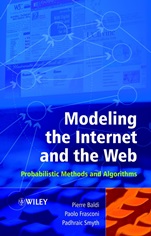
Modeling the Internet and the Web: Probabilistic Methods and Algorithms
ISBN 9780470849064
Autor: Pierre Baldi, Paolo Frasconi, Padhraic Smyth
Wydawca: Wiley
Dostępność: 3-6 tygodni
Cena: 473,55 zł
Przed złożeniem zamówienia prosimy o kontakt mailowy celem potwierdzenia ceny.
ISBN13: |
9780470849064 |
ISBN10: |
0470849061 |
Autor: |
Pierre Baldi, Paolo Frasconi, Padhraic Smyth |
Oprawa: |
Hardback |
Rok Wydania: |
2003-04-25 |
Ilość stron: |
306 |
Wymiary: |
240x160 |
Tematy: |
PB |
The World Wide Web is growing in size at a remarkable rate. It is a huge evolving system and its data are rife with uncertainties. Probability and statistics are the fundamental mathematical tools that enable us to model, reason and infer meaningful results from such data. Modelling the Internet and the Web covers the most important aspects of modeling the Web using a modern mathematical and probabilistic treatment. It focuses on the information and application layers, as well as some of the merging properties of the Internet.Provides a comprehensive introduction to the modeling of the Internet and Web at the information level.Takes a modern approach based on mathematical, probabilistic and graphical modeling.Provides an integrated presentation of theory, examples, exercies and applications.Covers key topics such as text analysis, link analysis, crawling techniques, human behaviour, and commerce on the Web.
Interdisciplinary in nature, Modeling the Internet and the Web will be of interest to students and researchers from a variety of disciplines including computer science, machine learning, engineering, statistics, economics, business and the social sciences.
Spis treści:
Preface.
1 Mathematical Background.
1.1 Probability and Learning from a Bayesian Perspective.
1.2 Parameter Estimation from Data.
1.3 Mixture Models and the Expectation Maximization Algorithm.
1.4 Graphical Models.
1.5 Classification.
1.6 Clustering.
1.7 Power–Law Distributions.
1.8 Exercises.
2 Basic WWW Technologies.
2.1 Web Documents.
2.2 Resource Identifiers: URI, URL, and URN.
2.3 Protocols.
2.4 Log Files.
2.5 Search Engines.
2.6 Exercises.
3 Web Graphs.
3.1 Internet and Web Graphs.
3.2 Generative Models for the Web Graph and Other Networks.
3.3 Applications.
3.4 Notes and Additional Technical References.
3.5
Exercises.
4 Text Analysis.
4.1 Indexing.
4.2 Lexical Processing.
4.3 Content–Based Ranking.
4.4 Probabilistic Retrieval.
4.5 Latent Semantic Analysis.
4.6 Text Categorization.
4.7 Exploiting Hyperlinks.
4.8 Document Clustering.
4.9 Information Extraction.
4.10 Exercises.
5 Link Analysis.
5.1 Early Approaches to Link Analysis.
5.2 Nonnegative Matrices and Dominant Eigenvectors.
5.3 Hubs and Authorities: HITS.
5.4 PageRank.
5.5 Stability.
5.6 Probabilistic Link Analysis.
5.7 Limitations of Link Analysis.
6 Advanced Crawling Techniques.
6.1 Selective Crawling.
6.2 Focused Crawling.
6.3 Distributed Crawling.
6.4 Web Dynamics.
7 Modeling and Understanding Human Behavior on the Web.
7.1 Introduction.
7.2 Web Data and Measurement Issues.
7.3 Empirical Client–Side Studies of Browsing Behavior.
7.4 Probabilistic Models of Browsing Behavior.
7.5 Modeling and Understanding Search Engine Querying.
7.6 Exercises.
8 Commerce on the Web: Models and Applications.
8.1 Introduction.
8.2 Customer Data on theWeb.
8.3 Automated Recommender Systems.
8.4 Networks and Recommendations.
8.5 Web Path Analysis for Purchase Prediction.
8.6 Exercises.
Appendix A: Mathematical Complements.
A.1 Graph Theory.
A.2 Distributions.
A.3 Singular Value Decomposition.
A.4 Markov Chains.
A.5 Information Theory.
Appendix B: List of Main Symbols and Abbreviations.
References.
Index.
Okładka tylna:
The World Wide Web is growing in size at a remarkable rate. It is a huge evolving system and its data are rife with uncertainties. Probability and statistics are the fundamental mathematical tools that enable us to model, reason and infer meaningful results from such data. Modelling the Internet and the Web covers the most important aspects of modeling the Web
using a modern mathematical and probabilistic treatment. It focuses on the information and application layers, as well as some of the merging properties of the Internet.Provides a comprehensive introduction to the modeling of the Internet and Web at the information level.Takes a modern approach based on mathematical, probabilistic and graphical modeling.Provides an integrated presentation of theory, examples, exercies and applications.Covers key topics such as text analysis, link analysis, crawling techniques, human behaviour, and commerce on the Web.
Interdisciplinary in nature, Modeling the Internet and the Web will be of interest to students and researchers from a variety of disciplines including computer science, machine learning, engineering, statistics, economics, business and the social sciences.
Koszyk
Książek w koszyku: 0 szt.
Wartość zakupów: 0,00 zł
Informacje


Kontakt
Gambit
Centrum Oprogramowania
i Szkoleń Sp. z o.o.
Al. Pokoju 29b/22-24
31-564 Kraków
Siedziba Księgarni
ul. Kordylewskiego 1
31-542 Kraków
+48 12 410 5991
+48 12 410 5987
+48 12 410 5989
Subskrypcje
Administratorem danych osobowych jest firma Gambit COiS Sp. z o.o. Na podany adres będzie wysyłany wyłącznie biuletyn informacyjny.
Autoryzacja płatności

Informacje na temat autoryzacji płatności poprzez PayU.

© Copyright 2012: GAMBIT COiS Sp. z o.o. Wszelkie prawa zastrzeżone.
Projekt i wykonanie: Alchemia Studio Reklamy