


Wydawcy
Katalog tematyczny
- Archeologia (109)
- Ekonomia, finanse, business (13704)
- Filozofia (1445)
- Historia (3040)
- Języki i językoznawstwo (2356)
- Lifestyle, hobby i rozrywka (475)
- Medycyna (9704)
- Nauki humanistyczne (4)
- Nauki o Ziemi i środowisku (2638)
- Nauki ścisłe (20412)
- Astronomia (294)
- Biologia (5119)
- Chemia (6540)
- Fizyka (3309)
- Matematyka (4574)
- Algebra (171)
- Analiza matematyczna (902)
- Filozofia matematyki (1)
- Geometria (237)
- Historia matematyki (57)
- Kombinatoryka, teoria grafów (67)
- Matematyka dyskretna (35)
- Matematyka stosowana (555)
- Optymalizacja (104)
- Podstawy matematyki (129)
- Statystyka, prawdopodobieństwo (296)
- Teoria grup (63)
- Teoria liczb (77)
- Topologia (66)
- Nauki ścisłe, ogólnie (503)
- Nauki społeczne (8486)
- Nauki techniczne (13450)
- Prawo (1696)
- Publikacje informacyjne i interdyscyplinarne (1288)
- Religia i wierzenia (917)
- Technika komputerowa (4067)
- Zdrowie, relacje międzyludzkie i rozwój osobisty (657)





Informacje szczegółowe o książce
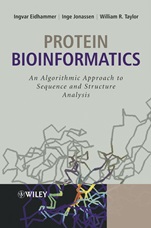
Protein Bioinformatics: An Algorithmic Approach to Sequence and Structure Analysis
ISBN 9780470848395
Autor: Ingvar Eidhammer, Inge Jonassen, William R. Taylor
Wydawca: Wiley
Dostępność: 3-6 tygodni
Cena: 437,85 zł
Przed złożeniem zamówienia prosimy o kontakt mailowy celem potwierdzenia ceny.
ISBN13: |
9780470848395 |
ISBN10: |
0470848391 |
Autor: |
Ingvar Eidhammer, Inge Jonassen, William R. Taylor |
Oprawa: |
Hardback |
Rok Wydania: |
2003-12-19 |
Ilość stron: |
380 |
Wymiary: |
244x166 |
Tematy: |
PB |
Bioinformatics is the study of biological information and biological systems – such as of the relationships between the sequence, structure and function of genes and proteins. The subject has seen tremendous development in recent years, and there are ever–increasing needs for good understanding of quantitative methods in the study of proteins. Protein Bioinformatics: An Algorithmic Approach to Sequence and Structure Analysis takes the novel approach of covering both the sequence and structure analysis of proteins in one volume and from an algorithmic perspective.Provides a comprehensive introduction to the analysis of protein sequences and structures.Provides an integrated presentation of methodology, examples, exercises and applications.Emphasises the algorithmic rather than mathematical aspects of the methods described.Covers comparison and alignment of protein sequences and structures as well as protein structure prediction focusing on threading approaches.Written in an accessible yet rigorous style, suitable for biologists, mathematicians and computer scientists alike.Suitable both for developers and users of bioinformatics tools.Supported by a Web site featuring exercises, solutions, images, and computer programs.
Protein Bioinformatics: An Algorithmic Approach to Sequence and Structure Analysis is ideally suited for advanced undergraduate and graduate students of bioinformatics, statistics, mathematics and computer science. It also provides an excellent introduction and reference source on the subject for practitioners and researchers.
Spis treści:
Preface.
Acknowledgements.
Part I: SEQUENCE ANALYSIS.
1. Pairwise Global Alignment of Sequences.
1.1 Alignment and Evolution.
1.2 What is an Alignment?
1.3 A Scoring Scheme for the Model.
1.4 Finding Highest–Scoring Alignments with Dynamic Programming.
1.4.1 Determine
Hi,j.
1.4.2 Use of matrices.
1.4.3 Finding the alignments that give the highest score.
1.4.4 Gaps.
1.5 Scoring Matrices.
1.6 Scoring Gaps: Gap Penalties.
1.7 Dynamic Programming for General Gap Penalty.
1.8 Dynamic Programming for Affine Gap Penalty.
1.9 Alignment Score and Sequence Distance.
1.10 Exercises.
1.11 Bibliographic notes.
2 Pairwise Local Alignment and Database Search.
2.1 The Basic Operation: Comparing Two Sequences.
2.2 Dot Matrices.
2.2.1 Filtering.
2.2.2 Repeating segments.
2.3 Dynamic Programming.
2.3.1 Initialization.
2.3.2 Finding the best local alignments.
2.3.3 Algorithms.
2.3.4 Scoring matrices and gap penalties.
2.4 Database Search: BLAST.
2.4.1 The procedure.
2.4.2 Preprocess the query: make the word list.
2.4.3 Scanning the database sequences.
2.4.4 Extending to HSP.
2.4.5 Introducing gaps.
2.4.6 Algorithm.
2.5 Exercises.
2.6 Bibliographic notes.
3. Statistical Analysis.
3.1 Hypothesis Testing for Sequence Homology.
3.1.1 Random generation of sequences.
3.1.2 Use of Z values for estimating the statistical significance.
3.2 Statistical Distributions.
3.2.1 Poisson probability distribution.
3.2.2 Extreme value distributions.
3.3 Theoretical Analysis of Statistical Significance.
3.3.1 The P value has an extreme value distribution.
3.3.2 Theoretical analysis for database search.
3.4 Probability Distributions for Gapped Alignments.
3.5 Assessing and Comparing Programs for Database Search.
3.5.1 Sensitivity and specificity.
3.5.2 Discrimination power.
3.5.3 Using more sequences as queries.
3.6 Exercises.
3.7 Bibliographic notes.
4 .Multiple Global Alignment and Phylogenetic Trees.
4.1 Dynamic Programming.
4.1.1 SP score of multiple alignments.
4.1.2 A pruning algorithm for the DP solution.
4.2 Multiple Alignments and Phylogenetic Trees.
4.3
Phylogeny.
4.3.1 The number of different tree topologies.
4.3.2 Molecular clock theory.
4.3.3 Additive and ultrametric trees.
4.3.4 Different approaches for reconstructing phylogenetic trees.
4.3.5 Distance–based construction.
4.3.6 Rooting of trees.
4.3.7 Statistical test: bootstrapping.
4.4 Progressive Alignment.
4.4.1 Aligning two subset alignments.
4.4.2 Clustering.
4.4.3 Sequence weights.
4.4.4 CLUSTAL.
4.5 Other Approaches.
4.6 Exercises.
4.7 Bibliographic notes.
5. Scoring Matrices.
5.1 Scoring Matrices Based on Physio–Chemical Properties.
5.2 PAM Scoring Matrices.
5.2.1 The evolutionary model.
5.2.2 Calculate substitution matrix.
5.2.3 Matrices for general evolutionary time.
5.2.4 Measuring sequence similarity by use of Mτ.
5.2.5 Odds matrices.
5.2.6 Scoring matrices (log–odds matrices).
5.2.7 Estimating the evolutionary distance.
5.3 BLOSUM Scoring Matrices.
5.3.1 Log–odds matrix.
5.3.2 Developing scoring matrices for different evolutionary distances.
5.4 Comparing BLOSUM and PAM Matrices.
5.5 Optimal Scoring Matrices.
5.5.1 Analysis for one sequence.
5.6 Exercises.
5.7 Bibliographic notes.
6. Profiles.
6.1 Constructing a Profile.
6.1.1 Notation.
6.1.2 Removing rows and columns.
6.1.3 Position weights.
6.1.4 Sequence weights.
6.1.5 Treating gaps.
6.2 Searching Databases with Profiles.
6.3 Iterated BLAST: PSI–BLAST.
6.3.1 Making the multiple alignment.
6.3.2 Constructing the profile.
6.4 HMM Profile.
6.4.1 Definitions for an HMM.
6.4.2 Constructing a profile HMM for a protein family.
6.4.3 Comparing a sequence with an HMM.
6.4.4 Protein family databases.
6.5 Exercises.
6.6 Bibliographic notes.
7. Sequence Patterns.
7.1 The PROSITE Language.
7.2 Exact/Approximate Matching.
7.3 Defining Pattern Classes by Imposing Con
straints.
7.4 Pattern Scoring: Information Theory.
7.4.1 Information theory.
7.4.2 Scoring patterns.
7.5 Generalization and Specialization.
7.6 Pattern Discovery: Introduction.
7.7 Comparison–Based Methods.
7.7.1 Pivot–based methods.
7.7.2 Tree progressive methods.
7.8 Pattern–Driven Methods: Pratt.
7.8.1 The main procedure.
7.8.2 Preprocessing.
7.8.3 The pattern space.
7.8.4 Searching.
7.8.5 Ambiguous components.
7.8.6 Specialization.
7.8.7 Pattern scoring.
7.9 Exercises.
7.10 Bibliographic notes.
Part II: STRUCTURE ANALYSIS
8. Structures and Structure Descriptions.
8.1 Units of Structure Descriptions.
8.2 Coordinates.
8.3 Distance Matrices.
8.4 Torsion Angles.
8.5 Coarse Level Description.
8.5.1 Line segments (sticks).
8.5.2 Ellipsoid.
8.5.3 Helices.
8.5.4 Strands and sheets.
8.5.5 Topology of Protein Structure (TOPS).
8.6 Identifying the SSEs.
8.6.1 Use of distance matrices.
8.6.2 Define Secondary Structure of Proteins (DSSP).
8.7 Structure Comparison.
8.7.1 Structure descriptions for comparison.
8.7.2 Structure representation.
8.8 Framework for Pairwise Structure Comparison.
8.9 Exercises.
8.10 Bibliographic notes.
9. Superposition and Dynamic Programming.
9.1 Superposition.
9.1.1 Coordinate RMSD.
9.1.2 Distance RMSD.
9.1.3 Using RMSD as scoring of structure similarities.
9.2 Alternating Superposition and Alignment.
9.3 Double Dynamic Programming.
9.3.1 Low–level scoring matrices.
9.3.2 High–level scoring matrix.
9.3.3 Iterated double dynamic programming.
9.4 Similarity of the Methods.
9.5 Exercises.
9.6 Bibliographic notes.
10. Geometric Techniques.
10.1 Geometric Hashing.
10.1.1 Two–dimensional geometric hashing.
10.1.2 Geometric hashing for structure comparison.
10.1.3 Geometric hashing for SSE representation.
10.1.4 Cluster
Koszyk
Książek w koszyku: 0 szt.
Wartość zakupów: 0,00 zł
Informacje


Kontakt
Gambit
Centrum Oprogramowania
i Szkoleń Sp. z o.o.
Al. Pokoju 29b/22-24
31-564 Kraków
Siedziba Księgarni
ul. Kordylewskiego 1
31-542 Kraków
+48 12 410 5991
+48 12 410 5987
+48 12 410 5989
Subskrypcje
Administratorem danych osobowych jest firma Gambit COiS Sp. z o.o. Na podany adres będzie wysyłany wyłącznie biuletyn informacyjny.
Autoryzacja płatności

Informacje na temat autoryzacji płatności poprzez PayU.

© Copyright 2012: GAMBIT COiS Sp. z o.o. Wszelkie prawa zastrzeżone.
Projekt i wykonanie: Alchemia Studio Reklamy