


Wydawcy
Katalog tematyczny
- Archeologia (109)
- Ekonomia, finanse, business (13704)
- Filozofia (1445)
- Historia (3040)
- Języki i językoznawstwo (2356)
- Lifestyle, hobby i rozrywka (475)
- Medycyna (9704)
- Nauki humanistyczne (4)
- Nauki o Ziemi i środowisku (2638)
- Nauki ścisłe (20412)
- Astronomia (294)
- Biologia (5119)
- Chemia (6540)
- Fizyka (3309)
- Matematyka (4574)
- Algebra (171)
- Analiza matematyczna (902)
- Filozofia matematyki (1)
- Geometria (237)
- Historia matematyki (57)
- Kombinatoryka, teoria grafów (67)
- Matematyka dyskretna (35)
- Matematyka stosowana (555)
- Optymalizacja (104)
- Podstawy matematyki (129)
- Statystyka, prawdopodobieństwo (296)
- Teoria grup (63)
- Teoria liczb (77)
- Topologia (66)
- Nauki ścisłe, ogólnie (503)
- Nauki społeczne (8486)
- Nauki techniczne (13450)
- Prawo (1696)
- Publikacje informacyjne i interdyscyplinarne (1288)
- Religia i wierzenia (917)
- Technika komputerowa (4067)
- Zdrowie, relacje międzyludzkie i rozwój osobisty (657)





Informacje szczegółowe o książce
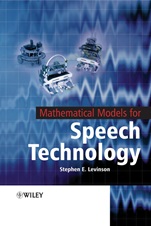
Mathematical Models for Speech Technology
ISBN 9780470844076
Autor: Stephen Levinson
Wydawca: Wiley
Dostępność: 3-6 tygodni
Cena: 639,45 zł
Przed złożeniem zamówienia prosimy o kontakt mailowy celem potwierdzenia ceny.
ISBN13: |
9780470844076 |
ISBN10: |
0470844078 |
Autor: |
Stephen Levinson |
Oprawa: |
Hardback |
Rok Wydania: |
2005-01-27 |
Ilość stron: |
282 |
Wymiary: |
251x170 |
Tematy: |
PB |
Humans use language to convey meaningful messages to each other. Linguistic competence consists in the ability to express meaning reliably, not simply to obtain faithful lexical transcriptions. This invaluable reference tool is the product of many years′ experience and research on language and speech technology. It presents the motivations for, intuitions behind and basic mathematical models of natural spoken language communication. From a preliminary discussion on the physics of speech production and the taxonomy of linguistic structure, there is a natural progression taking in issues of grammatical inference, automatic speech recognition and constructive theories of language. The author counterbalances theoretical explanations and illustrations with questions of a more philosophical nature designed to highlight the seemingly limitless future potential of speech technology. Emphasizes the physics of speech production in an argument underpinned by mathematical models of linguistic structure.Collates the formalisms and perspectives used by linguists and engineers and examines established theories, including the Markov process, the Chomsky hierarchy, the Miller–Nicely experiments and Baum and Baker’s experiments.Contains strong sections on the current status and evolution of Artificial Intelligence, the problem of consciousness and future prospects for a science of the mind.Illustrates all points throughout using detailed real world examples.This comprehensive resource will appeal to researchers and practitioners in the fields of mathematical linguistics and speech technology as well as those in the related disciplines of psychology, artificial intelligence, automata theory, information theory and philosophy.
Spis treści:
Author′s preface.
1 Introduction
2 Preliminaries
2.1 The physics of speech production
2.2 The source–filter model
2.3&#
160; Information–bearing features of the speech signal
2.4 Time–frequency representations
2.5 Classifications of acoustic patterns in speech
2.6 Temporal invariance and stationarity
2.7 Taxonomy of linguistic structure
3 Mathematical models of linguistic structure
3.1 Probabilistic functions of a discrete Markov process
3.2 Formal grammars and abstract automata
4 Syntactic analysis
4.1 Deterministic parsing algorithms
4.2 Probabilistic parsing algorithms
4.3 Parsing natural language
5 Grammatical inference
5.1 Exact inference and Gold′s theorem
5.2 Baum′s algorithm for regular grammars
5.3 Event counting in parse trees
5.4 Baker′s algorithm for context–free grammars
6 Information–theoretic analysis of speech communication
6.1 The Miller et al. experiments
6.2 Entropy of an information source
6.3 Recognition error rates and entropy
7 Automatic speech recognition and constructive theories of language
7.1 Integrated architectures
7.2 Modular architectures
7.3 Parameter estimation from fluent speech
7.4 System performance
7.5 Other speech technologies
8 Automatic speech understanding and semantics
8.1 Transcription and comprehension
8.2 Limited domain semantics
8.3 The semantics of natural language
8.4 System architectures
8.5 Human and machine performance
9 Theories of mind and language
9.1 The challenge of automatic natural language understanding
9.2 Metaphors for mind
9.3 The artificial intelligence program
10 A speculation on the prospects for a science of the mind
10.1 The parable of the thermos bottle: measurements and symbols
10.2 The four questions of science
10.3 A constructive theory of the mind
10.4 The problem of consciousness
10.5 The role of sensorimotor function, associative memory and reinforcement learning in automatic acquisition of spoken language by an autonomous robot
10.6 Final thoughts: predicting the course of discovery
Okładka tylna:
Humans use language to convey meaningful messages to each other. Linguistic competence consists in the ability to express meaning reliably, not simply to obtain faithful lexical transcriptions. This invaluable reference tool is the product of many years′ experience and research on language and speech technology. It presents the motivations for, intuitions behind and basic mathematical models of natural spoken language communication. From a preliminary discussion on the physics of speech production and the taxonomy of linguistic structure, there is a natural progression taking in issues of grammatical inference, automatic speech recognition and constructive theories of language. The author counterbalances theoretical explanations and illustrations with questions of a more philosophical nature designed to highlight the seemingly limitless future potential of speech technology. Emphasizes the physics of speech production in an argument underpinned by mathematical models of linguistic structure.Collates the formalisms and perspectives used by linguists and engineers and examines established theories, including the Markov process, the Chomsky hierarchy, the Miller–Nicely experiments and Baum and Baker’s experiments.Contains strong sections on the current status and evolution of Artificial Intelligence, the problem of consciousness and future prospects for a science of the mind.Illustrates all points throughout using detailed real world examples.This comprehensive resource will appeal to researchers and practitioners in the fields of mathem
atical linguistics and speech technology as well as those in the related disciplines of psychology, artificial intelligence, automata theory, information theory and philosophy.
Koszyk
Książek w koszyku: 0 szt.
Wartość zakupów: 0,00 zł
Informacje


Kontakt
Gambit
Centrum Oprogramowania
i Szkoleń Sp. z o.o.
Al. Pokoju 29b/22-24
31-564 Kraków
Siedziba Księgarni
ul. Kordylewskiego 1
31-542 Kraków
+48 12 410 5991
+48 12 410 5987
+48 12 410 5989
Subskrypcje
Administratorem danych osobowych jest firma Gambit COiS Sp. z o.o. Na podany adres będzie wysyłany wyłącznie biuletyn informacyjny.
Autoryzacja płatności

Informacje na temat autoryzacji płatności poprzez PayU.

© Copyright 2012: GAMBIT COiS Sp. z o.o. Wszelkie prawa zastrzeżone.
Projekt i wykonanie: Alchemia Studio Reklamy