


Wydawcy
Katalog tematyczny
- Archeologia (109)
- Ekonomia, finanse, business (13704)
- Filozofia (1445)
- Historia (3040)
- Języki i językoznawstwo (2356)
- Lifestyle, hobby i rozrywka (475)
- Medycyna (9704)
- Nauki humanistyczne (4)
- Nauki o Ziemi i środowisku (2638)
- Nauki ścisłe (20412)
- Astronomia (294)
- Biologia (5119)
- Chemia (6540)
- Fizyka (3309)
- Matematyka (4574)
- Algebra (171)
- Analiza matematyczna (902)
- Filozofia matematyki (1)
- Geometria (237)
- Historia matematyki (57)
- Kombinatoryka, teoria grafów (67)
- Matematyka dyskretna (35)
- Matematyka stosowana (555)
- Optymalizacja (104)
- Podstawy matematyki (129)
- Statystyka, prawdopodobieństwo (296)
- Teoria grup (63)
- Teoria liczb (77)
- Topologia (66)
- Nauki ścisłe, ogólnie (503)
- Nauki społeczne (8486)
- Nauki techniczne (13450)
- Prawo (1696)
- Publikacje informacyjne i interdyscyplinarne (1288)
- Religia i wierzenia (917)
- Technika komputerowa (4067)
- Zdrowie, relacje międzyludzkie i rozwój osobisty (657)





Informacje szczegółowe o książce
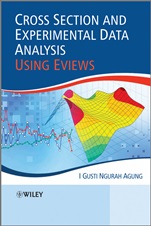
Cross Section and Experimental Data Analysis Using EViews
ISBN 9780470828427
Autor: I. Gusti Ngurah Agung
Wydawca: Wiley
Dostępność: 3-6 tygodni
Cena: 564,90 zł
Przed złożeniem zamówienia prosimy o kontakt mailowy celem potwierdzenia ceny.
ISBN13: |
9780470828427 |
ISBN10: |
0470828420 |
Autor: |
I. Gusti Ngurah Agung |
Oprawa: |
Hardback |
Rok Wydania: |
2011-04-05 |
Ilość stron: |
584 |
Wymiary: |
251x169 |
Tematy: |
PB |
"This book is a reflection of the vast experience and knowledge of the author. It is a useful reference for students and practitioners dealing with cross sectional data analysis ... The strength of the book lies in its wealth of material and well structured guidelines ..."
Prof. Yohanes Eko Riyanto, Nanyang Technological University, Singapore
"This is superb and brilliant. Prof. Agung has skilfully transformed his best experiences into new knowledge ... creating a new way of understanding data analysis."
Dr. I Putu Gede Ary Suta, The Ary Suta Center, Jakarta
This book offers an easily accessible, practical approach to the analysis of cross section and experimental data using the versatile Windows–based computer software program EViews. With a wealth of examples and an emphasis on defining and testing statistical hypotheses, Cross Section and Experimental Data Analysis Using EViews is an essential resource for solving real–life problems.
The author:
Supplies step–by–step directions on application of EViews to cross section data analysis – from multivariate analysis and nonlinear models to non–parametric regressionProffers guidance on developing relevant descriptive statistical summaries based on evaluation studiesExplains how to develop and evaluate statistical empirical models without the need for computational formulaeDiscusses alternative methods for data analysis based on various experimental data sets Presents over 200 examples as well as special notes and comments derived from his own experience, and illustrates techniques through practical examples from real situations
Designed as an instructive guide, Cross Section and Experimental Data Analysis Using EViews is ideally suited to undergraduate and graduate students taking econometrics,
population, or public policy courses. Applied policy researchers, decision makers, and bureaucrats will also find this book indispensible.
Access supplementary material for this text at the companion website: www.wiley.com/go/agungcross
Spis treści:
Preface.
1 Misinterpretation of Selected Theoretical Concepts of Statistics.
1.1 Introduction.
1.2 What is a Population?
1.3 A Sample and Sample Space.
1.4 Distribution of a Random Sample Space.
1.5 What is a Random Variable?
1.6 Theoretical Concept of a Random Sample.
1.7 Does a Representative Sample Really Exist?
1.8 Remarks on Statistical Powers and Sample Sizes.
1.9 Hypothesis and Hypothesis Testing.
1.10 Groups of Research Variables.
1.11 Causal Relationship between Variables.
1.12 Misinterpretation of Selected Statistics.
2 Simple Statistical Analysis but Good for Strategic Decision Making.
2.1 Introduction.
2.2 A Single Input for Decision Making.
2.3 Data Transformation.
2.4 Biserial Correlation Analysis.
2.5 One–Way Tabulation of a Variable.
2.6 Two–Way Tabulations.
2.7 Three–Way Tabulation.
2.8 Special Notes and Comments.
2.9 Special Cases of the N–Way Incomplete Tables.
2.10 Partial Associations.
2.11 Multiple Causal Associations Based on Categorical Variables.
2.12 Seemingly Causal Model Based on Categorical Variables.
2.13 Alternative Descriptive Statistical Summaries.
2.14 How to Present Descriptive Statistical Summary?
2.15 General Seemingly Causal Model.
2.16 Empirical Studies Presenting Descriptive Statistical Summaries.
3 One–Way Proportion Models.
3.1 Introduction.
3.2 One–Way Proportion Models Based on a 2 2 Table.
3.3 Binary Choice Models Based on a K 2 Table.
3.4 Binary Logit Models Based on N–Way Tabulation.
3.5 General Binary Choice Models.
3.6
Special Notes and Comments.
3.7 Association between Categorical Variables.
3.8 One–Way Binary Choice Models Based on N–Way Tabulation.
3.9 Special Notes and Comments on Binary Choice Models.
4 N–Way Cell–Proportion Models.
4.1 Introduction.
4.2 The N–Way Tabulation of Proportions.
4.3 The 2 2 Factorial Model of Proportions.
4.4 I J Factorial Models of Proportions.
4.5 Multifactorial Cell–Proportion Model.
4.6 Presenting the Statistical Summary.
5 N–Way Cell–Mean Models.
5.1 Introduction.
5.2 One–Way Multivariate Cell–Mean Models.
5.3 N–Way Multivariate Cell–Mean Models.
5.4 Equality Test by Classification.
5.5 Testing Weighted Means Differences.
5.6 Descriptive Statistical Summary.
6 Multinomial Choice Models with Categorical Exogenous Variables.
6.1 Introduction.
6.2 Multinomial Choice Models.
6.3 Ordered Choice Models.
6.4 Concordance–Discordance Measure of Association.
6.5 Multifactorial Ordered Choice Models.
6.6 Multilevel Choice Models.
6.7 Special Notes on the Multinomial Logit Model.
6.8 Selected Population Studies Using Multinomial Choice Models.
7 General Choice Models.
7.1 Introduction.
7.2 Binary Choice Models with a Numerical Variable.
7.3 Heterogeneous Binary Choice Models.
7.4 Homogeneous Binary Choice Models.
7.5 General Binary Choice Models.
7.6 Advanced Binary Choice Models.
7.7 Multidimensional Binary Choice Translog Linear Model.
7.8 Piecewise Binary Choice Models.
7.9 Ordered Choice Models with Numerical Independent Variables.
7.10 Studies Using General Choice Models.
7.11 Two–Stage Binary Choice Model.
8 Experimental Data Analysis.
8.1 Introduction.
8.2 Analysis Based on Cell–Mean Models.
8.3 Bivariate Correlation Analysis.
8.4 Effects of the Experimental Factors.
8.5 Effects
of the Experimental Factors and Covariates.
8.6 Application of the Ordered Choice Models.
8.7 Application of Seemingly Causal Models.
8.8 Multivariate Analysis of Covariance.
8.9 Tests for Equality of Medians.
8.10 The Simplest Experimental Design.
9 Seemingly Causal Models Based on Numerical Variables.
9.1 Introduction.
9.2 The Simplest Seemingly Causal Model.
9.3 General Linear Models Based on Bivariate (X, Y).
9.4 Models Based on Numerical Trivariate.
9.5 Regression Analysis Using the Principal Components.
9.6 Seemingly Causal Models Based on (X1, X2, Y1, Y2).
9.7 Seemingly Causal Models Based on (X1, X2, X3, Y1, Y2).
9.8 New Types of Interaction Model.
9.9 Special Cases.
9.10 Special Notes and Comments.
Appendix A.9.1 Hypothetical Data Set.
10 Factor Analysis and Latent Variables Models.
10.1 Introduction.
10.2 The Basic Concept of Factor Analysis.
10.3 The First–Level Latent Variables.
10.4 Illustrations Based on Hamsal’s (2006) Data Set.
10.5 Selected Cases Based on Ary Suta’s (2006) Data Set.
10.6 Evaluation Analysis Based on Latent Variables.
11 Application of the Stepwise Selection Methods.
11.1 Introduction.
11.2 The Options for the Stepwise Selection Methods.
11.3 Selection Method for the Numerical Variable Regression Models.
11.4 Multifactorial Stepwise Regression Models.
11.5 Illustrative Stepwise Regressions Based on Mlogit.wf1.
11.6 Special Notes and Comments.
12 Censored Multiple Regression Models.
12.1 Introduction.
12.2 Tobit Models.
12.3 General Tobit Model.
12.4 Zero–One Indicator of Censoring.
12.5 Illustrative Cases of Censored Observations.
12.6 Series for a Censoring Variable.
12.7 Switching Censored Regressions.
12.8 Special Notes and Comments.
Appendix A.12.1 Hypothetical Censored Data, Modified from Faad’s (2008) Data Set.
References.
Index.
Ok&
#322;adka tylna:
"This book is a reflection of the vast experience and knowledge of the author. It is a useful reference for students and practitioners dealing with cross sectional data analysis ... The strength of the book lies in its wealth of material and well structured guidelines ..."
Prof. Yohanes Eko Riyanto, Nanyang Technological University, Singapore
"This is superb and brilliant. Prof. Agung has skilfully transformed his best experiences into new knowledge ... creating a new way of understanding data analysis."
Dr. I Putu Gede Ary Suta, The Ary Suta Center, Jakarta
This book offers an easily accessible, practical approach to the analysis of cross section and experimental data using the versatile Windows–based computer software program EViews. With a wealth of examples and an emphasis on defining and testing statistical hypotheses, Cross Section and Experimental Data Analysis Using EViews is an essential resource for solving real–life problems.
The author:
Supplies step–by–step directions on application of EViews to cross section data analysis – from multivariate analysis and nonlinear models to non–parametric regressionProffers guidance on developing relevant descriptive statistical summaries based on evaluation studiesExplains how to develop and evaluate statistical empirical models without the need for computational formulaeDiscusses alternative methods for data analysis based on various experimental data sets Presents over 200 examples as well as special notes and comments derived from his own experience, and illustrates techniques through practical examples from real situations
Designed as an instructive guide, Cross Section and Experimental Data Analysis Using EViews is ideally suited to undergraduate and graduate studen
ts taking econometrics, population, or public policy courses. Applied policy researchers, decision makers, and bureaucrats will also find this book indispensible.
Access supplementary material for this text at the companion website: www.wiley.com/go/agungcross
Koszyk
Książek w koszyku: 0 szt.
Wartość zakupów: 0,00 zł
Informacje


Kontakt
Gambit
Centrum Oprogramowania
i Szkoleń Sp. z o.o.
Al. Pokoju 29b/22-24
31-564 Kraków
Siedziba Księgarni
ul. Kordylewskiego 1
31-542 Kraków
+48 12 410 5991
+48 12 410 5987
+48 12 410 5989
Subskrypcje
Administratorem danych osobowych jest firma Gambit COiS Sp. z o.o. Na podany adres będzie wysyłany wyłącznie biuletyn informacyjny.
Autoryzacja płatności

Informacje na temat autoryzacji płatności poprzez PayU.

© Copyright 2012: GAMBIT COiS Sp. z o.o. Wszelkie prawa zastrzeżone.
Projekt i wykonanie: Alchemia Studio Reklamy