


Wydawcy
Katalog tematyczny
- Archeologia (109)
- Ekonomia, finanse, business (13704)
- Filozofia (1445)
- Historia (3040)
- Języki i językoznawstwo (2356)
- Lifestyle, hobby i rozrywka (475)
- Medycyna (9704)
- Nauki humanistyczne (4)
- Nauki o Ziemi i środowisku (2638)
- Nauki ścisłe (20412)
- Astronomia (294)
- Biologia (5119)
- Chemia (6540)
- Fizyka (3309)
- Matematyka (4574)
- Algebra (171)
- Analiza matematyczna (902)
- Filozofia matematyki (1)
- Geometria (237)
- Historia matematyki (57)
- Kombinatoryka, teoria grafów (67)
- Matematyka dyskretna (35)
- Matematyka stosowana (555)
- Optymalizacja (104)
- Podstawy matematyki (129)
- Statystyka, prawdopodobieństwo (296)
- Teoria grup (63)
- Teoria liczb (77)
- Topologia (66)
- Nauki ścisłe, ogólnie (503)
- Nauki społeczne (8486)
- Nauki techniczne (13450)
- Prawo (1696)
- Publikacje informacyjne i interdyscyplinarne (1288)
- Religia i wierzenia (917)
- Technika komputerowa (4067)
- Zdrowie, relacje międzyludzkie i rozwój osobisty (657)





Informacje szczegółowe o książce
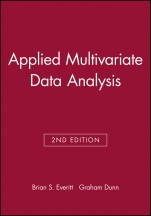
Applied Multivariate Data Analysis
ISBN 9780470711170
Autor: Brian S. Everitt, Graham Dunn
Wydawca: Wiley
Dostępność: 3-6 tygodni
Cena: 270,90 zł
Przed złożeniem zamówienia prosimy o kontakt mailowy celem potwierdzenia ceny.
ISBN13: |
9780470711170 |
ISBN10: |
0470711175 |
Autor: |
Brian S. Everitt, Graham Dunn |
Oprawa: |
Paperback |
Rok Wydania: |
2001-03-02 |
Numer Wydania: |
2nd Edition |
Ilość stron: |
354 |
Wymiary: |
239x151 |
Tematy: |
PBK |
Multivariate analysis plays an important role in the understanding of complex data sets requiring simultaneous examination of all variables. Breaking through the apparent disorder of the information, it provides the means for both describing and exploring data, aiming to extract the underlying patterns and structure. This intermediate–level textbook introduces the reader to the variety of methods by which multivariate statistical analysis may be undertaken. Now in its 2nd edition, ′Applied Multivariate Data Analysis′ has been fully expanded and updated, including major chapter revisions as well as new sections on neural networks and random effects models for longitudinal data. Maintaining the easy–going style of the first edition, the authors provide clear explanations of each technique, as well as supporting figures and examples, and minimal technical jargon. With extensive exercises following every chapter, ′Applied Multivariate Data Analysis′ is a valuable resource for students on applied statistics courses and applied researchers in many disciplines.
Spis treści:
1 Multivariate data and multivariate statistics.
1.1 Introduction.
1.2 Types of data.
1.3 Basic multivariate statistics.
1.4 The aims of multivariate analysis.
2 Exploring multivariate data graphically.
2.1 Introduction.
2.2 The scatterplot.
2.3 The scatterplot matrix.
2.4 Enhancing the scatterplot.
2.5 Coplots and trellis graphics.
2.6 Checking distributional assumptions using probability plots.
2.7 Summary.
Exercises.
3 Principal components analysis.
3.1 Introduction.
3.2 Algebraic basics of principal components.
3.3 Rescaling principal components.
3.4 Calculating principal component scores.
3.5 Choosing the number of components.
3.6 Two simple examples of principal components analysis.
3.7 More complex examples of the application of principal components analys
is.
3.8 Using principal components analysis to select a subset of variables.
3.9 Using the last few principal components.
3.10 The biplot.
3.11 Geometrical interpretation of principal components analysis.
3.12 Projection pursuit.
3.13 Summary.
Exercises.
4 Correspondence analysis.
4.1 Introduction.
4.2 A simple example of correspondence analysis.
4.3 Correspondence analysis for two–dimensional contingency tables.
4.4 Three applications of correspondence analysis.
4.5 Multiple correspondence analysis.
4.6 Summary
Exercises.
5 Multidimensional scaling.
5.1 Introduction.
5.2 Proximity matrices and examples of multidimensional scaling.
5.4 Metric least–squares multidimensional scaling.
5.5 Non–metric multidimensional scaling.
5.6 Non–Euclidean metrics.
5.7 Three–way multidimensional scaling.
5.8 Inference in multidimensional scaling.
5.9 Summary.
Exercises.
6 Cluster analysis.
6.1 Introduction.
6.2 Agglomerative hierarchical clustering techniques.
6.3 Optimization methods.
6.4 Finite mixture models for cluster analysis.
6.5 Summary.
Exercises.
7 The generalized linear model.
7.1 Linear models.
7.2 Non–linear models.
7.3 Link functions and error distributions in the generalized linear model.
7.4 Summary.
Exercises.
8 Regression and the analysis of variance.
8.1 Introduction.
8.2 Least–squares estimation for regression and analysis of variance models.
8.3 Direct and indirect effects.
8.4 Summary.
Exercises.
9 Log–linear and logistic models for categorical multivariate data.
9.1 Introduction.
9.2 Maximum likelihood estimation for log–linear and linear–logistic models.
9.3 Transition models for repeated binary response measures.
9.4 Summary.
Exercises.
10 Models for multivariate response variables.
10.1 Introduct
ion.
10.2 Repeated quantitative measures.
10.3 Multivariate tests.
10.4 Random effects models for longitudinal data.
10.5 Logistic models for multivariate binary responses.
10.6 Marginal models for repeated binary response measures.
10.7 Marginal modelling using generalized estimating equations.
10.8 Random effects models for multivariate repeated binary response measures.
10.9 Summary.
Exercises.
11 Discrimination, classification and pattern recognition.
11.1 Introduction.
11.2 A simple example.
11.3 Some examples of allocation rules.
11.4 Fisher′s linear discriminant function.
11.5 Assessing the performance of a discriminant function.
11.6 Quadratic discriminant functions.
11.7 More than two groups.
11.8 Logistic discrimination.
11.9 Selecting variables.
11.10 Other methods for deriving classification rules.
11.11 Pattern recognition and neural networks.
11.12 Summary.
Exercises.
12 Exploratory factor analysis.
12.1 Introduction.
12.2 The basic factor analysis model.
12.3 Estimating the parameters in the factor analysis model.
12.4 Rotation of factors.
12.5 Some examples of the application of factor analysis.
12.6 Estimating factor scores.
12.7 Factor analysis with categorical variables.
12.8 Factor analysis and principal components analysis compared.
12.9 Summary.
Exercises.
13 Confirmatory factor analysis and covariance structure models.
13.1 Introduction.
13.2 Path analysis and path diagrams.
13.3 Estimation of the parameters in structural equation models.
13.4 A simple covariance structure model and identification.
13.5 Assessing the fit of a model.
13.6 Some examples of fitting confirmatory factor analysis models.
13.7 Structural equation models.
13.8 Causal models and latent variables: myths and realities.
13.9 Summary.
Exercises.
Appendices.
A Software packages.
A.1 General&
#8211;purpose packages.
A.2 More specialized packages.
B Missing values.
C Answers to selected exercises.
References.
Index.
Koszyk
Książek w koszyku: 0 szt.
Wartość zakupów: 0,00 zł
Informacje


Kontakt
Gambit
Centrum Oprogramowania
i Szkoleń Sp. z o.o.
Al. Pokoju 29b/22-24
31-564 Kraków
Siedziba Księgarni
ul. Kordylewskiego 1
31-542 Kraków
+48 12 410 5991
+48 12 410 5987
+48 12 410 5989
Subskrypcje
Administratorem danych osobowych jest firma Gambit COiS Sp. z o.o. Na podany adres będzie wysyłany wyłącznie biuletyn informacyjny.
Autoryzacja płatności

Informacje na temat autoryzacji płatności poprzez PayU.

© Copyright 2012: GAMBIT COiS Sp. z o.o. Wszelkie prawa zastrzeżone.
Projekt i wykonanie: Alchemia Studio Reklamy