


Wydawcy
Katalog tematyczny
- Archeologia (109)
- Ekonomia, finanse, business (13704)
- Filozofia (1445)
- Historia (3040)
- Języki i językoznawstwo (2356)
- Lifestyle, hobby i rozrywka (475)
- Medycyna (9704)
- Nauki humanistyczne (4)
- Nauki o Ziemi i środowisku (2638)
- Nauki ścisłe (20412)
- Astronomia (294)
- Biologia (5119)
- Chemia (6540)
- Fizyka (3309)
- Matematyka (4574)
- Algebra (171)
- Analiza matematyczna (902)
- Filozofia matematyki (1)
- Geometria (237)
- Historia matematyki (57)
- Kombinatoryka, teoria grafów (67)
- Matematyka dyskretna (35)
- Matematyka stosowana (555)
- Optymalizacja (104)
- Podstawy matematyki (129)
- Statystyka, prawdopodobieństwo (296)
- Teoria grup (63)
- Teoria liczb (77)
- Topologia (66)
- Nauki ścisłe, ogólnie (503)
- Nauki społeczne (8486)
- Nauki techniczne (13450)
- Prawo (1696)
- Publikacje informacyjne i interdyscyplinarne (1288)
- Religia i wierzenia (917)
- Technika komputerowa (4067)
- Zdrowie, relacje międzyludzkie i rozwój osobisty (657)





Informacje szczegółowe o książce
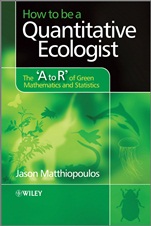
How to be a Quantitative Ecologist: The A to R of Green Mathematics and Statistics
ISBN 9780470699799
Autor: Jason Matthiopoulos
Wydawca: Wiley
Dostępność: 3-6 tygodni
Cena: 267,75 zł
Przed złożeniem zamówienia prosimy o kontakt mailowy celem potwierdzenia ceny.
ISBN13: |
9780470699799 |
ISBN10: |
0470699795 |
Autor: |
Jason Matthiopoulos |
Oprawa: |
Paperback |
Rok Wydania: |
2011-04-18 |
Ilość stron: |
490 |
Wymiary: |
247x173 |
Tematy: |
PB |
Ecological research is becoming increasingly quantitative, yet students often opt out of courses in mathematics and statistics, unwittingly limiting their ability to carry out research in the future. This textbook provides a practical introduction to quantitative ecology for students and practitioners who have realised that they need this opportunity.
The text is addressed to readers who haven′t used mathematics since school, who were perhaps more confused than enlightened by their undergraduate lectures in statistics and who have never used a computer for much more than word processing and data entry. From this starting point, it slowly but surely instils an understanding of mathematics, statistics and programming, sufficient for initiating research in ecology. The book’s practical value is enhanced by extensive use of biological examples and the computer language R for graphics, programming and data analysis.
Key Features:Provides a complete introduction to mathematics statistics and computing for ecologists.Presents a wealth of ecological examples demonstrating the applied relevance of abstract mathematical concepts, showing how a little technique can go a long way in answering interesting ecological questions.Covers elementary topics, including the rules of algebra, logarithms, geometry, calculus, descriptive statistics, probability, hypothesis testing and linear regression.Explores more advanced topics including fractals, non–linear dynamical systems, likelihood and Bayesian estimation, generalised linear, mixed and additive models, and multivariate statistics.R boxes provide step–by–step recipes for implementing the graphical and numerical techniques outlined in each section.
How to be a Quantitative Ecologist provides a comprehensive introduction to mathematics, statistics and computing and is the ideal textbook for late undergraduate and postgraduate courses in environmen
tal biology.
"With a book like this, there is no excuse for people to be afraid of maths, and to be ignorant of what it can do." Professor Tim Benton, Faculty of Biological Sciences, University of Leeds, UK
Spis treści:
0. How to start a meaningful relationship with your computer
Introduction to R
0.1 What is R?
0.2 Why use R for this book?
0.3 Computing with a scientific package like R
0.4 Installing and interacting with R
0.5 Style conventions
0.6 Valuable R accessories
0.7 Getting help
0.8 Basic R usage
0.9 Importing data from a spreadsheet
0.10 Storing data in data frames
0.11 Exporting data from R
0.12 Further reading
0.13 References
1. How to make mathematical statements
Numbers, equations and functions
1.1 Quantitative and qualitative scales
• Habitat classifications
1.2 Numbers
• Observations of spatial abundance
1.3 Symbols
• Population size and carrying capacity
1.4 Logical operations
1.5 Algebraic operations
• Size matters in garter snakes
1.6 Manipulating numbers
1.7 Manipulating units
1.8 Manipulating expressions
• Energy acquisition in voles
1.9 Polynomials
• The law of mass action in epidemiology
1.10 Equations
1.11 First order polynomial equations
• Linking population size to population composition
1.12 Proportionality and scaling
• Simple mark–recapture
• Converting density to population size
1.13 Second and higher–order polynomial equations
• Estimating the number of infected animals from the rate of infection
1.14 Systems of polynomial equations
• Deriving population structure from data on population size
1.15 Inequalities
• Minimum energetic requirements in voles
1.16 Coordinate sy
stems
• Non–cartesian map projections
1.17 Complex numbers
1.18 Relations and functions
• Food webs
• Mating systems in animals
1.19 The graph of a function
• Two aspects of vole energetics
1.20 First order polynomial functions
• Population stability in a time series
• Population stability and population change
• Visualising goodness–of–fit
1.21 Higher–order polynomial functions
1.22 The relationship between equations and functions
• Extent of an epidemic when the transmission rate exceeds a critical value
1.23 Other useful functions
• Modelling saturation
1.24 Inverse functions
1.25 Functions of more than one variables
1.26 Further reading
1.27 References
2. How to describe regular shapes and patterns
Geometry and trigonometry
2.1 Primitive elements
2.2 Axioms of Euclidean geometry
• Suicidal lemmings, parsimony, evidence and proof
2.3 Propositions
• Radio–tracking of terrestrial animals
2.4 Distance between two points
• Spatial autocorrelation in ecological variables
2.5 Areas and volumes
• Hexagonal territories
2.6 Measuring angles
• The bearing of a moving animal
2.7 The trigonometric circle
• The position of a seed following dispersal
2.8 Trigonometric functions
2.9 Polar coordinates
• Random walks
2.10 Graphs of trigonometric functions
2.11 Trigonometric identities
• A two–step random walk
2.12 Inverses of trigonometric functions
• Displacement during a random walk
2.13 Trigonometric equations
• VHF tracking for terrestrial animals
2.14 Modifying the basic trigonometric graphs
• Nocturnal flowering in dry climates
2.15 Sup
erimposing trigonometric functions
• More realistic model of nocturnal flowering in dry climates
2.16 Spectral analysis
• Dominant frequencies in Norwegian lemming populations
• Spectral analysis of oceanographic covariates
2.17 Fractal geometry
• Availability of coastal habitat • Fractal dimension of the Koch curve
2.18 Further reading
2.19 References
3. How to change things, one step at a time
Sequences, difference equations and logarithms
3.1 Sequences
• Reproductive output in social wasps
• Unrestricted population growth
3.2 Difference equations
• More realistic models of population growth
3.3 Higher–order difference equations
• Delay–difference equations in a biennial herb
3.4 Initial conditions and parameters
3.5 Solutions of a difference equation
3.6 Equilibrium solutions
• Unrestricted population growth with harvesting
• Visualising the equilibria
3.7 Stable and unstable equilibria
• Parameter sensitivity and ineffective fishing quotas
• Stable and unstable equilibria in a density–dependent population
3.8 Investigating stability
• Cobweb plot for unconstrained, harvested population
• Conditions for stability under unrestricted growth
3.9 Chaos
• Deterministic chaos in a model with density–dependence
3.10 Exponential function
• Modelling bacterial loads in continuous time
• A negative blue tit? Using exponential functions to constrain models
3.11 Logarithmic function
• Log–transforming population time series
3.12 Logarithmic equations
3.13 Further reading
3.14 References
4. How to change things, continuously
Derivatives and their applications
4.1 Av
erage rate of change
• Seasonal tree growth
4.2 Instantaneous rate of change
4.3 Limits
• Pheromone concentration around termite mounds
4.4 The derivative of a function
• Plotting change in tree biomass
• Linear tree growth
4.5 Differentiating polynomials
• Spatial gradients
4.6 Differentiating other functions
• Consumption rates of specialist predators
4.7 The chain rule
• Diurnal rate of change in the attendance of insect pollinators
4.8 Higher–order derivatives
• Spatial gradients and foraging in beaked whales
4.9 Derivatives for functions of many variables
• The slope of the sea floor
4.10 Optimisation
• Maximum rate of disease transmission
• The marginal value theorem
4.11 Local stability for difference equations
• Unconstrained population growth
• Density dependence and proportional harvesting
4.12 Series expansions
4.13 Further reading
4.14 References
5. How to work with accumulated change
Integrals and their applications
5.1 Antiderivatives
• Invasion fronts
• Diving in seals
5.2 Indefinite integrals
• Allometry
5.3 Three analytical methods of integration
• Stopping invasion fronts
5.4 Summation
• Metapopulations
5.5 Area under a curve
• Swimming speed in seals
5.6 Definite integrals
• Swimming speed in seals
5.7 Some properties of definite integrals
• Total reproductive output in social wasps
• Net change in number of birds at migratory stop–over
• Total number of arrivals and departures at migratory stop–over
5.8 Improper integrals
• Failing to stop invasion fronts
5.9 Differe
ntial equations
• A differential equation for a plant invasion front
5.10 Solving differential equations
• Exponential population growth in continuous time
• Constrained growth in continuous time
5.11 Stability analysis for differential equations
• Constrained growth in continuous time
• The Levins model for metapopulations
5.12 Further reading
5.13 References
6. How to keep stuff organised in tables
Matrices and their applications
6.1 Matrices
• Plant community composition
• Inferring diet from fatty acid analysis
6.2 Matrix operations
Movement in metapopulations
6.3 Geometric interpretation of vectors & square matrices
• Random walks as sequences of vectors
6.4 Solving systems of equations with matrices
• Plant community composition
6.5 Markov chains
• Redistribution in metapopulations
6.6 Eigenvalues and eigenvectors
• Metapopulation growth
6.7 Leslie matrix models
• Stage–structured seal populations
• Equilibrium of the linear Leslie model
• Stability in a linear Leslie model
• Stable age structure in a linear Leslie model
6.8 Analysis of linear dynamical systems
• A metapopulation in continuous time
• Phase–space for a two–patch metapopulation
• Stability analysis of a two–patch metapopulation
6.9 Analysis of non–linear dynamical systems
• The Lotka–Volterra predator–prey model • Stability analysis of the Lotka–Volterra model
6.10 Further reading
6.11 References
7. How to visualise and summarise data
Descriptive statistics
7.1 Overview of statistics
7.2 Statistical variables
• Activity budgets in honey
bees
7.3 Populations and samples
• Gannet chick production
7.4 Single variable samples
7.5 Frequency distributions
• Activity budgets
• Comparing activity budgets
• Visualising activity budgets
• The height of fern trees
• Gannets on Bass rock
7.6 Measures of centrality
• Chick rearing in red grouse
• Swimming speed in grey seals
• Median chick rearing in red grouse
7.7 Measures of spread
• Gannet foraging
7.8 Skewness and kurtosis
7.9 Graphical summaries
7.10 Data sets with more than one variable
7.11 Association between two qualitative variables
• Community recovery in abandoned fields
7.12 Association between two quantitative variables
• Height and root depth of tree ferns
7.13 Joint frequency distributions
• Mosaics of abandoned fields
• Joint distributions of tree height and root depth
• Joint and marginal distributions of tree size
7.14 Further reading
7.15 References
8. How to put a value on uncertainty
Probability
8.1 Random experiments and event spaces
• Assumptions of random experiments
8.2 Events
• Plant occurrence in survey quadrats
• Overlapping events
• Mutually exclusive events
8.3 Frequentist probability
Fluctuating frequency of newborn male wildebeest
8.4 Equally likely events
• Something is certain to occur, even if it is nothing
• Undirected movement
8.5 The union of events
• Seed germination in a gridded landscape.
• Coexisting sparrows.
8.6 Conditional probability
• Territoriality and survival in red grouse
8.7 Independent events
• The sex of successive calves
8.8
Total probability
• Seed germination in a heterogeneous environment
8.9 Bayesian probability
• Does the sex ratio at birth deviate from 1:1?
• Null and alternative hypotheses for wildebeest sex ratio
• Bayesian updating for wildebeest sex ratio
8.10 Further reading
8.11 References
9. How to identify different kinds of randomness
Probability distributions
9.1 Probability distributions
• Probability distribution of nominal variables
9.2 Discrete probability distributions
• Beetle eggs per cluster: A count
• PMF for egg cluster size
• CDF for egg cluster size
9.3 Continuous probability distributions
• Are all exact measurements of height impossible?
• CDF for tree fern heights
• PDF for tree fern height
9.4 Expectation
• Mean egg cluster size
• Expected tree fern heights
9.5 Named distributions
9.6 Equally likely events: The uniform distribution
• River otter home ranges
9.7 Hit or miss: The Bernoulli distribution
• Bernoulli births
9.8 Count of occurrences in a given number of trials: The binomial distribution
• Wildebeest reproductive histories
• Wildebeest reproductive output
9.9 Counting different types of occurrences: The multinomial distribution
• Metapopulation transitions
9.10 Number of occurrences in a unit of time or space: The Poisson distribution
• Data on plant abundance
9.11 The gentle art of waiting: geometric, negative binomial, exponential and gamma distributions
• Catastrophic events and species extinctions
9.12 Assigning probabilities to probabilities: The beta and Dirichlet distributions
9.13 Perfect symmetry: The normal distribution
• Weight distribution
Koszyk
Książek w koszyku: 0 szt.
Wartość zakupów: 0,00 zł
Informacje


Kontakt
Gambit
Centrum Oprogramowania
i Szkoleń Sp. z o.o.
Al. Pokoju 29b/22-24
31-564 Kraków
Siedziba Księgarni
ul. Kordylewskiego 1
31-542 Kraków
+48 12 410 5991
+48 12 410 5987
+48 12 410 5989
Subskrypcje
Administratorem danych osobowych jest firma Gambit COiS Sp. z o.o. Na podany adres będzie wysyłany wyłącznie biuletyn informacyjny.
Autoryzacja płatności

Informacje na temat autoryzacji płatności poprzez PayU.

© Copyright 2012: GAMBIT COiS Sp. z o.o. Wszelkie prawa zastrzeżone.
Projekt i wykonanie: Alchemia Studio Reklamy