


Wydawcy
Katalog tematyczny
- Archeologia (109)
- Ekonomia, finanse, business (13704)
- Filozofia (1445)
- Historia (3040)
- Języki i językoznawstwo (2356)
- Lifestyle, hobby i rozrywka (475)
- Medycyna (9704)
- Nauki humanistyczne (4)
- Nauki o Ziemi i środowisku (2638)
- Nauki ścisłe (20412)
- Astronomia (294)
- Biologia (5119)
- Chemia (6540)
- Fizyka (3309)
- Matematyka (4574)
- Algebra (171)
- Analiza matematyczna (902)
- Filozofia matematyki (1)
- Geometria (237)
- Historia matematyki (57)
- Kombinatoryka, teoria grafów (67)
- Matematyka dyskretna (35)
- Matematyka stosowana (555)
- Optymalizacja (104)
- Podstawy matematyki (129)
- Statystyka, prawdopodobieństwo (296)
- Teoria grup (63)
- Teoria liczb (77)
- Topologia (66)
- Nauki ścisłe, ogólnie (503)
- Nauki społeczne (8486)
- Nauki techniczne (13450)
- Prawo (1696)
- Publikacje informacyjne i interdyscyplinarne (1288)
- Religia i wierzenia (917)
- Technika komputerowa (4067)
- Zdrowie, relacje międzyludzkie i rozwój osobisty (657)





Informacje szczegółowe o książce
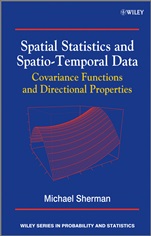
Spatial Statistics and Spatio–Temporal Data: Covariance Functions and Directional Properties
ISBN 9780470699584
Autor: Michael Sherman
Wydawca: Wiley
Dostępność: 3-6 tygodni
Cena: 457,80 zł
Przed złożeniem zamówienia prosimy o kontakt mailowy celem potwierdzenia ceny.
ISBN13: |
9780470699584 |
ISBN10: |
0470699582 |
Autor: |
Michael Sherman |
Oprawa: |
Hardback |
Rok Wydania: |
2010-11-23 |
Ilość stron: |
294 |
Wymiary: |
202x157 |
Tematy: |
PB |
In the spatial or spatio–temporal context, specifying the correct covariance function is fundamental to obtain efficient predictions, and to understand the underlying physical process of interest. This book focuses on covariance and variogram functions, their role in prediction, and appropriate choice of these functions in applications. Both recent and more established methods are illustrated to assess many common assumptions on these functions, such as, isotropy, separability, symmetry, and intrinsic correlation.
After an extensive introduction to spatial methodology, the book details the effects of common covariance assumptions and addresses methods to assess the appropriateness of such assumptions for various data structures.
Key features:An extensive introduction to spatial methodology including a survey of spatial covariance functions and their use in spatial prediction (kriging) is given.Explores methodology for assessing the appropriateness of assumptions on covariance functions in the spatial, spatio–temporal, multivariate spatial, and point pattern settings.Provides illustrations of all methods based on data and simulation experiments to demonstrate all methodology and guide to proper usage of all methods.Presents a brief survey of spatial and spatio–temporal models, highlighting the Gaussian case and the binary data setting, along with the different methodologies for estimation and model fitting for these two data structures.Discusses models that allow for anisotropic and nonseparable behaviour in covariance functions in the spatial, spatio–temporal and multivariate settings.Gives an introduction to point pattern models, including testing for randomness, and fitting regular and clustered point patterns. The importance and assessment of isotropy of point patterns is detailed.
Statisticians, researchers, and data analysts working with spatial and space–time data will benefit from
this book as well as will graduate students with a background in basic statistics following courses in engineering, quantitative ecology or atmospheric science.
Spis treści:
Preface.
1 Introduction.
1.1 Stationarity.
1.2 The Effect of Correlation in Estimation and Prediction.
1.3 Texas Tidal Data.
2 Geostatistics.
2.1 A Model for Optimal Prediction and Error Assessment.
2.2 Optimal Prediction (Kriging).
2.3 Prediction Intervals.
2.4 Universal Kriging.
2.5 The Intuition Behind Kriging.
3 Variogram and Covariance Models and Estimation.
3.1 Empirical Estimation of the Variogram or Covariance Function.
3.2 On the Necessity of Parametric Variogram and Covariance Models.
3.3 Covariance and Variogram Models.
3.4 Convolution Methods and Extensions.
3.5 Parameter Estimation for Variogram and Covariance Models.
3.6 Prediction for the Phosphorus Data.
3.7 Nonstationary Covariance Models.
4 Spatial Models and Statistical Inference.
4.1 Estimation in the Gaussian Case.
4.2 Estimation for Binary Spatial Observations.
5 Isotropy.
5.1 Geometric anisotropy.
5.2 Other Types of Anisotropy.
5.3 Covariance Modelling under Anisotropy.
5.4 Detection of Anisotropy: The Rose Plot.
5.5 Parametric Methods to Assess Isotropy.
5.6 Nonparametric Methods of Assessing Anisotropy.
5.7 Assessment of Isotropy for General Sampling Designs.
5.8 An Assessment of Isotropy for the Longleaf Pine Sizes.
6 Space Time Data.
6.1 Space–Time Observations.
6.2 Spatio–Temporal Stationarity and Spatio–Temporal Prediction.
6.3 Empirical Estimation of the Variogram, Covariance Models, and Estimation.
6.4 Spatio–Temporal Covariance Models.
6.5 Space–Time Models.
6.6 Parametric Methods of Assessing Full Symmetry and Space–Time Separability.
6.7 Nonparametric Methods of Assessing Full Symmetry and Spa
ce–Time Separability.
6.8 Nonstationary Space Time Covariance Models.
7 Spatial Point Patterns.
7.1 The Poisson Process and Spatial Randomness.
7.2 Inhibition Models.
7.3 Clustered Models.
8 Isotropy for Spatial Point Patterns.
8.1 Some Large Sample Results.
8.2 A Test for Isotropy.
8.3 Practical Issues.
8.4 Numerical Results.
8.5 An Application to Leukemia Data.
9 Multivariate Spatial and Spatio–temporal Models.
9.1 CoKriging.
9.2 An Alternative to CoKriging.
9.3 Multivariate Covariance Functions.
9.4 Testing and Assessing Intrinsic Correlation.
9.5 Numerical Experiments.
9.6 A Data Application to Pollutants.
9.7 Discussion.
10 Resampling for Correlated Observations.
10.1 Independent Observations.
10.2 Other Data Structures.
10.3 Model Based Bootstrap.
10.4 Model Free Resampling Methods.
10.5 Spatial Resampling.
10.6 Model Free Spatial Resampling.
10.7 Unequally Spaced Observations.
Bibliography.
Index.
Okładka tylna:
In the spatial or spatio–temporal context, specifying the correct covariance function is fundamental to obtain efficient predictions, and to understand the underlying physical process of interest. This book focuses on covariance and variogram functions, their role in prediction, and appropriate choice of these functions in applications. Both recent and more established methods are illustrated to assess many common assumptions on these functions, such as, isotropy, separability, symmetry, and intrinsic correlation.
After an extensive introduction to spatial methodology, the book details the effects of common covariance assumptions and addresses methods to assess the appropriateness of such assumptions for various data structures.
Key features:An extensive introduction to spatial methodology including a survey of spatial covariance functions and their use in spatial
prediction (kriging) is given.Explores methodology for assessing the appropriateness of assumptions on covariance functions in the spatial, spatio–temporal, multivariate spatial, and point pattern settings.Provides illustrations of all methods based on data and simulation experiments to demonstrate all methodology and guide to proper usage of all methods.Presents a brief survey of spatial and spatio–temporal models, highlighting the Gaussian case and the binary data setting, along with the different methodologies for estimation and model fitting for these two data structures.Discusses models that allow for anisotropic and nonseparable behaviour in covariance functions in the spatial, spatio–temporal and multivariate settings.Gives an introduction to point pattern models, including testing for randomness, and fitting regular and clustered point patterns. The importance and assessment of isotropy of point patterns is detailed.
Statisticians, researchers, and data analysts working with spatial and space–time data will benefit from this book as well as will graduate students with a background in basic statistics following courses in engineering, quantitative ecology or atmospheric science.
Koszyk
Książek w koszyku: 0 szt.
Wartość zakupów: 0,00 zł
Informacje


Kontakt
Gambit
Centrum Oprogramowania
i Szkoleń Sp. z o.o.
Al. Pokoju 29b/22-24
31-564 Kraków
Siedziba Księgarni
ul. Kordylewskiego 1
31-542 Kraków
+48 12 410 5991
+48 12 410 5987
+48 12 410 5989
Subskrypcje
Administratorem danych osobowych jest firma Gambit COiS Sp. z o.o. Na podany adres będzie wysyłany wyłącznie biuletyn informacyjny.
Autoryzacja płatności

Informacje na temat autoryzacji płatności poprzez PayU.

© Copyright 2012: GAMBIT COiS Sp. z o.o. Wszelkie prawa zastrzeżone.
Projekt i wykonanie: Alchemia Studio Reklamy