


Wydawcy
Katalog tematyczny
- Archeologia (109)
- Ekonomia, finanse, business (13704)
- Filozofia (1445)
- Historia (3040)
- Języki i językoznawstwo (2356)
- Lifestyle, hobby i rozrywka (475)
- Medycyna (9704)
- Nauki humanistyczne (4)
- Nauki o Ziemi i środowisku (2638)
- Nauki ścisłe (20412)
- Astronomia (294)
- Biologia (5119)
- Chemia (6540)
- Fizyka (3309)
- Matematyka (4574)
- Algebra (171)
- Analiza matematyczna (902)
- Filozofia matematyki (1)
- Geometria (237)
- Historia matematyki (57)
- Kombinatoryka, teoria grafów (67)
- Matematyka dyskretna (35)
- Matematyka stosowana (555)
- Optymalizacja (104)
- Podstawy matematyki (129)
- Statystyka, prawdopodobieństwo (296)
- Teoria grup (63)
- Teoria liczb (77)
- Topologia (66)
- Nauki ścisłe, ogólnie (503)
- Nauki społeczne (8486)
- Nauki techniczne (13450)
- Prawo (1696)
- Publikacje informacyjne i interdyscyplinarne (1288)
- Religia i wierzenia (917)
- Technika komputerowa (4067)
- Zdrowie, relacje międzyludzkie i rozwój osobisty (657)





Informacje szczegółowe o książce
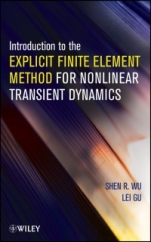
Introduction to the Explicit Finite Element Method for Nonlinear Transient Dynamics
ISBN 9780470572375
Autor: Shen R. Wu, Lei Gu
Wydawca: Wiley
Dostępność: 3-6 tygodni
Cena: 636,30 zł
Przed złożeniem zamówienia prosimy o kontakt mailowy celem potwierdzenia ceny.
ISBN13: |
9780470572375 |
ISBN10: |
047057237X |
Autor: |
Shen R. Wu, Lei Gu |
Oprawa: |
Hardback |
Rok Wydania: |
2012-10-12 |
Ilość stron: |
352 |
Wymiary: |
243x156 |
Tematy: |
PB |
A systematic introduction to the theories and formulations of the explicit finite element method As numerical technology continues to grow and evolve with industrial applications, understanding the explicit finite element method has become increasingly important, particularly in the areas of crashworthiness, metal forming, and impact engineering. Introduction to the Explicit Finite Element Method for Nonlinear Transient Dynamics is the first book to address specifically what is now accepted as the most successful numerical tool for nonlinear transient dynamics. The book aids readers in mastering the explicit finite element method and programming code without requiring extensive background knowledge of the general finite element. The authors present topics relating to the variational principle, numerical procedure, mechanical formulation, and fundamental achievements of the convergence theory. In addition, key topics and techniques are provided in four clearly organized sections: • Fundamentals explores a framework of the explicit finite element method for nonlinear transient dynamics and highlights achievements related to the convergence theory • Element Technology discusses four–node, three–node, eight–node, and two–node element theories • Material Models outlines models of plasticity and other nonlinear materials as well as the mechanics model of ductile damage • Contact and Constraint Conditions covers subjects related to three–dimensional surface contact, with examples solved analytically, as well as discussions on kinematic constraint conditions Throughout the book, vivid figures illustrate the ideas and key features of the explicit finite element method. Examples clearly present results, featuring both theoretical assessments and industrial applications. Introduction to the Explicit Finite Element Method for Nonlinear Transient Dynamics is an ideal book for both engineers who require more theoretical discussions and for theoreticians searching for interesting and challenging research topics. The book also serves as an excellent resource for courses on applied mathematics, applied mechanics, and numerical methods at the graduate level.
PART 1 Fundamentals1 Introduction 1.1 Era of Simulation and Computer Aided Engineering 1.2 Preliminaries 2 Framework of Explicit Finite Element Method for Nonlinear Transient Dynamics 2.1 Transient Structural Dynamics 2.2 Variational Principles for Transient Dynamics 2.3 Finite Element Equations and the Explicit Procedures 2.4 Main Features of the Explicit Finite Element Method 2.5 Assessment of Explicit Finite Element Method PART 2 Element Technology 3 Four–Node Shell Element (Reissner–Mindlin Plate Theory) 3.1 Fundamentals of Plates and Shells 3.2 Linear Theory of R–M Plate 3.3 Interpolation for Four–Node R–M Plate Element 3.4 Reduced Integration and Selective Reduced Integration 3.5 Perturbation Hourglass Control – Belytschko–Tsay (B–T) Element 3.6 Physical Hourglass Control – Belytschko–Leviathan (B–L) (QPH) Element 3.7 Shear Projection Method – Bathe–Dvorkin (B–D) Element 3.8 Assessment of Four–Node R–M Plate Element 4 Three–Node Shell Element (Reissner–Mindlin Plate Theory) 4.1 Fundamentals of a Three–Node C0 Element 4.2 Decomposition Method for C0 Triangular Element with One Point Integration 4.3 Discrete Kirchhoff Triangular (DKT) Element 4.4 Assessment of Three–Node R–M Plate Element 5 Eight–Node Solid Element 5.1 Trilinear Interpolation for the Eight–Node Hexahedron Element 5.2 Locking Issues of the Eight–Node Solid Element 5.3 One– Point Reduced Integration and the Perturbed Hourglass Control 5.4 Assumed Strain Method and Selective / Reduced Integration 5.5 Assumed Deviatoric Strain 5.6 An Enhanced Assumed Strain Method 5.7 Taylor Expansion of Assumed Strain about the Element Center 5.8 Evaluation of Eight–Node Solid Element 6 Two–Node Element 6.1 Truss and Rod Element 6.2 Timoshenko Beam Element 6.3 Spring Element 6.4 Spot Weld Element PART 3 Material Models 7 Material Model of Plasticity 7.1 Fundamentals of Plasticity 7.2 Constitutive Equations 7.3 Software Implementation 7.4 Evaluation of Shell Elements with Plastic Deformation 8 Continuum Mechanics Model of Ductile Damage 8.1 Concept of Damage Mechanics 8.2 Gurson’s Model 8.3 Chow′s Isotropic Model of Continuum Damage Mechanics 8.4 Chow′s Anisotropic Model of Continuum Damage Mechanics 9 Models of Nonlinear Materials 9.1 Vicoelasticity 9.2 Polymer and Engineering Plastics 9.3 Rubber 9.4 Foam 9.5 Honeycomb 9.6 Laminated Glazing PART 4 Contact and Constraint Conditions 10 Three–Dimensional Surface Contact 10.1 Examples of Contact Problems 10.2 Description of Contact Conditions 10.3 Variational Principle for the Dynamic Contact Problem 10.4 Penalty Method and the Regularization of Variational Inequality 11 Numerical Procedures for Three–Dimensional Surface Contact 11.1 A Contact Algorithm with Slave Node Searching Master Segment 11.2 A Contact Algorithm with Master Segment Searching Slave Node 11.3 Method of Contact Territory and Defense Node 11.4 Pin– Ball Contact Algorithm 11.5 Edge (Line Segment) Contact 11.6 Evaluation of Contact Algorithm with Penalty Method 12 Kinematic Constraint Conditions 12.1 Rigid Wall 12.2 Rigid Body 12.3 Explicit Finite Element Procedure with Constraint Conditions 12.4 Application Examples with Constraint Conditions
Koszyk
Książek w koszyku: 0 szt.
Wartość zakupów: 0,00 zł
Informacje


Kontakt
Gambit
Centrum Oprogramowania
i Szkoleń Sp. z o.o.
Al. Pokoju 29b/22-24
31-564 Kraków
Siedziba Księgarni
ul. Kordylewskiego 1
31-542 Kraków
+48 12 410 5991
+48 12 410 5987
+48 12 410 5989
Subskrypcje
Administratorem danych osobowych jest firma Gambit COiS Sp. z o.o. Na podany adres będzie wysyłany wyłącznie biuletyn informacyjny.
Autoryzacja płatności

Informacje na temat autoryzacji płatności poprzez PayU.

© Copyright 2012: GAMBIT COiS Sp. z o.o. Wszelkie prawa zastrzeżone.
Projekt i wykonanie: Alchemia Studio Reklamy