


Wydawcy
Katalog tematyczny
- Archeologia (109)
- Ekonomia, finanse, business (13704)
- Filozofia (1445)
- Historia (3040)
- Języki i językoznawstwo (2356)
- Lifestyle, hobby i rozrywka (475)
- Medycyna (9704)
- Nauki humanistyczne (4)
- Nauki o Ziemi i środowisku (2638)
- Nauki ścisłe (20412)
- Astronomia (294)
- Biologia (5119)
- Chemia (6540)
- Fizyka (3309)
- Matematyka (4574)
- Algebra (171)
- Analiza matematyczna (902)
- Filozofia matematyki (1)
- Geometria (237)
- Historia matematyki (57)
- Kombinatoryka, teoria grafów (67)
- Matematyka dyskretna (35)
- Matematyka stosowana (555)
- Optymalizacja (104)
- Podstawy matematyki (129)
- Statystyka, prawdopodobieństwo (296)
- Teoria grup (63)
- Teoria liczb (77)
- Topologia (66)
- Nauki ścisłe, ogólnie (503)
- Nauki społeczne (8486)
- Nauki techniczne (13450)
- Prawo (1696)
- Publikacje informacyjne i interdyscyplinarne (1288)
- Religia i wierzenia (917)
- Technika komputerowa (4067)
- Zdrowie, relacje międzyludzkie i rozwój osobisty (657)





Informacje szczegółowe o książce
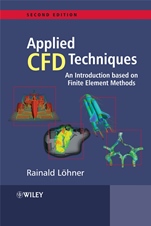
Applied Computational Fluid Dynamics Techniques: An Introduction Based on Finite Element Methods
ISBN 9780470519073
Autor: Rainald Löhner
Wydawca: Wiley
Dostępność: 3-6 tygodni
Cena: 614,25 zł
Przed złożeniem zamówienia prosimy o kontakt mailowy celem potwierdzenia ceny.
ISBN13: |
9780470519073 |
ISBN10: |
047051907X |
Autor: |
Rainald Löhner |
Oprawa: |
Hardback |
Rok Wydania: |
2008-03-14 |
Numer Wydania: |
2nd Edition |
Ilość stron: |
538 |
Wymiary: |
262x173 |
Tematy: |
PB |
Computational fluid dynamics (CFD) is concerned with the efficient numerical solution of the partial differential equations that describe fluid dynamics. CFD techniques are commonly used in the many areas of engineering where fluid behavior is an important factor. Traditional fields of application include aerospace and automotive design, and more recently, bioengineering and consumer and medical electronics. With Applied Computational Fluid Dynamics Techniques, 2nd edition, Rainald Löhner introduces the reader to the techniques required to achieve efficient CFD solvers, forming a bridge between basic theoretical and algorithmic aspects of the finite element method and its use in an industrial context where methods have to be both as simple but also as robust as possible.
This heavily revised second edition takes a practice–oriented approach with a strong emphasis on efficiency, and offers important new and updated material on;
Overlapping and embedded grid methods
Treatment of free surfaces
Grid generation
Optimal use of supercomputing hardware
Optimal shape and process design
Applied Computational Fluid Dynamics Techniques, 2nd edition is a vital resource for engineers, researchers and designers working on CFD, aero and hydrodynamics simulations and bioengineering. Its unique practical approach will also appeal to graduate students of fluid mechanics and aero and hydrodynamics as well as biofluidics.
Spis treści:
FOREWORD TO THE SECOND EDITION.
ACKNOWLEDGEMENTS.
1 INTRODUCTION AND GENERAL CONSIDERATIONS.
1.1 The CFD code.
1.2 Porting research codes to an industrial context.
1.3 Scope of the book.
2 DATA STRUCTURES AND ALGORITHMS.
2.1 Representation of a grid.
2.2 Derived data structures for static data.
2.3 Derived data structures for dynamic data.
2.4 Sorting and searching.
2.5 Proximity ins pace.
2.6 Nearest–neighbou
rs and graphs.
2.7 Distance to surface.
3 GRID GENERATION.
3.1 Description of the domain to be gridded.
3.2 Variation of element size and shape.
3.3 Element type.
3.4 Automatic grid generation methods.
3.5 Other grid generation methods.
3.6 The advancing front technique.
3.7 Delaunay triangulation.
3.8 Grid improvement.
3.9 Optimal space–filling tetrahedra.
3.10 Grids with uniform cores.
3.11 Volume–to–surface meshing.
3.12 Navier–Stokes gridding techniques.
3.13 Filling space with points/arbitrary objects.
3.14 Applications.
4 APPROXIMATION THEORY.
4.1 The basic problem.
4.2 Choice of trial functions.
4.3 General properties of shape functions.
4.4 Weighted residual methods with local functions.
4.5 Accuracy and effort.
4.6 Grid estimates.
5 APPROXIMATION OF OPERATORS.
5.1 Taxonomy of methods.
5.2 The Poisson operator.
5.3 Recovery of derivatives.
6 DISCRETIZATION IN TIME.
6.1 Explicit schemes.
6.2 Implicit schemes.
6.3 Awordof caution.
7 SOLUTION OF LARGE SYSTEMS OF EQUATIONS.
7.1 Direct solvers.
7.2 Iterative solvers.
7.3 Multigrid methods.
8 SIMPLE EULER/NAVIER–STOKES SOLVERS.
8.1 Galerkin approximation.
8.2 Lax–Wendroff (Taylor–Galerkin).
8.3 Solving for the consistent mass matrix.
8.4 Artificial viscosities.
8.5 Boundary conditions.
8.6 Viscous fluxes.
9 FLUX–CORRECTED TRANSPORT SCHEMES.
9.1 The FCT Concept.
9.2 Algorithmic implementation.
9.3 Steepening.
9.4 FCT for Taylor–Galerkin schemes.
9.5 Iterative limiting.
9.6 Limiting for systems of equations.
9.7 Examples.
9.8 Summary.
10 EDGE–BASED COMPRESSIBLE FLOWSOLVERS.
10.1 The Laplacian operator.
10.2 First derivatives: first form.
10.3 First derivatives: second form.
10.4 Edge–based schemes for advection–dominated PDE
s.
11 INCOMPRESSIBLE FLOWSOLVERS.
11.1 The advection operator.
11.2 The divergence operator.
11.3 Artificial compressibility.
11.4 Temporal discretization:projection schemes.
11.5 Temporal discretization: implicit schemes.
11.6 Temporal discretization of higher order.
11.7 Acceleration to the steady state.
11.8 Projective prediction of pressure increments.
11.9 Examples.
12 MESH MOVEMENT.
12.1 The ALE frame of reference.
12.2 Geometric conservation law.
12.3 Mesh movement algorithms.
12.4 Region of moving elements.
12.5 PDE–based distance functions.
12.6 Penalization of deformed elements.
12.7 Special movement techniques for RANS grids.
12.8 Rotating parts/domains.
12.9 Applications.
13 INTERPOLATION.
13.1 Basic interpolation algorithm.
13.2 Fastest 1–timealgorithm:brute force.
13.3 Fastest N–time algorithm: octree search.
13.4 Fastest known vicinity algorithm: neighbour–to–neighbour.
13.5 Fastest grid–to–grid algorithm: advancing–front vicinity.
13.6 Conservative interpolation.
13.7 Surface–grid–to–surface–grid interpolation.
13.8 Particle–grid interpolation.
14 ADAPTIVE MESH REFINEMENT.
14.1 Optimal–mesh criteria.
14.2 Error indicators/estimators.
14.3 Refinement strategies.
14.4 Tutorial: h–refinement with tetrahedra.
14.5 Examples.
15 EFFICIENT USE OF COMPUTER HARDWARE.
15.1 Reduction of cache–misses.
15.2 Vector machines.
15.3 Parallel machines: general considerations.
15.4 Shared–memory parallel machines.
15.5 SIMD machines.
15.6 MIMD machines.
15.7 The effect of Moore’s law on parallel computing.
16 SPACE–MARCHING AND DEACTIVATION.
16.1 Space–marching.
16.2 Deactivation.
17 OVERLAPPING GRIDS.
17.1 Interpolation criteria.
17.2 External bounda
ries and domains.
17.3 Interpolation: initialization.
17.4 Treatment of domains that are partially outside.
17.5 Removal of inactive regions.
17.6 Incremental interpolation.
17.7 Changes to the flow solver.
17.8 Examples.
18 EMBEDDED AND IMMERSED GRID TECHNIQUES.
18.1 Kinetic treatment of embedded or immersed objects.
18.2 Kinematic treatment of embedded surfaces.
18.3 Deactivation of interior regions.
18.4 Extrapolation of the solution.
18.5 Adaptive mesh refinement.
18.6 Load/flux transfer.
18.7 Treatment of gaps or cracks.
18.8 Direct link to particles.
18.9 Examples.
19 TREATMENT OF FREE SURFACES.
19.1 Interface fitting methods.
19.2 Interface capturing methods.
20 OPTIMAL SHAPE AND PROCESS DESIGN.
20.1 The general optimization problem.
20.2 Optimization techniques.
20.3 Adjoint solvers.
20.4 Geometric constraints.
20.5 Approximate gradients.
20.6 Multipoint optimization.
20.7 Representation of surface changes.
20.8 Hierarchical design procedures.
20.9 Topological optimization via porosities.
20.10 Examples.
References.
Index.
Okładka tylna:
Computational fluid dynamics (CFD) is concerned with the efficient numerical solution of the partial differential equations that describe fluid dynamics. CFD techniques are commonly used in the many areas of engineering where fluid behavior is an important factor. Traditional fields of application include aerospace and automotive design, and more recently, bioengineering and consumer and medical electronics. With Applied Computational Fluid Dynamics Techniques, 2nd edition, Rainald Löhner introduces the reader to the techniques required to achieve efficient CFD solvers, forming a bridge between basic theoretical and algorithmic aspects of the finite element method and its use in an industrial context where methods have to be both as simple but also as robust as p
Koszyk
Książek w koszyku: 0 szt.
Wartość zakupów: 0,00 zł
Informacje


Kontakt
Gambit
Centrum Oprogramowania
i Szkoleń Sp. z o.o.
Al. Pokoju 29b/22-24
31-564 Kraków
Siedziba Księgarni
ul. Kordylewskiego 1
31-542 Kraków
+48 12 410 5991
+48 12 410 5987
+48 12 410 5989
Subskrypcje
Administratorem danych osobowych jest firma Gambit COiS Sp. z o.o. Na podany adres będzie wysyłany wyłącznie biuletyn informacyjny.
Autoryzacja płatności

Informacje na temat autoryzacji płatności poprzez PayU.

© Copyright 2012: GAMBIT COiS Sp. z o.o. Wszelkie prawa zastrzeżone.
Projekt i wykonanie: Alchemia Studio Reklamy