


Wydawcy
Katalog tematyczny
- Archeologia (109)
- Ekonomia, finanse, business (13704)
- Filozofia (1445)
- Historia (3040)
- Języki i językoznawstwo (2356)
- Lifestyle, hobby i rozrywka (475)
- Medycyna (9704)
- Nauki humanistyczne (4)
- Nauki o Ziemi i środowisku (2638)
- Nauki ścisłe (20412)
- Astronomia (294)
- Biologia (5119)
- Chemia (6540)
- Fizyka (3309)
- Matematyka (4574)
- Algebra (171)
- Analiza matematyczna (902)
- Filozofia matematyki (1)
- Geometria (237)
- Historia matematyki (57)
- Kombinatoryka, teoria grafów (67)
- Matematyka dyskretna (35)
- Matematyka stosowana (555)
- Optymalizacja (104)
- Podstawy matematyki (129)
- Statystyka, prawdopodobieństwo (296)
- Teoria grup (63)
- Teoria liczb (77)
- Topologia (66)
- Nauki ścisłe, ogólnie (503)
- Nauki społeczne (8486)
- Nauki techniczne (13450)
- Prawo (1696)
- Publikacje informacyjne i interdyscyplinarne (1288)
- Religia i wierzenia (917)
- Technika komputerowa (4067)
- Zdrowie, relacje międzyludzkie i rozwój osobisty (657)





Informacje szczegółowe o książce
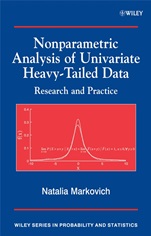
Nonparametric Analysis of Univariate Heavy–Tailed Data: Research and Practice
ISBN 9780470510872
Autor: Natalia Markovich
Wydawca: Wiley
Dostępność: 3-6 tygodni
Cena: 575,40 zł
Przed złożeniem zamówienia prosimy o kontakt mailowy celem potwierdzenia ceny.
ISBN13: |
9780470510872 |
ISBN10: |
0470510870 |
Autor: |
Natalia Markovich |
Oprawa: |
Hardback |
Rok Wydania: |
2007-10-26 |
Ilość stron: |
336 |
Wymiary: |
235x156 |
Tematy: |
PB |
Nonparametric Analysis of Univariate Heavy–Tailed Data: Research and Practice by Natalia Markovich â Institute of Control Sciences, Russian Academy of Sciences, Moscow, Russia
Heavy–tailed distributions are typical for phenomena in complex multi–component systems. They possess a number of specific features including the slower than exponential decay to zero of the tail, the violation of Cramerâs condition, a possible non–existence of some moments, and sparse observations in the tail of the distribution. Consequently the analysis of such distributions requires unique statistical methods.Nonparametric Analysis of Univariate Heavy–Tailed Data introduces these statistical techniques. It provides a survey of classical results and explores recent developments in the theory of nonparametric estimation of the heavy–tailed probability density function and its application to classification when objects belong to populations distributed with heavy tails, the tail index, high quantiles, the hazard rate, and the renewal function.
The book:
Presents non–asymptotical methods of heavy–tailed data analysis.
Demonstrates preliminary data analysis and how to detect heavy tails and dependence.
Presents the unique data transformations to estimate heavy–tailed probability density function at infinity better.
Discusses a regularization theory of the solution of inverse ill–posed stochastic operator equations, and its application to the estimation of the probability density function, the hazard rate and the identification of Markov models.
Provides and examines smoothing methods of the nonparametric estimates as the key point for accurate approximation.
Features numerous exercises and examples of real–life applications in teletraffic theory, population analysis and finance.
Nonparametric Analysis of Univariate Heavy–Tailed Data as
sumes only an introductory knowledge of probability theory, statistical methods and functional analysis. It is ideally suited for statisticians, researchers and PhD students in statistics and probability theory. There is also much to benefit those working and studying in a wide range of disciplines from computer science, telecommunications and performance evaluation, to demography and population analysis.
Spis treści:
Preface.
1. Definitions and rough detection of tail heaviness.
1.1 Definitions and basic properties of classes of heavy–tailed Distributions.
1.2 Tail index estimation.
1.2.1 Estimators of a positive–valued tail index.
1.2.2 The choice of k in Hill′s estimator.
1.2.3 Estimators of a real–valued tail index.
1.2.4 On–line estimation of the tail index.
1.3 Detection of tail heaviness and dependence.
1.3.1 Rough tests of tail heaviness.
1.3.2 Analysis of Web traffic and TCP flow data.
1.3.3 Dependence detection from univariate data.
1.3.4 Dependence detection from bivariate data.
1.3.5 Bivariate analysis of TCP flow data.
1.4 Notes and comments.
1.5 Exercises.
2. Classical methods of probability density estimation.
2.1 Principles of density estimation.
2.2 Methods of density estimation.
2.2.1 Kernel estimators.
2.2.2 Projection estimators.
2.2.3 Spline estimators.
2.2.4 Smoothing methods.
2.2.5 Illustrative examples.
2.3 Kernel estimation from dependent data.
2.3.1 Statement of the problem.
2.3.2 Numerical calculation of the bandwidth.
2.3.3 Data–driven selection of the bandwidth.
2.4 Applications.
2.4.1 Finance: evaluation of market risk.
2.4.2 Telecommunications.
2.4.3 Population analysis.
2.5 Exercises.
3. Heavy–tailed density estimation.
3.1 Problems of the estimation of heavy–tailed densities.
3.2 Combined parametric–nonparametric method.
3.2.1
Nonparametric estimation of the density by structural risk minimization.
3.2.2 Illustrative examples.
3.2.3 Web data analysis by a combined parametric–nonparametric method.
3.3 Barronâs estimator and Ï2–optimality.
3.4 Kernel estimators with variable bandwidth.
3.5 Retransformed nonparametric estimators.
3.6 Exercises.
4. Transformations and heavy–tailed density estimation.
4.1 Problems of data transformations.
4.2 Estimates based on a fixed transformation.
4.3 Estimates based on an adaptive transformation.
4.3.1 Estimation algorithm.
4.3.2 Analysis of the algorithm.
4.3.3 Further remarks.
4.4 Estimating the accuracy of retransformed estimates.
4.5 Boundary kernels.
4.6 Accuracy of a nonvariable bandwidth kernel estimator.
4.7 The D method for a nonvariable bandwidth kernel estimator.
4.8 The D method for a variable bandwidth kernel estimator.
4.8.1 Method and results.
4.8.2 Application to Web traffic characteristics.
4.9 The Ï2 method for the projection estimator.
4.10 Exercises.
5. Classification and retransformed density estimates.
5.1 Classification and quality of density estimation.
5.2 Convergence of the estimated probability of misclassification.
5.3 Simulation study.
5.4 Application of the classification technique to Web data analysis.
5.4.1 Intelligent browser.
5.4.2 Web data analysis by traffic classification.
5.4.3 Web prefetching.
5.5 Exercises.
6. Estimation of high quantiles.
6.1 Introduction.
6.2 Estimators of high quantiles.
6.3 Distribution of high quantile estimates.
6.4 Simulation study.
6.4.1 Comparison of high quantile estimates in terms of relative bias and mean squared error.
6.4.2 Comparison of high quantile estimates in terms of confidence intervals.
6.5 Application to Web traffic data.
6.6 Exercises.
7. Nonparametric estimation of th
e hazard rate function.
7.1 Definition of the hazard rate function.
7.2 Statistical regularization method.
7.3 Numerical solution of ill–posed problems.
7.4 Estimation of the hazard rate function of heavy–tailed distributions.
7.5 Hazard rate estimation for compactly supported distributions.
7.5.1 Estimation of the hazard rate from the simplest equations.
7.5.2 Estimation of the hazard rate from a special kernel equation.
7.6 Estimation of the ratio of hazard rates.
7.6.1 Failure time detection.
7.6.2 Hormesis detection.
7.7 Hazard rate estimation in teletraffic theory.
7.7.1 Teletraffic processes at the packet level.
7.7.2 Estimation of the intensity of a nonhomogeneous Poisson process.
7.8 Semi–Markov modeling in teletraffic engineering.
7.8.1 The Gilbert–Elliott model.
7.8.2 Estimation of a retrial process.
7.9 Exercises.
8. Nonparametric estimation of the renewal function.
8.1 Traffic modeling by recurrent marked point processes.
8.2 Introduction to renewal function estimation.
8.3 Histogram–type estimator of the renewal function.
8.4 Convergence of the histogram–type estimator.
8.5 Selection of k by a bootstrap method.
8.6 Selection of k by a plot.
8.7 Simulation study.
8.8 Application to the inter–arrival times of TCP connections.
8.9 Conclusions and discussion.
8.10 Exercises.
Appendices.
A Proofs of Chapter 2.
B Proofs of Chapter 4.
C Proofs of Chapter 5.
D Proofs of Chapter 6.
E Proofs of Chapter 7.
F Proofs of Chapter 8.
List of Main Symbols and Abbreviations.
References.
Index.
Nota biograficzna:
Natalia Markovich – Institute of Control Sciences, Russian Academy of Sciences, Moscow
Having been the Leading Scientist at the Institute of Control Sciences for the last eleven years, Dr Markovich has had much experience in this area. An extremely active member of
Koszyk
Książek w koszyku: 0 szt.
Wartość zakupów: 0,00 zł
Informacje


Kontakt
Gambit
Centrum Oprogramowania
i Szkoleń Sp. z o.o.
Al. Pokoju 29b/22-24
31-564 Kraków
Siedziba Księgarni
ul. Kordylewskiego 1
31-542 Kraków
+48 12 410 5991
+48 12 410 5987
+48 12 410 5989
Subskrypcje
Administratorem danych osobowych jest firma Gambit COiS Sp. z o.o. Na podany adres będzie wysyłany wyłącznie biuletyn informacyjny.
Autoryzacja płatności

Informacje na temat autoryzacji płatności poprzez PayU.

© Copyright 2012: GAMBIT COiS Sp. z o.o. Wszelkie prawa zastrzeżone.
Projekt i wykonanie: Alchemia Studio Reklamy