


Wydawcy
Katalog tematyczny
- Archeologia (109)
- Ekonomia, finanse, business (13704)
- Filozofia (1445)
- Historia (3040)
- Języki i językoznawstwo (2356)
- Lifestyle, hobby i rozrywka (475)
- Medycyna (9704)
- Nauki humanistyczne (4)
- Nauki o Ziemi i środowisku (2638)
- Nauki ścisłe (20412)
- Astronomia (294)
- Biologia (5119)
- Chemia (6540)
- Fizyka (3309)
- Matematyka (4574)
- Algebra (171)
- Analiza matematyczna (902)
- Filozofia matematyki (1)
- Geometria (237)
- Historia matematyki (57)
- Kombinatoryka, teoria grafów (67)
- Matematyka dyskretna (35)
- Matematyka stosowana (555)
- Optymalizacja (104)
- Podstawy matematyki (129)
- Statystyka, prawdopodobieństwo (296)
- Teoria grup (63)
- Teoria liczb (77)
- Topologia (66)
- Nauki ścisłe, ogólnie (503)
- Nauki społeczne (8486)
- Nauki techniczne (13450)
- Prawo (1696)
- Publikacje informacyjne i interdyscyplinarne (1288)
- Religia i wierzenia (917)
- Technika komputerowa (4067)
- Zdrowie, relacje międzyludzkie i rozwój osobisty (657)





Informacje szczegółowe o książce
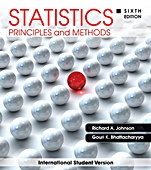
Statistics: Principles and Methods
ISBN 9780470505779
Autor: Richard A. Johnson, Gouri K. Bhattacharyya
Wydawca: Wiley
Dostępność: 3-6 tygodni
Cena: 309,75 zł
Przed złożeniem zamówienia prosimy o kontakt mailowy celem potwierdzenia ceny.
ISBN13: |
9780470505779 |
ISBN10: |
047050577X |
Autor: |
Richard A. Johnson, Gouri K. Bhattacharyya |
Oprawa: |
Paperback |
Rok Wydania: |
2010-03-19 |
Numer Wydania: |
6th Edition International Student Version |
Ilość stron: |
712 |
Wymiary: |
231x191 |
Tematy: |
PB |
Johnson provides a comprehensive, accurate introduction to statistics for business professionals who need to learn how to apply key concepts. The chapters have been updated with real–world data to make the material more relevant. The revised pedagogy will help them contextualize statistical concepts and procedures. The numerous examples clearly demonstrate the important points of the methods. New What Will We Learn opening paragraphs set the stage for the material being discussed. Using Statistics Wisely boxes summarize key lessons. In addition, Statistics in Context sections give business professionals an understanding of applications in which a statistical approach to variation is needed.
Spis treści:
1. Introduction
1. What is Statistics?
2. Statistics in Our Everyday Life
3. Statistics in Aid of Scientific Inquiry
4. Two Basic Concepts– Population and Sample
5. The Purposeful Collection of Data
6. Statistics in Context
7. Objectives of Statistics
2. Organization and Description of Data
1. Introduction
2. Main Types of Data
3. Describing Data by Tables and Graphs
4. Measures of Center
5. Measures of Variation
6. Checking the Stability of the Observations over Time
7. More on Graphics
8. Statistics in Context
3. Descriptive Study of Bivariate Data
1. Introduction
2. Summarization of Bivariate Categorical Data
3. A Designed Experiment for Making a Comparison
4. Scatter Diagram of Bivariate Measurement Data
5. The Correlation Coefficient– A Measure of Linear Relation
6. Prediction of One Variable from Another (Linear Regression)
4. Probability
1. Introduction
2. Probability of an Event
3. Methods of Assigning Probability
4. Event Relations and Two Laws of Probability
5. Conditional Probability and Independence
6. Bayes’ Theorem
7. Random Sampling from a Finite Population
5. Probability Distributions
1. Introduction
2. Random Variables
3. Probability Distribution of a Discrete Random Variable
4. Expectation (Mean) and Standard Deviation of a Probability Distribution
5. Success and Failures– Bernoulli Trials
6. The Binomal Distribution
7. The Binomal Distribution in Context
6. The Normal Distribution
1. Probability Model for a Continuous Random Variable
2. The Normal Distribution–Its General Features
3. The Standard Normal Distribution
4. Probability Calculations with Normal Distributions
5. The Normal Approximation to the Binomial
6. Checking the Plausibility of a Normal Model
7. Transforming Observations to Attain Near Normality
7. Variation in Repeated Samples–Sampling Distribution
1. Introduction
2. The Sampling Distribution of a Statistic
3. Distribution of the Sample Mean and the Central Limit Theorem
4. Statistics in Context
8. Drawing Inferences From Large Samples
1. Introduction
2. Point Estimation of Population Mean
3. Confidence Interval for a Population Mean
4. Testing Hypotheses about a Population Mean
5. Inferences about a Population Proportion
9. Small–Sample Inferences for Normal Populations
1. Introduction
2. Student′s t Distribution
3. Inferences about µ –Small Sample Size
4. Relationship between Tests and Confidence Intervals
5. Inferences About the Standard Deviation σ
(The Chi–Square Distribution)
6. Robustness of Inference Procedures
10. Comparing Two Treatments
1. Introduction
2. Independent Random Samples from Two Populations
3. Large Samples Inference about Difference of Two Means
4. Inferences from Small Samples: Normal Populations with Equal Variances
5. Inferences from Small Samples: Normal Populations but Unequal Variances
6. Randomization and its Role in Inference
7. Matched Pairs C
omparisons
8. Choosing Between Independent Samples and a Matched Pairs Sample
9. Comparing Two Population Proportions
11. Regression Analysis I
(Simple Linear Regression)
1. Introduction
2. Regression with a Single Predictor
3. A Straight–Line Regression Model
4. The Method of Least Squares
5. The Sampling Variability of the Least Squares Estimators—Tools for Inference
6. Important Inference Problems
7. The Strength of a Linear Relation
8. Remarks About the Straight Line Model Assumption
12. Regression Analysis– II
Multiple Linear Regression and Other Topics
1. Introduction
2. Nonlinear Relations and Linearizing Transformations
3. Multiple Linear Regression
4. Residual Plots to Check the Adequacy of a Statistical Model
5. Review Exercises
13. Analysis of Categorical Data
1. Introduction
2. Pearson′s x^2 Test for Goodness of Fit
3. Contingency Table with One Margin Fixed
(Test of Homogeneity)
4. Contingency Table with Neither Margin Fixed
(Test of Independence)
5. Review Exercises
14. Analysis of Variance (ANOVA)
1. Introduction
2. Comparison of Several Treatments– The Completely Randomized Design
3. Population Model and Inferences for a Completely Randomized Design
4. Simultaneous Confidence Intervals
5. Graphical Diagnostics and Displays to Supplement ANOVA
6. Randomized Block Experiments for Comparing k Treatments
7. Review Exercises
Appendix A1 Summation Notation
Appendix A2 Rules for Counting
Appendix A3 Expectation and Standard Deviation—Properties
Appendix A4 The Expected Value and Standard Deviation of X
Appendix B Tables
Koszyk
Książek w koszyku: 0 szt.
Wartość zakupów: 0,00 zł
Informacje


Kontakt
Gambit
Centrum Oprogramowania
i Szkoleń Sp. z o.o.
Al. Pokoju 29b/22-24
31-564 Kraków
Siedziba Księgarni
ul. Kordylewskiego 1
31-542 Kraków
+48 12 410 5991
+48 12 410 5987
+48 12 410 5989
Subskrypcje
Administratorem danych osobowych jest firma Gambit COiS Sp. z o.o. Na podany adres będzie wysyłany wyłącznie biuletyn informacyjny.
Autoryzacja płatności

Informacje na temat autoryzacji płatności poprzez PayU.

© Copyright 2012: GAMBIT COiS Sp. z o.o. Wszelkie prawa zastrzeżone.
Projekt i wykonanie: Alchemia Studio Reklamy