


Wydawcy
Katalog tematyczny
- Archeologia (109)
- Ekonomia, finanse, business (13704)
- Filozofia (1445)
- Historia (3040)
- Języki i językoznawstwo (2356)
- Lifestyle, hobby i rozrywka (475)
- Medycyna (9704)
- Nauki humanistyczne (4)
- Nauki o Ziemi i środowisku (2638)
- Nauki ścisłe (20412)
- Astronomia (294)
- Biologia (5119)
- Chemia (6540)
- Fizyka (3309)
- Matematyka (4574)
- Algebra (171)
- Analiza matematyczna (902)
- Filozofia matematyki (1)
- Geometria (237)
- Historia matematyki (57)
- Kombinatoryka, teoria grafów (67)
- Matematyka dyskretna (35)
- Matematyka stosowana (555)
- Optymalizacja (104)
- Podstawy matematyki (129)
- Statystyka, prawdopodobieństwo (296)
- Teoria grup (63)
- Teoria liczb (77)
- Topologia (66)
- Nauki ścisłe, ogólnie (503)
- Nauki społeczne (8486)
- Nauki techniczne (13450)
- Prawo (1696)
- Publikacje informacyjne i interdyscyplinarne (1288)
- Religia i wierzenia (917)
- Technika komputerowa (4067)
- Zdrowie, relacje międzyludzkie i rozwój osobisty (657)





Informacje szczegółowe o książce
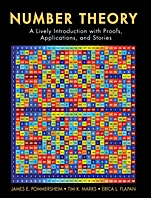
Number Theory: A Lively Introduction with Proofs, Applications, and Stories
ISBN 9780470424131
Autor: James Pommersheim, Tim Marks, Erica Flapan
Wydawca: Wiley
Dostępność: 3-6 tygodni
Cena: 909,30 zł
Przed złożeniem zamówienia prosimy o kontakt mailowy celem potwierdzenia ceny.
ISBN13: |
9780470424131 |
ISBN10: |
0470424133 |
Autor: |
James Pommersheim, Tim Marks, Erica Flapan |
Oprawa: |
Hardback |
Rok Wydania: |
2010-03-19 |
Ilość stron: |
784 |
Wymiary: |
250x198 |
Tematy: |
PB |
Can learning math actually be fun?
Number Theory: A Lively Introduction with Proofs, Applications, and Stories proves it can!
Number Theory: A Lively Introduction with Proofs, Applications, and Stories will introduce you to elementary number theory, helping you develop your proof writing skills while learning the core concepts in number theory as well as advanced topics used in modern applications.
To help you succeed, you′ll learn "math myths"—fictional stories starring famous mathematicians that illustrate important number theory topics in a friendly, inviting manner that′s easy to understand and remember. "Numerical Proof Previews" give you a concrete way to understand the key ideas of a proof. Illustrations throughout the text add to the fun and your understanding.
As accessible as the book is, it does not skimp on the serious mathematics. You′ll explore:Methods of proof and the basic properties of the integers, including mathematical inductionCentral concepts and theorems in elementary number theory using a developmental approach, including basic divisibility properties, prime numbers, the Euclidean Algorithm, modular arithmetic (including applications), Fermat′s Little Theorem, Euler′s Theorem, and RSA (public–key) encryptionPrimitive roots, primality testing, quadratic reciprocity, Gaussian integers, Fermat′s Two Squares Theorem, continued fractions, Pell′s Equation, and Fermat′s Last Theorem, and much moreIdeal for first–timers in number theory as well as math majors and math education majors, Number Theory: A Lively Introduction with Proofs, Applications, and Stories makes learning number theory a joy!
Spis treści:
Preface.
To the Student.
To the Instructor.
Acknowledgements.
0. Prologue.
1. Numbers, Rational and Irrational.
(Historical fi
gures: Pythagoras and Hypatia).
1.1 Numbers and the Greeks.
1.2 Numbers you know.
1.3 A First Look at Proofs.
1.4 Irrationality of he square root of 2.
1.5 Using Quantifiers.
2. Mathematical Induction.
(Historical figure: Noether).
2.1.The Principle of Mathematical Induction.
2.2 Strong Induction and the Well Ordering Principle.
2.3 The Fibonacci Sequence and the Golden Ratio.
2.4 The Legend of the Golden Ratio.
3. Divisibility and Primes.
(Historical figure: Eratosthenes).
3.1 Basic Properties of Divisibility.
3.2 Prime and Composite Numbers.
3.3 Patterns in the Primes.
3.4 Common Divisors and Common Multiples.
3.5 The Division Theorem.
3.6 Applications of gcd and lcm.
4.The Euclidean Algorithm.
(Historical figure: Euclid).
4.1 The Euclidean Algorithm.
4.2 Finding the Greatest Common Divisor.
4.3 A Greeker Argument that the square root of 2 is Irrational.
5. Linear Diophantine Equations.
(Historical figure: Diophantus).
5.1 The Equation aX + bY = 1.
5.2 Using the Euclidean Algorithm to Find a Solution.
5.3 The Diophantine Equation aX + bY = n.
5.4 Finding All Solutions to a Linear Diophantine Equation.
6. The Fundamental Theorem of Arithmetic.
(Historical figure: Mersenne).
6.1 The Fundamental Theorem.
6.2 Consequences of the Fundamental Theorem.
7. Modular Arithmetic.
(Historical figure: Gauss).
7.1 Congruence modulo n.
7.2 Arithmetic with Congruences.
7.3 Check Digit Schemes.
7.4 The Chinese Remainder Theorem.
7.5 The Gregorian Calendar.
7.6 The Mayan Calendar.
8. Modular Number Systems.
(Historical figure: Turing).
8.1 The Number System Zn: an Informal View.
8.2 The Number System Zn: Definition and Basic Properties.
8.3 Multiplicative Inverses in Zn.
8.4 Element
ary Cryptography.
8.5 Encryption Using Modular Multiplication.
9. Exponents Modulo n.
(Historical figure: Fermat).
9.1 Fermat′s Little Theorem.
9.2 Reduced Residues and the Euler \phi–function.
9.3 Euler′s Theorem.
9.4 Exponentiation Ciphers with a Prime modulus.
9.5 The RSA Encryption Algorithm.
10. Primitive Roots.
(Historical figure: Lagrange).
10.1 Zn.
10.2 Solving Polynomial Equations in Zn.
10.3 Primitive Roots.
10.4 Applications of Primitive Roots.
11. Quadratic Residues.
(Historical figure: Eisenstein)
11.1 Squares Modulo n
11.2 Euler′s Identity and the Quadratic Character of –1
11.3 The Law of Quadratic Reciprocity
11.4 Gauss′s Lemma
11.5 Quadratic Residues and Lattice Points.
11.6 The Proof of Quadratic Reciprocity.
12. Primality Testing.
(Historical figure: Erdös).
12.1 Primality testing.
12.2 Continued Consideration of Charmichael Numbers.
12.3 The Miller–Rabin Primality test.
12.4 Two Special Polynomial Equations in Zp.
12.5 Proof that Millar–Rabin is Effective.
12.6 Prime Certificates.
12.7 The AKS Deterministic Primality Test.
13. Gaussian Integers.
(Historical figure: Euler).
13.1 Definition of Gaussian Integers
13.2 Divisibility and Primes in Z[i].
13.3 The Division Theorem for the Gaussian Integers.
13.4 Unique Factorization in Z[i].
13.5 Gaussian Primes.
13.6 Fermat′s Two Squares Theorem.
14. Continued Fractions.
(Historical figure: Ramanujan).
14.1 Expressing Rational Numbers as Continued Fractions.
14.2 Expressing Irrational Numbers as Continued Fractions.
14.3 Approximating Irrational Numbers Using Continued Fractions.
14.4 Proving that Convergents are Fantastic Approximations.
15
. Some Nonlinear Diophantine Equations.
(Historical figure: Germain).
15.1 Pell′s Equation
15.2 Fermat′s Last Theorem
15.3 Proof of Fermat′s Last Theorem for n = 4.
15.4 Germain′s Contributions to Fermat′s Last Theorem
15.5 A Geometric look at the Equation x4 + y4 = z2.
Appendix: Axioms of Number Theory.
A.1 What is a Number System?
A.2 Order Properties of the Integers.
A.3 Building Results From Our Axioms.
A.4 The Principle of Mathematical Induction.
Nota biograficzna:
James Pommersheim is the Katharine Piggott Professor of Mathematics at Reed College. He held post–doctoral positions at the Institute for Advanced Study, M.I.T., and U.C. Berkeley, and he served on the mathematics faculty at New Mexico State University and Pomona College. Pommersheim has published research papers in a wide variety of areas, including algebraic geometry, number theory, topology, and quantum computation. He has enjoyed teaching number theory to students at many levels: college math and math education students, talented high school students, and advanced graduate students. Pommersheim earned his Ph.D. from the University of Chicago, where he studied under William Fulton.
Tim Marks is a Research Scientist at Mitsubishi Electric Research Laboratories in Cambridge, Massachusetts. Previously, he taught high school mathematics and physics for three years, and he worked for three years as a mathematics textbook editor at McDougal Littell/ Houghton Mifflin. Marks and Pommersheim have taught number theory at the Johns Hopkins University′s Center for Talented Youth (CTY) summer program for 19 years. Marks earned his A.B. degree from Harvard University. He completed his Ph.D. and postdoctoral research at the University of California, San Diego.
Erica Flapan joined the mathematics department at Pomona College in 1986. She held post̵
Koszyk
Książek w koszyku: 0 szt.
Wartość zakupów: 0,00 zł
Informacje


Kontakt
Gambit
Centrum Oprogramowania
i Szkoleń Sp. z o.o.
Al. Pokoju 29b/22-24
31-564 Kraków
Siedziba Księgarni
ul. Kordylewskiego 1
31-542 Kraków
+48 12 410 5991
+48 12 410 5987
+48 12 410 5989
Subskrypcje
Administratorem danych osobowych jest firma Gambit COiS Sp. z o.o. Na podany adres będzie wysyłany wyłącznie biuletyn informacyjny.
Autoryzacja płatności

Informacje na temat autoryzacji płatności poprzez PayU.

© Copyright 2012: GAMBIT COiS Sp. z o.o. Wszelkie prawa zastrzeżone.
Projekt i wykonanie: Alchemia Studio Reklamy