


Wydawcy
Katalog tematyczny
- Archeologia (109)
- Ekonomia, finanse, business (13704)
- Filozofia (1445)
- Historia (3040)
- Języki i językoznawstwo (2356)
- Lifestyle, hobby i rozrywka (475)
- Medycyna (9704)
- Nauki humanistyczne (4)
- Nauki o Ziemi i środowisku (2638)
- Nauki ścisłe (20412)
- Nauki społeczne (8486)
- Nauki techniczne (13450)
- Prawo (1696)
- Publikacje informacyjne i interdyscyplinarne (1288)
- Religia i wierzenia (917)
- Technika komputerowa (4067)
- Bazy danych (75)
- Bezpieczeństwo komputerowe (454)
- Certyfikacja komputerowa (1)
- Grafika i media cyfrowe (32)
- Informatyka (779)
- Komputery, ogólnie (74)
- Programowanie (351)
- Programy komercyjne (49)
- Sieci komputerowe (350)
- Sprzęt komputerowy (4)
- Systemy operacyjne (32)
- Technika cyfrowa na co dzień (7)
- Zdrowie, relacje międzyludzkie i rozwój osobisty (657)





Informacje szczegółowe o książce
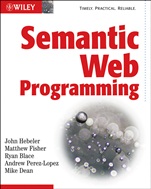
Semantic Web Programming
ISBN 9780470418017
Autor: John Hebeler, Matthew Fisher, Ryan Blace, Andrew Perez–Lopez, Mike Dean
Wydawca: Wiley
Dostępność: 3-6 tygodni
Cena: 236,25 zł
Przed złożeniem zamówienia prosimy o kontakt mailowy celem potwierdzenia ceny.
ISBN13: |
9780470418017 |
ISBN10: |
047041801X |
Autor: |
John Hebeler, Matthew Fisher, Ryan Blace, Andrew Perez–Lopez, Mike Dean |
Oprawa: |
Paperback |
Rok Wydania: |
2009-04-09 |
Ilość stron: |
652 |
Wymiary: |
243x191 |
Tematy: |
UP |
Go beyond the basics to build practical, real–world Semantic Web applications
The Semantic Web offers a revolutionary and powerful way to build intelligent software applications that take advantage of the information and services that exist on the Web, as well as within the enterprise. The Semantic Web delivers on the promise of "Web 3.0" — facilitating automated data integration, processing, and reasoning.
This author team of Semantic Web professionals shows how to apply Semantic Web technologies to build practical, real–world applications and to solve real–world problems. The authors provide a generous supply of working code examples showing how to put concepts into practice.
They fully cover such key technologies as Microformats, Resource Description Framework (RDF), RDF Schema (RDFS), the Web Ontology Language (OWL), Semantic Web Rule Language (SWRL), SPARQL Protocol and RDF Query Language (SPARQL).
In addition, Semantic Web Programming covers:
Semantic Web architectures, tools, and best practices
Ways in which knowledge representation and application integration drive a Semantic Web application
The methods that integrate, align, and output data and information in many formats and locations
A look into the future of the Semantic Web, including advanced integration and distribution, advanced reasoning, visualization, and more
A detailed look into the burgeoning OWL 2 W3C Recommendations and how they will affect and improve your software architectures
An extensive Semantic Web application that ingests data from many sources include Facebook, mySQL®, Jabber, and others, aligns and unifies the information, queries across the unified information and then exports to various formats
The companion Web site offers access to all related articles, complete code examples, an active blog and wiki, and any book or code updates.
Visit our w
ebsite at www.wiley.com/compbooks/
Visit the companion website at www.wiley.com/go/semanticwebprogramming
Spis treści:
Foreword.
Introduction.
Part One Introducing Semantic Web Programming.
Chapter 1 Preparing to Program a Semantic Web of Data.
Defining the Semantic Web.
Identifying the Major Programming Components.
Determining Impacts on Programming.
Establishing aWeb Data–Centric Perspective.
Expressing Semantic Data.
Sharing Data.
Making Data Dynamic and Flexible.
Avoiding the Roadblocks, Myths, and Hype.
Semantic Web Roadblocks.
Semantic Web Myths.
Semantic Web Hype.
Understanding SemanticWeb Origins.
Exploring SemanticWeb Examples.
Semantic Wikis (semantic–mediawiki.org).
Twine (www.twine.com).
The FOAF Project (www.foaf–project.org).
RDFa and Microformats.
Semantic Query Endpoint (dbpedia.org/sparql).
Semantic Search (www.trueknowledge.com).
Summary and Onward.
Notes.
Chapter 2 Hello Semantic Web World.
Setting Up Your Semantic Web Development Environment.
Programming the Hello Semantic WebWorld Application.
Summary.
Part Two Foundations of Semantic Web Programming.
Chapter 3 Modeling Information.
Modeling Information in Software.
Sharing Information: Syntax and Semantics.
Serialized Objects.
Relational Databases.
Extensible Markup Language (XML).
Metadata and Data in Information Sharing.
The SemanticWeb Information Model: The Resource Description Framework (RDF).
Nodes: Resources and Literals.
Edges: Predicates.
Exchanging Information with RDF.
Statements as Points.
RDF Serializations.
RDF/XML.
Terse RDF Triple Language (Turtle).
N–Triples.
Quick Hack.
More RDF.
Blank Nod
es.
Reification.
RDF Organizational Constructs.
Summary.
Chapter 4 Incorporating Semantics.
Semantics on the Web.
Motivating Factors.
Understanding the World WideWeb.
Knowledge Domain Integration.
Expressing Semantics in RDF.
Vocabularies, Taxonomies, and Ontologies.
A Vocabulary Language for RDF.
An Ontology Language for the Web.
Introduction to Ontologies.
Distributed Knowledge.
Open World Assumption.
No Unique Names Assumption.
Overview of Ontology Elements.
Ontology Header.
Classes and Individuals.
Properties.
Annotations.
Data types.
Elements of an Ontology.
OWL 2 Typing.
Ontology Header.
Annotations.
Basic Classification.
Classes and Individuals.
Instance versus Subclass.
Defining and Using Properties.
Property Domain and Range.
Describing Properties.
Top and Bottom Properties.
Inverse Properties.
Disjoint Properties.
Property Chains.
Symmetric, Reflexive, and Transitive Properties.
Functional and Inverse Functional Properties.
Keys.
Datatypes.
Data type Restrictions.
Defining Datatypes in Terms of Other Datatypes.
Negative Property Assertions.
Property Restrictions.
Value Restrictions.
Cardinality Restrictions.
Qualified Cardinality Restrictions.
Advanced Class Description.
Enumerating Class Membership.
Set Operators.
Disjoint Classes.
Equivalence in OWL.
Equivalence among Individuals.
Equivalence among Classes and Properties.
Summary.
Chapter 5 Modeling Knowledge in the Real World.
Exploring the Components of the SemanticWeb.
Semantic Web Frameworks.
Storing and Retrieving RDF.
RDF Store Implementations.
Retrieving Information in a Knowledgebase.
Realizing the Semantics of OWL.
Understanding Forward Chaining Inference.
Understanding Backward Chaining Inference.
Choosing the Right Inference Method.
Common Frameworks and Components.
RDF Store Imple
mentations.
Retrieval Components.
Reasoning Engines.
Knowledgebase Performance.
Exploring the Profiles of OWL.
OWL Full and OWL DL.
The Profiles of OWL.
OWL EL.
OWL QL.
OWL RL.
Demonstrating OWL Inference.
The Ontology.
The Example Application.
The Results.
Performing No Inference.
Performing RDFS Inference.
Performing OWL Inference.
Working with Ontologies.
Decoupling the Knowledge Model from the Application.
Sharing across Domain and Application Boundaries.
What Is a Foundational Ontology?
Common Foundational Ontologies.
BFO.
Cyc and OpenCyc.
DOLCE.
SUMO.
Dublin Core Metadata Initiative.
FOAF.
GeoRSS and OWL–Time.
Finding Ontologies to Reuse or Extend.
Choosing the Right Foundational Ontologies.
Summary.
Chapter 6 Discovering Information.
Navigating the SemanticWeb.
Searching the Semantic Web.
Querying the Semantic Web.
Quickstart with SPARQL.
Four Foundational Query Forms.
SELECT Essentials.
RDF Datasets, FROM and FROM NAMED.
Query Modifiers.
DISTINCT.
REDUCED.
ORDER BY.
Data Streaming with OFFSET and LIMIT.
Flexible Querying with FILTER and OPTIONAL.
FILTER.
OPTIONAL.
UNION.
CONSTRUCT Essentials.
DESCRIBE Essentials.
ASK Essentials.
SPARQL Entailment.
Unsupported Functionality.
Data Modification.
Subqueries.
Aggregation.
Summary.
Chapter 7 Adding Rules.
What Are Rules?
Reasons for Rules.
No Support for Property Composition.
Use of Built–ins.
Ontological Mediation.
Limiting Assumptions.
Rule Languages.
SWRL Essentials.
The Abstract Syntax.
The XML Concrete Syntax.
var.
imp.
rlab.
body.
head.
classAtom.
datarangeAtom.
individualPropertyAtom.
datavaluedPropertyAtom.
sameIndividualAtom.
differentIndividualsAtom.
builtinAtom.
The RDF Concrete Syntax.
Built–ins.
Examples.
DL–Safe Ru
Koszyk
Książek w koszyku: 0 szt.
Wartość zakupów: 0,00 zł
Informacje


Kontakt
Gambit
Centrum Oprogramowania
i Szkoleń Sp. z o.o.
Al. Pokoju 29b/22-24
31-564 Kraków
Siedziba Księgarni
ul. Kordylewskiego 1
31-542 Kraków
+48 12 410 5991
+48 12 410 5987
+48 12 410 5989
Subskrypcje
Administratorem danych osobowych jest firma Gambit COiS Sp. z o.o. Na podany adres będzie wysyłany wyłącznie biuletyn informacyjny.
Autoryzacja płatności

Informacje na temat autoryzacji płatności poprzez PayU.

© Copyright 2012: GAMBIT COiS Sp. z o.o. Wszelkie prawa zastrzeżone.
Projekt i wykonanie: Alchemia Studio Reklamy