


Wydawcy
Katalog tematyczny
- Archeologia (109)
- Ekonomia, finanse, business (13704)
- Filozofia (1445)
- Historia (3040)
- Języki i językoznawstwo (2356)
- Lifestyle, hobby i rozrywka (475)
- Medycyna (9704)
- Nauki humanistyczne (4)
- Nauki o Ziemi i środowisku (2638)
- Nauki ścisłe (20412)
- Astronomia (294)
- Biologia (5119)
- Chemia (6540)
- Fizyka (3309)
- Matematyka (4574)
- Algebra (171)
- Analiza matematyczna (902)
- Filozofia matematyki (1)
- Geometria (237)
- Historia matematyki (57)
- Kombinatoryka, teoria grafów (67)
- Matematyka dyskretna (35)
- Matematyka stosowana (555)
- Optymalizacja (104)
- Podstawy matematyki (129)
- Statystyka, prawdopodobieństwo (296)
- Teoria grup (63)
- Teoria liczb (77)
- Topologia (66)
- Nauki ścisłe, ogólnie (503)
- Nauki społeczne (8486)
- Nauki techniczne (13450)
- Prawo (1696)
- Publikacje informacyjne i interdyscyplinarne (1288)
- Religia i wierzenia (917)
- Technika komputerowa (4067)
- Zdrowie, relacje międzyludzkie i rozwój osobisty (657)





Informacje szczegółowe o książce
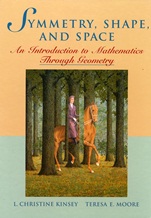
Symmetry, Shape, and Space: An Introduction to Mathematics Through Geometry
ISBN 9780470412381
Autor: L. Christine Kinsey, Teresa E. Moore
Wydawca: Wiley
Dostępność: 3-6 tygodni
Cena: 801,15 zł
Przed złożeniem zamówienia prosimy o kontakt mailowy celem potwierdzenia ceny.
ISBN13: |
9780470412381 |
ISBN10: |
0470412380 |
Autor: |
L. Christine Kinsey, Teresa E. Moore |
Oprawa: |
Hardback |
Rok Wydania: |
2008-09-16 |
Ilość stron: |
494 |
Wymiary: |
236x186 |
Tematy: |
PB |
Symmetry, shape, and Space is designed to involve students in discovering mathematics. It is appropriate for introduction to mathematics and liberal arts mathematics courses and assumes no mathematics beyond the high school level. Students in many diverse programs will benefit from the authors′ use of innovative and engaging pedagogical models. Geometry is the basis of the text because the visual nature of the subject allows students to use their intuition and imagination while developing the ability to think critically. Students study and analyze patterns for themselves, thereby learning and enhancing analytic skills, creativity, and visualization skills. Varied content within the text, activities, and examples leads students into an investigative process and provides the experience of doing and discovering mathematics as mathematicians do. Many of the exercises in the text require students to express their ideas clearly in writing, wile other exercises require drawings or physical models, which help make math a more hands–on experience. The dual geometric and algebraic nature of mathematics is integrated throughout the text.
This text is written so that each chapter is essentially independent of the others, allowing a great deal o flexibility in designing a course. Much of the material in this book is written in such a way that mathematics teachers at the secondary or elementary level can use it for enrichment purposes. Students of art, architecture, and design will enjoy experiencing geometry from a mathematical perspective. Mathematics professionals and educators will find these explorations of nontraditional geometric topics intriguing. Topics include billiards, theoretical origami, tailings, polyhedra, the fourth dimension, optical illusions, soap bubbles, mazes, and topology.Recommended for courses in: Liberal Arts Mathematics, Mathematics Explorations, Mathematics for teaches, Topics in Geometry, Special topics in Mathematics.Also
available bundled with The Geometer′s Sketchpad Dynamic Geometry software at a special price.
Spis treści:
Preface.
To the Reader.
1. The Basics.
1.1 Measurement.
1.2 Polygons.
2. Grids.
2.1. Billiards.
2.2. Celtic Knots.
3. Constructions.
3.1. Ruler and Compass Constructions.
3.2. The Pentagon and the Golden Ratio.
3.3. Theoretical Origami.
3.4. Knots and Stars.
3.5. Linkages.
4. Tesselations.
4.1. Regular and Semiregular Tilings.
4.2. Irregular Tilings.
4.3. Penrose Tilings.
5. Two–Dimensional Symmetry.
5.1. Kaleidoscopes.
5.2. Rosette Groups: Point Symmetry.
5.3. Frieze Patterns: Line Symmetry.
5.4. Wallpaper Patterns: Plane Symmetry.
5.5. Islamic Lattice Patterns.
6. Other Dimensions, Other Worlds.
6.1. Flatlands.
6.2. The Fourth Dimension.
7. Polyhedra.
7.1. Pyramids, Prisms, and Antiprisms.
7.2. The Platonic Solids.
7.3. The Archimedean Solids.
7.4. Polyhedral Transformations.
7.5. Models of Polyhedra.
7.6. Infinite Polyhedra.
8. Three–Dimensional Symmetry.
8.1. Symmetries of Polyhedra.
8.2. Three–Dimensional Kaleidoscopes.
9. Spiral Growth.
9.1. Spirals and Helices.
9.2. Fibonacci Numbers and Phyllotaxis.
10. Drawing Three Dimensions in Two.
10.1. Perspective.
10.2. Optical Illusions.
11. Shape.
11.1. Noneuclidean Geometry.
11.2. Map Projections.
11.3. Curvature of Curves.
11.4. Curvature of Surfaces.
11.5. Soap Bubbles.
12. Graph Theory.
12.1. Graphs.
12.2. Trees.
12.3. Mazes.
13. Topology.
13.1. Dimension.
13.2. Surfaces.
13.3. More About Surfaces.
13.4. Map Coloring Problems.
Hints and Solutions to Selected Problems.
Bibliography.
Index.
Permissions.
Okładka tylna:
Symmetry, shape, and Space is designed to involve
students in discovering mathematics. It is appropriate for introduction to mathematics and liberal arts mathematics courses and assumes no mathematics beyond the high school level. Students in many diverse programs will benefit from the authors′ use of innovative and engaging pedagogical models. Geometry is the basis of the text because the visual nature of the subject allows students to use their intuition and imagination while developing the ability to think critically. Students study and analyze patterns for themselves, thereby learning and enhancing analytic skills, creativity, and visualization skills. Varied content within the text, activities, and examples leads students into an investigative process and provides the experience of doing and discovering mathematics as mathematicians do. Many of the exercises in the text require students to express their ideas clearly in writing, wile other exercises require drawings or physical models, which help make math a more hands–on experience. The dual geometric and algebraic nature of mathematics is integrated throughout the text.
This text is written so that each chapter is essentially independent of the others, allowing a great deal o flexibility in designing a course. Much of the material in this book is written in such a way that mathematics teachers at the secondary or elementary level can use it for enrichment purposes. Students of art, architecture, and design will enjoy experiencing geometry from a mathematical perspective. Mathematics professionals and educators will find these explorations of nontraditional geometric topics intriguing. Topics include billiards, theoretical origami, tailings, polyhedra, the fourth dimension, optical illusions, soap bubbles, mazes, and topology.Recommended for courses in: Liberal Arts Mathematics, Mathematics Explorations, Mathematics for teaches, Topics in Geometry, Special topics in Mathematics.Also available bundled with The Geometer′s Sket
chpad Dynamic Geometry software at a special price.
Koszyk
Książek w koszyku: 0 szt.
Wartość zakupów: 0,00 zł
Informacje


Kontakt
Gambit
Centrum Oprogramowania
i Szkoleń Sp. z o.o.
Al. Pokoju 29b/22-24
31-564 Kraków
Siedziba Księgarni
ul. Kordylewskiego 1
31-542 Kraków
+48 12 410 5991
+48 12 410 5987
+48 12 410 5989
Subskrypcje
Administratorem danych osobowych jest firma Gambit COiS Sp. z o.o. Na podany adres będzie wysyłany wyłącznie biuletyn informacyjny.
Autoryzacja płatności

Informacje na temat autoryzacji płatności poprzez PayU.

© Copyright 2012: GAMBIT COiS Sp. z o.o. Wszelkie prawa zastrzeżone.
Projekt i wykonanie: Alchemia Studio Reklamy