


Wydawcy
Katalog tematyczny
- Archeologia (109)
- Ekonomia, finanse, business (13704)
- Filozofia (1445)
- Historia (3040)
- Języki i językoznawstwo (2356)
- Lifestyle, hobby i rozrywka (475)
- Medycyna (9704)
- Nauki humanistyczne (4)
- Nauki o Ziemi i środowisku (2638)
- Nauki ścisłe (20412)
- Astronomia (294)
- Biologia (5119)
- Chemia (6540)
- Fizyka (3309)
- Matematyka (4574)
- Algebra (171)
- Analiza matematyczna (902)
- Filozofia matematyki (1)
- Geometria (237)
- Historia matematyki (57)
- Kombinatoryka, teoria grafów (67)
- Matematyka dyskretna (35)
- Matematyka stosowana (555)
- Optymalizacja (104)
- Podstawy matematyki (129)
- Statystyka, prawdopodobieństwo (296)
- Teoria grup (63)
- Teoria liczb (77)
- Topologia (66)
- Nauki ścisłe, ogólnie (503)
- Nauki społeczne (8486)
- Nauki techniczne (13450)
- Prawo (1696)
- Publikacje informacyjne i interdyscyplinarne (1288)
- Religia i wierzenia (917)
- Technika komputerowa (4067)
- Zdrowie, relacje międzyludzkie i rozwój osobisty (657)





Informacje szczegółowe o książce
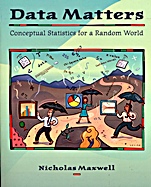
Data Matters: Conceptual Statistics for a Random World
ISBN 9780470412282
Autor: Nicholas Maxwell
Wydawca: Wiley
Dostępność: 3-6 tygodni
Cena: 795,90 zł
Przed złożeniem zamówienia prosimy o kontakt mailowy celem potwierdzenia ceny.
ISBN13: |
9780470412282 |
ISBN10: |
0470412283 |
Autor: |
Nicholas Maxwell |
Oprawa: |
Paperback |
Rok Wydania: |
2008-09-12 |
Ilość stron: |
626 |
Wymiary: |
235x187 |
Tematy: |
PB |
With an analytical approach that emphasizes concepts and comprehension, Data Matters provides a crucial introduction to statistics by preparing readers to think critically about the most common statistics found in the natural and social sciences. Real data and events taken from the daily news media bring relevance to the subject and turn the general reader into a critical and capable consumer of everyday statistics. With its pleasant, conversational style, Data Matters engages and interests readers while it covers the basics and lays a foundation for further study in statistics.
Spis treści:
Foreword by George Cobb vii
Preface
To the Instructor ix
To the Student xiii
Acknowledgments xiv
Introduction: Why Data Matters 1
Part I Statistics in the News 7
Basic Concepts of Statistical Thinking Presented
in the Context of Categorical Data
Chapter 1 Proportions in Samples, Proportions in Populations 8
1.1 The Most Popular News Statistics 9
Percentage, Proportions, Raw Counts, Pie Charts, Bar Charts
1.2 How Many People Are There? 36
U.S. and World Populations, Population Growth,
Proportional Changes, The Unemployment Rate, X–Y Plots
1.3 Things Vary, and Small Samples Vary the Most 54
The Law of Large Numbers
Chapter 2 The Pattern in Random Sample Proportions 73
2.1 Taking a Good Sample of a Population 74
Representative and Biased Samples, Random Sampling,
Self–Selected Samples
2.2 How Samples Vary 94
Histograms, Bell Curves
2.3 How Widely Samples Vary 111
The Standard Error of a Proportion, The Normal Distribution
Chapter 3 Making Inferences 132
3.1 Forecasting the Future 133
Prediction Intervals for Sample Proportions
3.2 What a Sample Reveals About a Population 150
Confidence Intervals for Proportions in Populations
3.3 The Story of Statistical Inference 170
Null Hypothesis, P–Value, Alpha, Significance
Chapter 4 Testing Locations and Di
fferences of Proportions 194
4.1 Testing Where a Proportion Is 195
The Z–Test
4.2 How to Look for Differences in Chances 213
Cross–Tabulations, Correlation, The Null Hypothesis
of the Chi–Square Test
4.3 Checking for No Correlation with the Chi–Square Test 234
Chi–Square Distribution, Degrees of Freedom,
Correlation Is Not Causation
Chapter 5 Averages and Other Number Line Statistics in the News 257
5.1 Incomes and Other Quantities 258
Medians, Number Line Observations,Means
5.2 Which Tells the Truth—The Mean, the Median . . . or 281
the Weighted Mean?
Standard Deviation, Spread,Weighted Means
5.3 Inflation and the Consumer Price Index 302
Adjusting for Inflation
Part II Statistics in Science 317
Descriptive and Inferential Statistics for Continuous Data
Chapter 6 What Sample Data Distribution Reveals About the Population 318
6.1 Exploratory Data Analysis 319
Histograms, Stem–and–Leaf Plots, Box Plots
6.2 Describing Number Line Variation 338
Standard Deviation of Samples,Variance
6.3 How to See the Future 360
Prediction Intervals for Number Line Observations
and Sample Means, Standard Error of Means, Confidence
Intervals for Population Means, Central Limit Theorem
Chapter 7 Testing Treatments 378
7.1 A Cautionary Tale 380
William Gosset’s Troubles with the Z–Test and the T–Distribution,
The T–Test
7.2 How to Test Whether a Treatment Works 399
The Logic of Experiments, Correlational Studies
7.3 Variances Between and Within 413
Estimating the Population Variance from Variation
Within Groups and from Variation Between Group Means
Chapter 8 Analysis of Variance 431
8.1 Fisher’s Analysis of Variance 432
Calculating Fisher’s F–Value
8.2 What If the Data Are Not Normally Distributed? 451
The Effect of Nonconstant Variances and Non–normality on
ANOVA, Non
parametric Tests
8.3 American Counties 471
Correlation, Scatter Plots
Chapter 9 Best Lines 495
9.1 Lines 496
How to Calculate the Equation of a Line
9.2 Finding Best–Fitting Lines 512
The Least Squares Line
9.3 An Excellent Line 522
Calculating the Slope of the Regression Equation,
Standard Error and Confidence Interval for the Regression Equation
Chapter 10 Tests of Regression 544
10.1 How to Test the Regression Models 545
R2, Pearson’s r, A T–Test for the Regression Slope
10.2 What If the Assumptions of the Regression Test Are Not Valid? 568
Spearman’s Rho, Effect of Nonconstant Variances on
Correlation Tests, Effect of Non–normality on
Correlation Tests, Nonlinear Regression
Postscript: A Statistical Life 592
References 599
Index 609
Some Useful Equations 624
Koszyk
Książek w koszyku: 0 szt.
Wartość zakupów: 0,00 zł
Informacje


Kontakt
Gambit
Centrum Oprogramowania
i Szkoleń Sp. z o.o.
Al. Pokoju 29b/22-24
31-564 Kraków
Siedziba Księgarni
ul. Kordylewskiego 1
31-542 Kraków
+48 12 410 5991
+48 12 410 5987
+48 12 410 5989
Subskrypcje
Administratorem danych osobowych jest firma Gambit COiS Sp. z o.o. Na podany adres będzie wysyłany wyłącznie biuletyn informacyjny.
Autoryzacja płatności

Informacje na temat autoryzacji płatności poprzez PayU.

© Copyright 2012: GAMBIT COiS Sp. z o.o. Wszelkie prawa zastrzeżone.
Projekt i wykonanie: Alchemia Studio Reklamy