


Wydawcy
Katalog tematyczny
- Archeologia (109)
- Ekonomia, finanse, business (13704)
- Filozofia (1445)
- Historia (3040)
- Języki i językoznawstwo (2356)
- Lifestyle, hobby i rozrywka (475)
- Medycyna (9704)
- Nauki humanistyczne (4)
- Nauki o Ziemi i środowisku (2638)
- Nauki ścisłe (20412)
- Astronomia (294)
- Biologia (5119)
- Chemia (6540)
- Fizyka (3309)
- Matematyka (4574)
- Algebra (171)
- Analiza matematyczna (902)
- Filozofia matematyki (1)
- Geometria (237)
- Historia matematyki (57)
- Kombinatoryka, teoria grafów (67)
- Matematyka dyskretna (35)
- Matematyka stosowana (555)
- Optymalizacja (104)
- Podstawy matematyki (129)
- Statystyka, prawdopodobieństwo (296)
- Teoria grup (63)
- Teoria liczb (77)
- Topologia (66)
- Nauki ścisłe, ogólnie (503)
- Nauki społeczne (8486)
- Nauki techniczne (13450)
- Prawo (1696)
- Publikacje informacyjne i interdyscyplinarne (1288)
- Religia i wierzenia (917)
- Technika komputerowa (4067)
- Zdrowie, relacje międzyludzkie i rozwój osobisty (657)





Informacje szczegółowe o książce
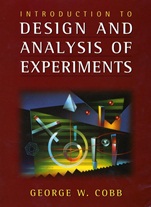
Introduction to Design and Analysis of Experiments
ISBN 9780470412169
Autor: George W. Cobb
Wydawca: Wiley
Dostępność: 3-6 tygodni
Cena: 899,85 zł
Przed złożeniem zamówienia prosimy o kontakt mailowy celem potwierdzenia ceny.
ISBN13: |
9780470412169 |
ISBN10: |
047041216X |
Autor: |
George W. Cobb |
Oprawa: |
Paperback |
Rok Wydania: |
2008-09-12 |
Ilość stron: |
832 |
Wymiary: |
244x178 |
Tematy: |
PB |
Data analysis is an interpretive activity. George Cobb′s goals in Introduction to Design and Analysis of Experiments are to explain how to choose sound and suitable design structures and to engage the student misunderstanding the interpretive and constructive nature of data analysis and experimental design. Developed over years of classroom use, this text can be used as an introduction to statistics emphasizing experimental design. Technical prerequisites are kept to a minimum. It can also be used as an elementary graduate survey course.
Cobb′s approach and careful exposition allow students to build a deep understanding of Statistical concepts over time as they analyze and design experiments. He presents the Statistics concepts over time as they analyze and design experiments. he presents the field of statistics to students as a matrix, rather than a hierarchy, of related concepts.
This text introduces the main concepts of Statistical thinking in the context of experimental design and ANOVA, allowing the material to be covered in half of the usual time.
Introduction to Design and Analysis of Experiments was originally published by Springer–Verlag, New York and is now being reprinted by Key College Publishing. It is available for sale from either publisher.
Spis treści:
To the Instructor.
Sample Exam Questions.
To the Student.
Acknowledgments.
1. Introduction to Experimental Design.
1. The Challenge of planning a good experiment.
2. Three basic principles and four experimental designs.
3. The factor structure of the four experimental designs.
2. Informal Analysis and Checking Assumptions.
1. What analysis of variance does.
2. The six fisher assumptions.
3. Informal analysis, part 1: parallel dot graphs and choosing a scale.
4. Informal analysis, part 2: interaction graph for the log concentrations.
3. Formal Anova: Decomposing the Data and Measuring Variabil
ity, Testing Hypothesis and Estimating True Differences.
1. Decomposing the data.
2. Computing mean squares to measure average variability.
3. Standard deviation = root mean square for residuals.
4. Formal hypothesis testing: are the effects detectable?
5. Confidence intervals: the likely size of true differences.
4. Decisions About the Content of an Experiment.
1. The response.
2. Conditions.
3. Material.
5. Randomization and the Basic Factorial Design.
1. The basic factorial design (“What you do”).
2. Informal analysis.
3. Factor structure (“What you get”).
4. Decomposition and analysis of variance for one–way BF designs.
5. Using a computer [Optional].
6. Algebraic notation for factor structure [Optional].
6. Interaction and the Principle of Factorial Crossing.
1. Factorial crossing and the two–way basic factorial design, or BF[2].
2. Interaction and the interaction graph.
3. Decomposition and ANOVA for the two–way design.
4. Using a computer [Optional].
5. Algebraic notation for the two–way BF design [Optional].
7. The Principle of Blocking.
1. Blocking and the complete block design (CB).
2. Two nuisance factors: the Latin square design(LS).
3. The split plot/repeated measures design (SP/RM).
4. Decomposition and analysis of variance.
5. Scatterplots for data sets with blocks.
6. Using a computer. [Optional].
7. Algebraic notation for the CB, LS And SP/RM Designs.
8. Working with the Four Basic Designs.
1. Comparing and recognizing design structures.
2. Choosing a design structure: deciding about blocking.
3. Informal analysis: examples.
4. Recognizing alternative to ANOVA.
9. Extending the Basic Designs by Factorial Crossing.
1. Extending the BF design: general principles.
2. Three or more crossed factors of interest.
3. Compound within–blocks fac
tors.
4.Graphical methods for 3–factor interactions.
5. Analysis of variance.
10. Decomposing a Data Set.
1. The basic decomposition step and the BF[1] design.
2. Decomposing data from balanced designs.
11. Comparisons, Contrasts, and Confidence Intervals.
1. Comparisons: confidence intervals and tests.
2. Adjustments for multiple comparisons.
3. Between–blocks factors and compound within–blocks factors.
4. Linear estimators and orthogonal contrasts [Optional].
12. The Fisher Assumptions and How to Check Them.
1. Same SDs (s).
2. Independent chance errors (I).
3. The normality assumption (N).
4. Effects are additive (A) and constant (C).
5. Estimating replacement values for outliers.
13. Other Experimental Designs and Models.
1. New factor structures built by crossing and nesting.
2. New uses for old factor structures: fixed versus random effects.
3. Models with mixed interaction effects.
4. Expected mean square and f–ratios.
14. Continuous Carriers: A Visual Approach to Regression, Correlation and Analysis of Covariance.
1. Regression.
2. Balloon summaries and correlation.
3. Analysis of covariance.
15. Sampling Distributions and the Role of the Assumptions.
1. The logic of hypothesis testing.
2. Ways to think about sampling distributions.
3. Four fundamental families of distributions.
4. Sampling distributions for linear estimators.
5. Approximate sampling distributions for f–ratios.
6. Why (and when) are the models reasonable?
Tables.
Data Sources.
Subject Index.
Examples.
Okładka tylna:
Data analysis is an interpretive activity. George Cobb′s goals in Introduction to Design and Analysis of Experiments are to explain how to choose sound and suitable design structures and to engage the student misunderstanding the interpretive and constructive nature of
data analysis and experimental design. Developed over years of classroom use, this text can be used as an introduction to statistics emphasizing experimental design. Technical prerequisites are kept to a minimum. It can also be used as an elementary graduate survey course.
Cobb′s approach and careful exposition allow students to build a deep understanding of Statistical concepts over time as they analyze and design experiments. He presents the Statistics concepts over time as they analyze and design experiments. he presents the field of statistics to students as a matrix, rather than a hierarchy, of related concepts.
This text introduces the main concepts of Statistical thinking in the context of experimental design and ANOVA, allowing the material to be covered in half of the usual time.
Introduction to Design and Analysis of Experiments was originally published by Springer–Verlag, New York and is now being reprinted by Key College Publishing. It is available for sale from either publisher.
Koszyk
Książek w koszyku: 0 szt.
Wartość zakupów: 0,00 zł
Informacje


Kontakt
Gambit
Centrum Oprogramowania
i Szkoleń Sp. z o.o.
Al. Pokoju 29b/22-24
31-564 Kraków
Siedziba Księgarni
ul. Kordylewskiego 1
31-542 Kraków
+48 12 410 5991
+48 12 410 5987
+48 12 410 5989
Subskrypcje
Administratorem danych osobowych jest firma Gambit COiS Sp. z o.o. Na podany adres będzie wysyłany wyłącznie biuletyn informacyjny.
Autoryzacja płatności

Informacje na temat autoryzacji płatności poprzez PayU.

© Copyright 2012: GAMBIT COiS Sp. z o.o. Wszelkie prawa zastrzeżone.
Projekt i wykonanie: Alchemia Studio Reklamy