


Wydawcy
Katalog tematyczny
- Archeologia (109)
- Ekonomia, finanse, business (13704)
- Filozofia (1445)
- Historia (3040)
- Języki i językoznawstwo (2356)
- Lifestyle, hobby i rozrywka (475)
- Medycyna (9704)
- Nauki humanistyczne (4)
- Nauki o Ziemi i środowisku (2638)
- Nauki ścisłe (20412)
- Nauki społeczne (8486)
- Nauki techniczne (13450)
- Prawo (1696)
- Publikacje informacyjne i interdyscyplinarne (1288)
- Religia i wierzenia (917)
- Technika komputerowa (4067)
- Bazy danych (75)
- Bezpieczeństwo komputerowe (454)
- Certyfikacja komputerowa (1)
- Grafika i media cyfrowe (32)
- Informatyka (779)
- Komputery, ogólnie (74)
- Programowanie (351)
- Programy komercyjne (49)
- Sieci komputerowe (350)
- Sprzęt komputerowy (4)
- Systemy operacyjne (32)
- Technika cyfrowa na co dzień (7)
- Zdrowie, relacje międzyludzkie i rozwój osobisty (657)







Informacje szczegółowe o książce
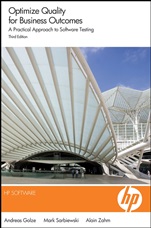
Optimize Quality for Business Outcomes: A Practical Approach to Software Testing
ISBN 9780470404669
Autor: Andreas Golze, Mark Sarbiewski, Alain Zahm
Wydawca: Wiley
Dostępność: 3-6 tygodni
Cena: 203,70 zł
Przed złożeniem zamówienia prosimy o kontakt mailowy celem potwierdzenia ceny.
ISBN13: |
9780470404669 |
ISBN10: |
0470404663 |
Autor: |
Andreas Golze, Mark Sarbiewski, Alain Zahm |
Oprawa: |
Paperback |
Rok Wydania: |
2008-06-27 |
Ilość stron: |
304 |
Wymiary: |
227x155 |
Tematy: |
US |
Published in partnership with HP, this guide shares more than 20 years of software testing wisdom from both HP consultants and customers aimed at improving performance measurement. You’ll learn from the experts how to move through software development and testing processes in the most effective, cost–efficient way as you examine fundamental questions around testing from a business perspective: what to test and how to assure that testing has accomplished its objective, the various behavioral modeling methods, using key performance indicators, and more.
Spis treści:
Acknowledgements.
Introduction.
Chapter 1 What Is the Big Deal About Testing?
Quality Goals and Test Phases.
Requirements Verification.
Unit Test.
Integration Test.
System Test.
Performance Test.
User Acceptance Test.
Operational Readiness Test.
Case Study: Flight Application.
Requirements Verification.
Unit Test.
Integration Test.
System Test.
Performance Test.
User Acceptance Test.
Operational Readiness Test.
Test Concepts and Techniques.
White–Box Testing.
Black–Box Testing.
Wrapping Up.
Chapter 2 Testing the Business Requirements: Start at the Root of the Problem.
Build a Common Reference.
Document the Separate Business Functions.
Link Requirements into the Structure.
Define Proof Points.
Chapter 3 Test Rules: Build the Backbone for Effective Testing.
Equivalence Partitioning with Root Cause Analysis.
Chapter 4 Test Cases: Let’s Get Down to the Real Stuff.
Step 1: Select a Test Rule.
Step 2: Specifying Master Data.
Take Data from Production.
Build Data Using the Existing Application.
Generate Data from Scratch.
Step 3: Finalize the Test Case Description.
Test Scenarios.
Test Execution.
Chapter 5 Test Optimization: Balancing Risk and Effort.
Risk Assessment.
Business Impact Analysis.
Failure P
robability.
Derive Business Risk.
Test Procedure Definition.
Functional Complexity.
Test Effort Estimation.
How to Calculate the Optimal Level of Automation.
Test Effort Optimization.
Improving Test Automation and Manual Testing.
Improving Regression Test Efficiency.
Chapter 6 Why Bother with Non–Functional Testing?
Non–Functional Scope.
Performance.
Load.
Availability.
Reliability.
Consider Non–Functional Testing at the Business Level.
Performance Testing.
Step 1: Defining Performance Requirements.
Step 2: Performance Breakdown.
Step 3: Performance Instrumentation.
Step 4: Performance Test Execution.
Step 5: Performance Test Analysis.
Step 6: Performance Enhancements.
Load Testing.
Step 1: Stability.
Step 2: Load Support.
Step 3: Scalability.
Step 4: Sustainability.
Step 5: Overload.
Availability Testing.
Expressing Availability.
Turning Availability Rate into Concrete Terms.
High Availability Testing.
Reliability Testing.
Reliability Requirements.
Reliability Testing.
Non–Functional Testing Critical for Success.
Chapter 7 Application Security Testing: The Next Frontier.
Understanding the Application Security Problem.
The Technical Problem.
The Lifecycle Problem.
The Business Problem.
The Solution.
Enterprise Security Strategy and Policies.
Process and Practices.
Education and Training.
Key Stakeholders.
Technology.
Static Analysis (aka Source Code Analysis).
Dynamic Analysis (aka Black–Box Testing).
Hybrid Analysis.
Secure Code Libraries.
Continuously Updated Security Knowledge–Bases.
So Where Does That Leave Us?
Chapter 8 Test Sourcing: How Outsourcing Improves.
Cost Effective Testing.
Why — and How — Does Outsourcing Work in Other Industries?
Successful IT Outsourcing.
Step 1: Test Rule Definition.
Step 2: Test D
ata Specification.
Step 3: Data Load Procedures.
Step 4: Test Script Development.
Step 5: Compare Utility Development.
Step 6: Automated Test Evaluation.
Step 7: Manual Test Execution.
Step 8: Test Evaluation.
Chapter 9 SUCCESSFUL Goal–Driven KPI Approach.
Set Business Goals.
Understand the Impact of Each Department on Business Goals.
Choose Supporting Business Processes.
Create Business Process Goals.
Examine What to Measure.
Standardize Measurements Across Departments.
Scope Data Source and Integration Needs.
Formalize Indicators and Thresholds.
Utilize and Execute Appropriate Action Plans.
Lay the Groundwork and Baseline.
Chapter 10 Getting Started: Putting It All Together.
Level 0: Quality Agnostic.
Level 1: Quality Initializing.
Process Characteristics.
Product Characteristics.
People Characteristics.
Level 2: Quality Conscious.
Process Characteristics.
Product Characteristics.
People Characteristics.
Level 3: Quality Savvy.
Process Characteristics.
Product Characteristics.
People Characteristics.
Level 4: Quality Expert.
Process Characteristics.
Product Characteristics.
People Characteristics.
Self Evaluation — Designing a Roadmap.
Appendix A Common Test Techniques.
Appendix B HP Application Quality Management Solutions Introduction and Overview.
Appendix C Verification.
Appendix D Naming Conventions.
References.
Glossary.
Koszyk
Książek w koszyku: 0 szt.
Wartość zakupów: 0,00 zł
Informacje


Kontakt
Gambit
Centrum Oprogramowania
i Szkoleń Sp. z o.o.
Al. Pokoju 29b/22-24
31-564 Kraków
Siedziba Księgarni
ul. Kordylewskiego 1
31-542 Kraków
+48 12 410 5991
+48 12 410 5987
+48 12 410 5989
Subskrypcje
Administratorem danych osobowych jest firma Gambit COiS Sp. z o.o. Na podany adres będzie wysyłany wyłącznie biuletyn informacyjny.
Autoryzacja płatności

Informacje na temat autoryzacji płatności poprzez PayU.

© Copyright 2012: GAMBIT COiS Sp. z o.o. Wszelkie prawa zastrzeżone.
Projekt i wykonanie: Alchemia Studio Reklamy