


Wydawcy
Katalog tematyczny
- Archeologia (109)
- Ekonomia, finanse, business (13704)
- Filozofia (1445)
- Historia (3040)
- Języki i językoznawstwo (2356)
- Lifestyle, hobby i rozrywka (475)
- Medycyna (9704)
- Nauki humanistyczne (4)
- Nauki o Ziemi i środowisku (2638)
- Nauki ścisłe (20412)
- Astronomia (294)
- Biologia (5119)
- Chemia (6540)
- Fizyka (3309)
- Matematyka (4574)
- Algebra (171)
- Analiza matematyczna (902)
- Filozofia matematyki (1)
- Geometria (237)
- Historia matematyki (57)
- Kombinatoryka, teoria grafów (67)
- Matematyka dyskretna (35)
- Matematyka stosowana (555)
- Optymalizacja (104)
- Podstawy matematyki (129)
- Statystyka, prawdopodobieństwo (296)
- Teoria grup (63)
- Teoria liczb (77)
- Topologia (66)
- Nauki ścisłe, ogólnie (503)
- Nauki społeczne (8486)
- Nauki techniczne (13450)
- Prawo (1696)
- Publikacje informacyjne i interdyscyplinarne (1288)
- Religia i wierzenia (917)
- Technika komputerowa (4067)
- Zdrowie, relacje międzyludzkie i rozwój osobisty (657)





Informacje szczegółowe o książce
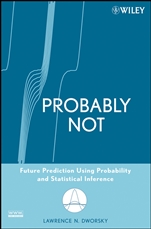
Probably Not: Future Prediction Using Probability and Statistical Inference
ISBN 9780470184011
Autor: Lawrence N. Dworsky
Wydawca: Wiley
Dostępność: 3-6 tygodni
Cena: 430,50 zł
Przed złożeniem zamówienia prosimy o kontakt mailowy celem potwierdzenia ceny.
ISBN13: |
9780470184011 |
ISBN10: |
0470184019 |
Autor: |
Lawrence N. Dworsky |
Oprawa: |
Paperback |
Rok Wydania: |
2008-05-20 |
Ilość stron: |
328 |
Wymiary: |
234x158 |
Tematy: |
PB |
An engaging, entertaining, and informative introduction to probability and prediction in our everyday lives
Although Probably Not deals with probability and statistics, it is not heavily mathematical and is not filled with complex derivations, proofs, and theoretical problem sets. This book unveils the world of statistics through questions such as what is known based upon the information at hand and what can be expected to happen. While learning essential concepts including "the confidence factor" and "random walks," readers will be entertained and intrigued as they move from chapter to chapter. Moreover, the author provides a foundation of basic principles to guide decision making in almost all facets of life including playing games, developing winning business strategies, and managing personal finances.
Much of the book is organized around easy–to–follow examples that address common, everyday issues such as:
How travel time is affected by congestion, driving speed, and traffic lights
Why different gambling casino strategies ultimately offer players no advantage
How to estimate how many different birds of one species are seen on a walk through the woods
Seemingly random events—coin flip games, the Central Limit Theorem, binomial distributions and Poisson distributions, Parrando′s Paradox, and Benford′s Law—are addressed and treated through key concepts and methods in probability. In addition, fun–to–solve problems including "the shared birthday" and "the prize behind door number one, two, or three" are found throughout the book, which allow readers to test and practice their new probability skills. Requiring little background knowledge of mathematics, readers will gain a greater understanding of the many daily activities and events that involve random processes and statistics.
Combining the mathematics of probability with real–world examples, Probably
Not is an ideal reference for practitioners and students who would like to learn more about the role of probability and statistics in everyday decision making.
Spis treści:
Introduction.
1. An Introduction to Probability.
Predicting The Future.
Rule Making.
Random Events and Probability.
The Lottery {Very Improbable Events and Large Data Sets}.
Coin Flipping {Fair Games, Looking Backwards For Insight}.
The Coin Flip Strategy That Can’t Lose.
The Prize Behind The Door {Looking Backwards For Insight, Again}.
The Checker Board {Dealing With Only Part Of The Data Set}.
2. Probability Distribution Functions And Some Basics.
The Probability Distribution Function.
Averages And Weighted Averages.
Expected Values.
The Basic Coin Flip Game.
The Standard Deviation.
The Cumulative Distribution Function.
The Confidence Interval.
Final Points.
3. Building a Bell.
4. Random Walks.
The One Dimensional Random Walk.
What Probability Really Means.
Diffusion.
5. Life Insurance and Social Security.
Insurance as Gambling.
Life Tables.
Birth Rates and Population Stability.
Life Tables, Again.
Premiums.
Social Security – Sooner Or Later?.
6. Binomial Probabilities.
The Binomial Probability Formula.
Permutations And Combinations.
Large Number Approximations.
The Poisson Distribution.
Disease Clusters.
Clusters.
7. Pseudorandom Numbers and Monte Carlo Simulations.
Pseudorandom Numbers.
The Middle Square PSNG.
The Linear Congruential PSNG.
A Normal Distribution Generator.
An Arbitrary Distribution Generator.
Monte Carlo Simulations.
A League Of Our Own.
8. Some Gambling Games In Detail.
The Basic Coin Flip Game.
The Gantt Chart.
The Ultimate "Winning Strategy".
The Game Show.
Parimutuel Betting.
9. Traffic Lights And Traffic.
Outsmarting A Traffic Light?.
Many Lights And Many Cars.
Simulating T
raffic Flow – The Simulation.
Simulation Results.
10. Combined And Conditional Probabilities.
Functional Notation.
Conditional Probability.
Medical Test Results.
The Shared Birthday Problem.
11. Scheduling And Waiting.
Scheduling Appointments In The Doctor’s Office.
Lunch With A Friend.
Waiting For A Bus.
12. Stock Market Portfolios.
13. Benford, Parrondo and Simpson.
Benford’s Law.
Parrondo’s Paradox.
Simpson’s Paradox.
14. Networks, Infectious Disease Propagation and Chain Letters.
Degrees Of Separation.
Propagation Along Networks.
Some Other Uses Of Networks.
Neighborhood Chains.
15. Bird Counting.
A Walk In The Woods.
A Model Of Bird Flying Habits.
Spotting A Bird.
Putting It All Together.
16. Statistical Mechanics And Heat.
Statistical Mechanics.
Thermodynamics.
17. Introduction To Statistical Analysis.
Sampling.
Sample Distributions and Standard Deviations.
Estimating Population Average From A Sample.
The Student–T Distribution.
Polling Statistics.
Did A Sample Come From A Given Population?.
18. Chaos and Quanta.
Chaos.
Probability In Quantum Mechanics.
Nota biograficzna:
Lawrence N. Dworsky, PhD, is a former corporate research lab director at Motorola, Inc., where he was also a member of the Science Advisory Board. He has also served as a consultant to the Defense Advanced Research Projects Agency (DARPA), Littelfuse Corp., and HRL Laboratories, LLC. A Fellow of the Institute of Electrical and Electronic Engineers, Dr. Dworsky has held academic positions at Columbia University, Northern Illinois University, and Florida Atlantic University.
Okładka tylna:
An engaging, entertaining, and informative introduction to probability and prediction in our everyday lives
Although Probably Not deals with probability and statistics, it is not heavily mathematical and is n
ot filled with complex derivations, proofs, and theoretical problem sets. This book unveils the world of statistics through questions such as what is known based upon the information at hand and what can be expected to happen. While learning essential concepts including "the confidence factor" and "random walks," readers will be entertained and intrigued as they move from chapter to chapter. Moreover, the author provides a foundation of basic principles to guide decision making in almost all facets of life including playing games, developing winning business strategies, and managing personal finances.
Much of the book is organized around easy–to–follow examples that address common, everyday issues such as:
How travel time is affected by congestion, driving speed, and traffic lights
Why different gambling casino strategies ultimately offer players no advantage
How to estimate how many different birds of one species are seen on a walk through the woods
Seemingly random events—coin flip games, the Central Limit Theorem, binomial distributions and Poisson distributions, Parrando′s Paradox, and Benford′s Law—are addressed and treated through key concepts and methods in probability. In addition, fun–to–solve problems including "the shared birthday" and "the prize behind door number one, two, or three" are found throughout the book, which allow readers to test and practice their new probability skills. Requiring little background knowledge of mathematics, readers will gain a greater understanding of the many daily activities and events that involve random processes and statistics.
Combining the mathematics of probability with real–world examples, Probably Not is an ideal reference for practitioners and students who would like to learn more about the role of probability and statistics in everyday decision making.
Koszyk
Książek w koszyku: 0 szt.
Wartość zakupów: 0,00 zł
Informacje


Kontakt
Gambit
Centrum Oprogramowania
i Szkoleń Sp. z o.o.
Al. Pokoju 29b/22-24
31-564 Kraków
Siedziba Księgarni
ul. Kordylewskiego 1
31-542 Kraków
+48 12 410 5991
+48 12 410 5987
+48 12 410 5989
Subskrypcje
Administratorem danych osobowych jest firma Gambit COiS Sp. z o.o. Na podany adres będzie wysyłany wyłącznie biuletyn informacyjny.
Autoryzacja płatności

Informacje na temat autoryzacji płatności poprzez PayU.

© Copyright 2012: GAMBIT COiS Sp. z o.o. Wszelkie prawa zastrzeżone.
Projekt i wykonanie: Alchemia Studio Reklamy