


Wydawcy
Katalog tematyczny
- Archeologia (109)
- Ekonomia, finanse, business (13704)
- Filozofia (1445)
- Historia (3040)
- Języki i językoznawstwo (2356)
- Lifestyle, hobby i rozrywka (475)
- Medycyna (9704)
- Nauki humanistyczne (4)
- Nauki o Ziemi i środowisku (2638)
- Nauki ścisłe (20412)
- Astronomia (294)
- Biologia (5119)
- Chemia (6540)
- Fizyka (3309)
- Matematyka (4574)
- Algebra (171)
- Analiza matematyczna (902)
- Filozofia matematyki (1)
- Geometria (237)
- Historia matematyki (57)
- Kombinatoryka, teoria grafów (67)
- Matematyka dyskretna (35)
- Matematyka stosowana (555)
- Optymalizacja (104)
- Podstawy matematyki (129)
- Statystyka, prawdopodobieństwo (296)
- Teoria grup (63)
- Teoria liczb (77)
- Topologia (66)
- Nauki ścisłe, ogólnie (503)
- Nauki społeczne (8486)
- Nauki techniczne (13450)
- Prawo (1696)
- Publikacje informacyjne i interdyscyplinarne (1288)
- Religia i wierzenia (917)
- Technika komputerowa (4067)
- Zdrowie, relacje międzyludzkie i rozwój osobisty (657)





Informacje szczegółowe o książce
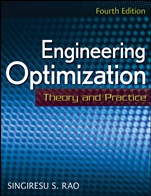
Engineering Optimization: Theory and Practice
ISBN 9780470183526
Autor: Singiresu S. Rao
Wydawca: Wiley
Dostępność: 3-6 tygodni
Cena: 920,85 zł
Przed złożeniem zamówienia prosimy o kontakt mailowy celem potwierdzenia ceny.
ISBN13: |
9780470183526 |
ISBN10: |
0470183527 |
Autor: |
Singiresu S. Rao |
Oprawa: |
Hardback |
Rok Wydania: |
2009-07-30 |
Numer Wydania: |
4th Edition |
Ilość stron: |
848 |
Wymiary: |
236x195 |
Tematy: |
PB |
Technology/Engineering/Mechanical
Helps you move from theory to optimizing engineering systems in almost any industry
Now in its Fourth Edition, Professor Singiresu Rao′s acclaimed text Engineering Optimization enables readers to quickly master and apply all the important optimization methods in use today across a broad range of industries. Covering both the latest and classical optimization methods, the text starts off with the basics and then progressively builds to advanced principles and applications.
This comprehensive text covers nonlinear, linear, geometric, dynamic, and stochastic programming techniques as well as more specialized methods such as multiobjective, genetic algorithms, simulated annealing, neural networks, particle swarm optimization, ant colony optimization, and fuzzy optimization. Each method is presented in clear, straightforward language, making even the more sophisticated techniques easy to grasp. Moreover, the author provides:
Case examples that show how each method is applied to solve real–world problems across a variety of industries
Review questions and problems at the end of each chapter to engage readers in applying their newfound skills and knowledge
Examples that demonstrate the use of MATLAB® for the solution of different types of practical optimization problems
References and bibliography at the end of each chapter for exploring topics in greater depth
Answers to Review Questions available on the author′s Web site to help readers to test their understanding of the basic concepts
With its emphasis on problem–solving and applications, Engineering Optimization is ideal for upper–level undergraduates and graduate students in mechanical, civil, electrical, chemical, and aerospace engineering. In addition, the text helps practicing engineers in almost any industry design improved, more efficient systems at less co
st.
Spis treści:
Preface.
1 Introduction to Optimization.
1.1 Introduction.
1.2 Historical Development.
1.3 Engineering Applications of Optimization.
1.4 Statement of an Optimization Problem.
1.5 Classification of Optimization Problems.
1.6 Optimization Techniques.
1.7 Engineering Optimization Literature.
1.8 Solution of Optimization Problems Using MATLAB.
References and Bibliography.
Review Questions.
Problems.
2 Classical Optimization Techniques.
2.1 Introduction.
2.2 Single–Variable Optimization.
2.3 Multivariable Optimization with No Constraints.
2.4 Multivariable Optimization with Equality Constraints.
2.5 Multivariable Optimization with Inequality Constraints.
2.6 Convex Programming Problem.
References and Bibliography.
Review Questions.
Problems.
3 Linear Programming I: Simplex Method.
3.1 Introduction.
3.2 Applications of Linear Programming.
3.3 Standard Form of a Linear Programming Problem.
3.4 Geometry of Linear Programming Problems.
3.5 Definitions and Theorems.
3.6 Solution of a System of Linear Simultaneous Equations.
3.7 Pivotal Reduction of a General System of Equations.
3.8 Motivation of the Simplex Method.
3.9 Simplex Algorithm.
3.10 Two Phases of the Simplex Method.
3.11 MATLAB Solution of LP Problems.
References and Bibliography.
Review Questions.
Problems.
4 Linear Programming II: Additional Topics and Extensions.
4.1 Introduction.
4.2 Revised Simplex Method.
4.3 Duality in Linear Programming.
4.4 Decomposition Principle.
4.5 Sensitivity or Postoptimality Analysis.
4.6 Transportation Problem.
4.7 Karmarkar’s Interior Method.
4.8 Quadratic Programming.
4.9 MATLAB Solutions.
References and Bibliography.
Review Questions.
Problems.
5 Nonlinear Programming I: One–Dimensional Minimization Methods.
5.1 Introduction.
5.2 U
nimodal Function.
ELIMINATION METHODS.
5.3 Unrestricted Search.
5.4 Exhaustive Search.
5.5 Dichotomous Search.
5.6 Interval Halving Method.
5.7 Fibonacci Method.
5.8 Golden Section Method.
5.9 Comparison of Elimination Methods.
INTERPOLATION METHODS.
5.10 Quadratic Interpolation Method.
5.11 Cubic Interpolation Method.
5.12 Direct Root Methods.
5.13 Practical Considerations.
5.14 MATLAB Solution of One–Dimensional Minimization Problems.
References and Bibliography.
Review Questions.
Problems.
6 Nonlinear Programming II: Unconstrained Optimization Techniques.
6.1 Introduction.
DIRECT SEARCH METHODS.
6.2 Random Search Methods.
6.3 Grid Search Method.
6.4 Univariate Method.
6.5 Pattern Directions.
6.6 Powell’s Method.
6.7 Simplex Method.
INDIRECT SEARCH (DESCENT) METHODS.
6.8 Gradient of a Function.
6.9 Steepest Descent (Cauchy) Method.
6.10 Conjugate Gradient (Fletcher–Reeves) Method.
6.11 Newton’s Method.
6.12 Marquardt Method.
6.13 Quasi–Newton Methods.
6.14 Davidon–Fletcher–Powell Method.
6.15 Broyden–Fletcher–Goldfarb–Shanno Method.
6.16 Test Functions.
6.17 MATLAB Solution of Unconstrained Optimization Problems.
References and Bibliography.
Review Questions.
Problems.
7 Nonlinear Programming III: Constrained Optimization Techniques.
7.1 Introduction.
7.2 Characteristics of a Constrained Problem.
DIRECT METHODS.
7.3 Random Search Methods.
7.4 Complex Method.
7.5 Sequential Linear Programming.
7.6 Basic Approach in the Methods of Feasible Directions.
7.7 Zoutendijk’s Method of Feasible Directions.
7.8 Rosen’s Gradient Projection Method.
7.9 Generalized Reduced Gradient Method.
7.10 Sequential Quadratic Programming.
INDIRECT METHODS.
7.11 Transformation Techniques.
7.12 Basic Approach of the Penalty Function Method.
7.13 Interior Penalty Function Method.
7.14 Convex Programming Problem.
7.15 Exterior Penalty Function Method.
7.16 Extrapolation Techniques in the Interior Penalty Function Method.
7.17 Extended Interior Penalty Function Methods.
7.18 Penalty Function Method for Problems with Mixed Equality and Inequality Constraints.
7.19 Penalty Function Method for Parametric Constraints.
7.20 Augmented Lagrange Multiplier Method.
7.21 Checking the Convergence of Constrained Optimization Problems.
7.22 Test Problems.
7.23 MATLAB Solution of Constrained Optimization Problems.
References and Bibliography.
Review Questions.
Problems.
8 Geometric Programming.
8.1 Introduction.
8.2 Posynomial.
8.3 Unconstrained Minimization Problem.
8.4 Solution of an Unconstrained Geometric Programming Program Using Differential Calculus.
8.5 Solution of an Unconstrained Geometric Programming Problem Using Arithmetic–Geometric Inequality.
8.6 Primal–Dual Relationship and Sufficiency Conditions in the Unconstrained Case.
8.7 Constrained Minimization.
8.8 Solution of a Constrained Geometric Programming Problem.
8.9 Primal and Dual Programs in the Case of Less–Than Inequalities.
8.10 Geometric Programming with Mixed Inequality Constraints.
8.11 Complementary Geometric Programming.
8.12 Applications of Geometric Programming.
References and Bibliography.
Review Questions.
Problems.
9 Dynamic Programming.
9.1 Introduction.
9.2 Multistage Decision Processes.
9.3 Concept of Suboptimization and Principle of Optimality.
9.4 Computational Procedure in Dynamic Programming.
9.5 Example Illustrating the Calculus Method of Solution.
9.6 Example Illustrating the Tabular Method of Solution.
9.7 Conversion of a Final Value Problem into an Initial Value Problem.
9.8 Linear Programming as a Case of Dynamic Programming.
9.9 Continuous Dynamic Programming.
9.10 Additiona
Koszyk
Książek w koszyku: 0 szt.
Wartość zakupów: 0,00 zł
Informacje


Kontakt
Gambit
Centrum Oprogramowania
i Szkoleń Sp. z o.o.
Al. Pokoju 29b/22-24
31-564 Kraków
Siedziba Księgarni
ul. Kordylewskiego 1
31-542 Kraków
+48 12 410 5991
+48 12 410 5987
+48 12 410 5989
Subskrypcje
Administratorem danych osobowych jest firma Gambit COiS Sp. z o.o. Na podany adres będzie wysyłany wyłącznie biuletyn informacyjny.
Autoryzacja płatności

Informacje na temat autoryzacji płatności poprzez PayU.

© Copyright 2012: GAMBIT COiS Sp. z o.o. Wszelkie prawa zastrzeżone.
Projekt i wykonanie: Alchemia Studio Reklamy