


Wydawcy
Katalog tematyczny
- Archeologia (1)
- Ekonomia, finanse, business (698)
- Filozofia (20)
- Historia (57)
- Języki i językoznawstwo (4)
- Lifestyle, hobby i rozrywka (32)
- Medycyna (1025)
- Nauki humanistyczne (2)
- Nauki o Ziemi i środowisku (430)
- Nauki ścisłe (1681)
- Nauki społeczne (1297)
- Nauki techniczne (530)
- Prawo (1437)
- Publikacje informacyjne i interdyscyplinarne (32)
- Religia i wierzenia (15)
- Technika komputerowa (237)
- Bazy danych (12)
- Bezpieczeństwo komputerowe (2)
- Grafika i media cyfrowe (2)
- Informatyka (108)
- Komputery, ogólnie (17)
- Programowanie (66)
- Programy komercyjne (6)
- Sieci komputerowe (13)
- Sprzęt komputerowy (2)
- Technika cyfrowa na co dzień (1)
- Zdrowie, relacje międzyludzkie i rozwój osobisty (4)





Informacje szczegółowe o książce
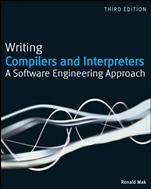
Writing Compilers and Interpreters: A Software Engineering Approach
ISBN 9780470177075
Autor: Ronald Mak
Wydawca: Wiley
Dostępność: 3-6 tygodni
Cena: 394,80 zł
Przed złożeniem zamówienia prosimy o kontakt mailowy celem potwierdzenia ceny.
ISBN13: |
9780470177075 |
ISBN10: |
0470177071 |
Autor: |
Ronald Mak |
Oprawa: |
Paperback |
Rok Wydania: |
2009-09-25 |
Numer Wydania: |
3rd Edition |
Ilość stron: |
864 |
Wymiary: |
235x190 |
Tematy: |
UP |
Master the skills you need to build your own compilers and interpreters
Compilers and interpreters are very difficult programs to write, but modern software engineering tackles the complexity. Design patterns and other object–oriented programming techniques guide you to develop well–structured code in incremental, understandable steps. Apply what you learn in this book to succeed with any complex software project.
You′ll learn to:
Use Java to develop scanners and parsers for programming languages
Employ UML to model software components
Manage symbol tables with the Java Collections Framework
Use XML to represent the generated intermediate code
Develop an interpreter to execute programs, including a powerful interactive source–level debugger
Implement an integrated development environment (IDE) that animates the execution of programs
Use the IDE′s graphical user interface to set breakpoints and single–step programs statement by statement with mouse clicks
Develop a code generator that emits object code for the Java Virtual Machine (JVM), and run the compiled code on multiple platforms
Spis treści:
Introduction.
Chapter 1 Introduction.
Chapter 2 Framework I: Compiler and Interpreter.
Chapter 3 Scanning.
Chapter 4 The Symbol Table.
Chapter 5 Parsing Expressions and Assignment Statements.
Chapter 6 Interpreting Expressions and Assignment Statements.
Chapter 7 Parsing Control Statements.
Chapter 8 Interpreting Control Statements.
Chapter 9 Parsing Declarations.
Chapter 10 Type Checking.
Chapter 11 Parsing Programs, Procedures, and Functions.
Chapter 12 Interpreting Pascal Programs.
Chapter 13 An Interactive Source–Level Debugger.
Chapter 14 Framework II: An Integrated Development Environment (IDE).
Chapter 15 Jasmin Assembly Language and Code Generation for the Java Virtual Machi
ne.
Chapter 16 Compiling Programs, Assignment Statements, and Expressions.
Chapter 17 Compiling Procedure and Function Calls and String Operations.
Chapter 18 Compiling Control Statements, Arrays, and Records.
Chapter 19 Additional Topics.
Index.
Nota biograficzna:
Ronald Mak wrote the earlier editions of this very successful book as well as The Martian Principles for Successful Enterprise Systems: 20 Lessons Learned from NASA′s Mars Exploration Rover Mission (also published by Wiley). He is also the author of Java Number Cruncher: The Java Programmer′s Guide to Numerical Computing. He develops advanced software systems for organizations from startups to NASA. Currently a research staff member at the IBM Almaden Research Center, he also teaches compiler writing and software engineering at San José State University.
Okładka tylna:
Master the skills you need to build your own compilers and interpreters
Compilers and interpreters are very difficult programs to write, but modern software engineering tackles the complexity. Design patterns and other object–oriented programming techniques guide you to develop well–structured code in incremental, understandable steps. Apply what you learn in this book to succeed with any complex software project.
You′ll learn to:
Use Java to develop scanners and parsers for programming languages
Employ UML to model software components
Manage symbol tables with the Java Collections Framework
Use XML to represent the generated intermediate code
Develop an interpreter to execute programs, including a powerful interactive source–level debugger
Implement an integrated development environment (IDE) that animates the execution of programs
Use the IDE′s graphical user interface to set breakpoints and single–step programs statement by statement with
mouse clicks
Develop a code generator that emits object code for the Java Virtual Machine (JVM), and run the compiled code on multiple platforms
Koszyk
Książek w koszyku: 0 szt.
Wartość zakupów: 0,00 zł
Informacje


Kontakt
Gambit
Centrum Oprogramowania
i Szkoleń Sp. z o.o.
Al. Pokoju 29b/22-24
31-564 Kraków
Siedziba Księgarni
ul. Kordylewskiego 1
31-542 Kraków
+48 12 410 5991
+48 12 410 5987
+48 12 410 5989
Subskrypcje
Administratorem danych osobowych jest firma Gambit COiS Sp. z o.o. Na podany adres będzie wysyłany wyłącznie biuletyn informacyjny.
Autoryzacja płatności

Informacje na temat autoryzacji płatności poprzez PayU.

© Copyright 2012: GAMBIT COiS Sp. z o.o. Wszelkie prawa zastrzeżone.
Projekt i wykonanie: Alchemia Studio Reklamy