


Wydawcy
Katalog tematyczny
- Archeologia (109)
- Ekonomia, finanse, business (13704)
- Filozofia (1445)
- Historia (3040)
- Języki i językoznawstwo (2356)
- Lifestyle, hobby i rozrywka (475)
- Medycyna (9704)
- Nauki humanistyczne (4)
- Nauki o Ziemi i środowisku (2638)
- Nauki ścisłe (20412)
- Astronomia (294)
- Biologia (5119)
- Chemia (6540)
- Fizyka (3309)
- Matematyka (4574)
- Algebra (171)
- Analiza matematyczna (902)
- Filozofia matematyki (1)
- Geometria (237)
- Historia matematyki (57)
- Kombinatoryka, teoria grafów (67)
- Matematyka dyskretna (35)
- Matematyka stosowana (555)
- Optymalizacja (104)
- Podstawy matematyki (129)
- Statystyka, prawdopodobieństwo (296)
- Teoria grup (63)
- Teoria liczb (77)
- Topologia (66)
- Nauki ścisłe, ogólnie (503)
- Nauki społeczne (8486)
- Nauki techniczne (13450)
- Prawo (1696)
- Publikacje informacyjne i interdyscyplinarne (1288)
- Religia i wierzenia (917)
- Technika komputerowa (4067)
- Zdrowie, relacje międzyludzkie i rozwój osobisty (657)





Informacje szczegółowe o książce
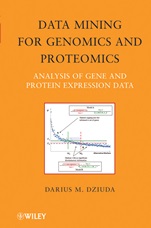
Data Mining for Genomics and Proteomics: Analysis of Gene and Protein Expression Data
ISBN 9780470163733
Autor: Darius M. Dziuda
Wydawca: Wiley
Dostępność: 3-6 tygodni
Cena: 513,45 zł
Przed złożeniem zamówienia prosimy o kontakt mailowy celem potwierdzenia ceny.
ISBN13: |
9780470163733 |
ISBN10: |
0470163739 |
Autor: |
Darius M. Dziuda |
Oprawa: |
Hardback |
Rok Wydania: |
2010-07-20 |
Ilość stron: |
328 |
Wymiary: |
240x157 |
Tematy: |
PB |
Practical methods for mining gene and protein expression data
Proper analysis and mining of the rapidly growing amount of available genomic and proteomic data is vital for advances in biomedical research. Data Mining for Genomics and Proteomics describes efficient methods for analysis of gene and protein expression data. Dr. Darius Dziuda demonstrates step by step how biomedical studies can and should be performed to maximize the chance of extracting new and useful biomedical knowledge from available data. Readers receive clear guidance on when to use particular data mining methods and why, along with the reasons why some popular approaches can lead to inferior results.
This book covers all aspects of gene and protein expression analysis—from technology, data preprocessing, quality assessment, and basic exploratory analysis to unsupervised and supervised learning algorithms, feature selection, and biomarker discovery. Also presented is a novel method for identification of the Informative Set of Genes, defined as a set containing all information significant for the differentiation of classes represented in training data. Special attention is given to multivariate biomarker discovery leading to parsimonious and generalizable classifiers. In addition, exercises and examples of hands–on analysis of real–world gene expression data sets give readers an opportunity to put the methods they have learned to practical use.
Data Mining for Genomics and Proteomics is an excellent resource for data mining specialists, bioinformaticians, computational biologists, biomedical scientists, computer scientists, molecular biologists, and life scientists. It is also ideal for upper–level undergraduate and graduate–level students of bioinformatics, data mining, computational biology, and biomedical sciences, as well as anyone interested in efficient methods of knowledge discovery based on high–dimensional data.
Spis treści:1. Introduction.
1.1 Basic terminology.
1.2 Overlapping areas of research.
1.2.1 Genomics.
1.2.2 Proteomics.
1.2.3 Bioinformatics.
1.2.4 Transcriptomics and other – omics ....
1.2.5 Data mining.
1. Basic analysis of gene expression microarray data.
2.1 Introduction.
2.2 Microarray technology.
2.3 Low–level preprocessing of Affymetrix microarrays.
2.4 Public repositories of microarray data.
2.5 Gene expression matrix.
2.6 Additional preprocessing, quality assessment and filtering.
2.7 Basic exploratory data analysis.
2.8 Unsupervised learning (taxonomy–related analysis).
2.8.1 Cluster analysis.
2.8.2 Principal component analysis.
2.8.3 Self–organizing maps.
2.9 Exercises.
1. Biomarker Discovery and Classification.
3.1 Overview.
3.2 Feature Selection.
3.2.1 Introduction.
3.2.2 Univariate versus multivariate approaches.
3.2.3 Supervised versus unsupervised methods.
3.2.4 Taxonomy of feature selection methods.
3.2.5 Feature selection for multiclass discrimination.
3.2.6 Regularization and feature selection.
3.2.7 Stability of biomarkers.
3.3 Discriminant Analysis.
3.3.1 Introduction.
3.3.2 Learning Algorithm.
3.3.3 A stepwise hybrid feature selection with T2.
3.4 Support Vector Machines.
3.4.1 Hard–Margin Support Vector Machines.
3.4.2 Soft– Margin Support Vector Machines.
3.4.3 Kernels.
3.4.4 SVMs and multiclass discrimination.
3.4.5 SVMs and Feature Selection: Recursive Feature Elimination.
3.4.6 Summary.
3.5 Random Forests.
3.5.1 Introduction.
3.5.2 Random Forests Learning Algorithm.
3.5.3 Random Forests and Feature Selection.
3.5.5 Summary.
3.6 Ensemble classifiers, bootstrap methods, and the modified bagging schema.
3.6.1 Ensemble classifiers.
3.6.2 Bootstrap methods.
3.6.3 Bootstrap and linear discriminant analysis.
3.6.4 The modified bagging schema.
3
.7 Other learning algorithms.
3.7.1 k–Nearest Neighbor classifiers.
3.7.2 Artificial Neural Networks.
3.8 Eight commandments of gene expression analysis (for biomarker discovery).
3.9 Exercises.
1. The Informative Set of Genes.
4.1 Introduction.
4.2 Definitions.
4.3 The method.
4.3.1 Identification of the Informative Set of Genes.
4.3.2 Primary expression patterns of the Informative Set of Genes.
4.3.3 The most frequently used genes of the primary expression patterns.
4.4 Using the Informative Set of Genes to identify robust multivariate biomarkers.
4.5 Summary.
4.6 Exercises.
1. Analysis of protein expression data.
5.1 Introduction.
5.2 Protein chip technology.
5.2.1 Antibody microarrays.
5.2.2 Peptide microarrays.
5.2.3 Protein microarrays.
5.2.4 Reverse phase microarrays.
5.3 Two–dimensional gel electrophoresis.
5.4 MALDI–TOF and SELDI–TOF mass spectrometry.
5.5 Preprocessing of mass spectrometry data.
5.6 Analysis of protein expression data.
5.6.1 Additional preprocessing.
5.6.2 Basic exploratory data analysis.
5.6.3 Unsupervised learning.
5.6.4 Supervised learning – feature selection and biomarker discovery.
5.6.5 Supervised learning – classification systems.
5.7 Associating biomarker peaks with proteins.
5.7.1 Introduction.
5.7.2 The Universal Protein Resource (UniProt).
5.7.3 Search programs.
5.7.4 Tandem mass spectrometry.
5.8 Summary.
1. Sketches for selected exercises.
6.1 Introduction.
6.2 Multiclass discrimination (Exercise 3.2).
6.3 Identifying the Informative Set of Genes (Exercises 4.2 to 4.6).
6.4 Using the Informative set of Genes to identify robust multivariate markers (Exercise 4.8).
6.5 Validating biomarkers on an independent test data set (Exercise 4.8).
6.6 Using a training set that combines more than one data set (Exercises 3.5 and 4.1 to 4.8).
Nota
biograficzna:
Darius M. Dziuda, PhD, is Associate Professor of Data Mining and Statistics in the Department of Mathematical Sciences at Central Connecticut State University (CCSU). His research and professional activities have been focused on efficient data mining of biomedical data and on methods for identification of parsimonious multivariate biomarkers for medical diagnosis, prognosis, personalized medicine, and drug discovery. For CCSU′s data mining program, Dr. Dziuda developed and teaches graduate–level courses on Data Mining for Genomics and Proteomics and on Biomarker Discovery.
Okładka tylna:
Practical methods for mining gene and protein expression data
Proper analysis and mining of the rapidly growing amount of available genomic and proteomic data is vital for advances in biomedical research. Data Mining for Genomics and Proteomics describes efficient methods for analysis of gene and protein expression data. Dr. Darius Dziuda demonstrates step by step how biomedical studies can and should be performed to maximize the chance of extracting new and useful biomedical knowledge from available data. Readers receive clear guidance on when to use particular data mining methods and why, along with the reasons why some popular approaches can lead to inferior results.
This book covers all aspects of gene and protein expression analysis—from technology, data preprocessing, quality assessment, and basic exploratory analysis to unsupervised and supervised learning algorithms, feature selection, and biomarker discovery. Also presented is a novel method for identification of the Informative Set of Genes, defined as a set containing all information significant for the differentiation of classes represented in training data. Special attention is given to multivariate biomarker discovery leading to parsimonious and generalizable classifiers. In addition, exercises and examples of hands–on analysis of real–world
Koszyk
Książek w koszyku: 0 szt.
Wartość zakupów: 0,00 zł
Informacje


Kontakt
Gambit
Centrum Oprogramowania
i Szkoleń Sp. z o.o.
Al. Pokoju 29b/22-24
31-564 Kraków
Siedziba Księgarni
ul. Kordylewskiego 1
31-542 Kraków
+48 12 410 5991
+48 12 410 5987
+48 12 410 5989
Subskrypcje
Administratorem danych osobowych jest firma Gambit COiS Sp. z o.o. Na podany adres będzie wysyłany wyłącznie biuletyn informacyjny.
Autoryzacja płatności

Informacje na temat autoryzacji płatności poprzez PayU.

© Copyright 2012: GAMBIT COiS Sp. z o.o. Wszelkie prawa zastrzeżone.
Projekt i wykonanie: Alchemia Studio Reklamy