


Wydawcy
Katalog tematyczny
- Archeologia (109)
- Ekonomia, finanse, business (13704)
- Filozofia (1445)
- Historia (3040)
- Języki i językoznawstwo (2356)
- Lifestyle, hobby i rozrywka (475)
- Medycyna (9704)
- Nauki humanistyczne (4)
- Nauki o Ziemi i środowisku (2638)
- Nauki ścisłe (20412)
- Astronomia (294)
- Biologia (5119)
- Chemia (6540)
- Fizyka (3309)
- Matematyka (4574)
- Algebra (171)
- Analiza matematyczna (902)
- Filozofia matematyki (1)
- Geometria (237)
- Historia matematyki (57)
- Kombinatoryka, teoria grafów (67)
- Matematyka dyskretna (35)
- Matematyka stosowana (555)
- Optymalizacja (104)
- Podstawy matematyki (129)
- Statystyka, prawdopodobieństwo (296)
- Teoria grup (63)
- Teoria liczb (77)
- Topologia (66)
- Nauki ścisłe, ogólnie (503)
- Nauki społeczne (8486)
- Nauki techniczne (13450)
- Prawo (1696)
- Publikacje informacyjne i interdyscyplinarne (1288)
- Religia i wierzenia (917)
- Technika komputerowa (4067)
- Zdrowie, relacje międzyludzkie i rozwój osobisty (657)





Informacje szczegółowe o książce
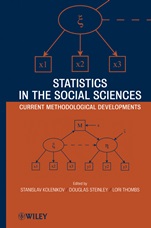
Statistics in the Social Sciences: Current Methodological Developments
ISBN 9780470148747
Autor: Stanislav Kolenikov, Lori Thombs, Douglas Steinley
Wydawca: Wiley
Dostępność: 3-6 tygodni
Cena: 484,05 zł
Przed złożeniem zamówienia prosimy o kontakt mailowy celem potwierdzenia ceny.
ISBN13: |
9780470148747 |
ISBN10: |
0470148748 |
Autor: |
Stanislav Kolenikov, Lori Thombs, Douglas Steinley |
Oprawa: |
Hardback |
Rok Wydania: |
2010-03-05 |
Ilość stron: |
222 |
Wymiary: |
234x156 |
Tematy: |
PB |
A one–of–a–kind compilation of modern statistical methods designed to support and advance research across the social sciences
Statistics in the Social Sciences: Current Methodological Developments presents new and exciting statistical methodologies to help advance research and data analysis across the many disciplines in the social sciences. Quantitative methods in various subfields, from psychology to economics, are under demand for constant development and refinement. This volume features invited overview papers, as well as original research presented at the Sixth Annual Winemiller Conference: Methodological Developments of Statistics in the Social Sciences, an international meeting that focused on fostering collaboration among mathematical statisticians and social science researchers.
The book provides an accessible and insightful look at modern approaches to identi–fying and describing current, effective methodologies that ultimately add value to various fields of social science research. With contributions from leading international experts on the topic, the book features in–depth coverage of modern quantitative social sciences topics, including:
Correlation Structures
Structural Equation Models and Recent Extensions
Order–Constrained Proximity Matrix Representations
Multi–objective and Multi–dimensional Scaling
Differences in Bayesian and Non–Bayesian Inference
Bootstrap Test of Shape Invariance across Distributions
Statistical Software for the Social Sciences
Statistics in the Social Sciences: Current Methodological Developments is an excellent supplement for graduate courses on social science statistics in both statistics departments and quantitative social sciences programs. It is also a valuable reference for researchers and practitioners in the fields of psychology, sociology, economics, and market research.
Spis treści:
List of Figures.
List of Tables.
Preface.
1 Analysis of Correlation Structures: Current Status and Open Problems.
1.1 Introduction.
1.2 Correlation versus Covariance Structures.
1.3 Estimation and Model Testing.
1.3.1 Basic Asymptotic Theory.
1.3.2 Distribution of T Under Model Misspecification.
1.3.3 Distribution of T Under Weight Matrix Misspecification.
1.3.4 Estimation and Testing with Arbitrary Distributions.
1.3.5 Tests of Model Fit Under Distributional Misspecification.
1.3.6 Scaled and Adjusted Statistics.
1.3.7 Normal Theory Estimation and Testing.
1.3.8 Elliptical Theory Estimation and Testing.
1.3.9 Heterogeneous Kurtosis Theory Estimation and Testing.
1.3.10 Least Squares Estimation and Testing.
1.4 Example.
1.5 Simulations.
1.5.1 Data.
1.5.2 Correlation Structure with ADF Estimation and Testing.
1.5.3 Correlation Structure with Robust Least Squares Methods.
1.6 Discussion.
References.
2 Overview of Structural Equation Models and Recent Extensions.
2.1 Model Specification and Assumptions.
2.1.1 Illustration of Special Cases.
2.1.2 Modeling Steps.
2.2 Multilevel SEM.
2.2.1 The Between–and–Within Specification.
2.2.2 Random Effects as Factors Specification.
2.2.3 Summary and Comparison.
2.3 Structural Equation Mixture Models.
2.3.1 The Model.
2.3.2 Estimation.
2.3.3 Sensitivity to Assumptions.
2.3.4 Direct and Indirect Applications.
2.3.5 Summary.
2.4 Item Response Models.
2.4.1 Categorical CFA.
2.4.2 CCFA Estimation.
2.4.3 Item Response Theory.
2.4.4 CCFA and IRT.
2.4.5 Advantages and Disadvantages.
2.5 Complex Samples and Sampling Weights.
2.5.1 Complex Samples and Their Features.
2.5.2 Probability (Sampling) Weights.
2.5.3 Violations of SEM Assumptions.
2.5.4 SEM Analysis Using Complex Samples with Unequal Probabilities of Selection.
2.5.5 Future
Research.
2.6 Conclusion.
References.
3 Order–Constrained Proximity Matrix Representations.
3.1 Introduction.
3.1.1 Proximity Matrix for Illustration: Agreement Among Supreme Court Justices.
3.2 Order–Constrained Ultrametrics.
3.2.1 The M–file ultrafndxonfit.m.
3.2.2 The M–file ultrafnd.confnd.rn.
3.2.3 Representing an (Order–Constrained) Ultrametric.
3.2.4 Alternative (and Generalizable) Graphical Representation for an Ultrametric.
3.2.5 Alternative View of Ultrametric Matrix Decomposition.
3.3 Ultrametric Extensions by Fitting Partitions Containing Contiguous Subsets.
3.3.1 Ordered Partition Generalizations.
3.4 Extensions to Additive Trees: Incorporating Centroid Metrics.
References.
4 Multiobjective Multidimensional (City–Block) Scaling.
4.1 Introduction.
4.2 City–Block MDS.
4.3 Multiobjective City–Block MDS.
4.3.1 The Metric Multiobjective City–Block MDS Model.
4.3.2 The Nonmetric Multiobjective City–Block MDS Model.
4.4 Combinatorial Heuristic.
4.5 Numerical Examples.
4.5.1 Example 1.
4.5.2 Example 2.
4.6 Summary and Conclusions.
References.
5 Critical Differences in Bayesian and Non–Bayesian Inference.
5.1 Introduction.
5.2 The Mechanics of Bayesian Inference.
5.2.1 Example with Count Data.
5.2.2 Comments on Prior Distributions.
5.3 Specific Differences Between Bayesians and non–Bayesians.
5.4 Paradigms For Testing.
5.5 Change–point Analysis of Thermonuclear Testing Data.
5.6 Conclusion.
References.
6 Bootstrap Test of Shape Invariance Across Distributions.
6.1 Lack of Robustness of a Parametric Test.
6.2 Development of a Nonparametric Shape Test.
6.3 Example.
6.4 Extension of the Shape Test.
6.5 Characteristics of the Bootstrap Shape Test.
6.6 Application.
6.7 Conclusion.
References.
7 Statistical Software for t
he Social Sciences.
7.1 Social Science Research: Primary Capabilities.
7.2 STATISTICAL SOCIAL SCIENCE STATISTICAL APPLICATIONS.
7.2.1 R.
7.2.2 SAS.
7.2.3 SPSS.
7.2.4 Stata.
7.2.5 STATISTIC A.
7.2.6 StatXact/LogXact.
7.3 STATISTICAL APPLICATION UTILITIES.
7.3.1 Stat/Transfer.
7.3.2 ePrint Professional.
7.3.3 nQuery Advisor.
7.4 Summary Comments.
References.
8 Conclusion: Roundtable Discussion.
Index.
Nota biograficzna:
STANISLAV KOLENIKOV, PhD, is Adjunct Assistant Professor of Statistics at the University of Missouri. He served as Program Chair of the Sixth Winemiller Conference. Dr. Kolenikov is an applied statistician with interests in structural equation modeling, survey statistics, econometrics, and statistical programming.
DOUGLAS STEINLEY, PhD, is Associate Professor of Psychology at the University of Missouri. Dr. Steinley currently conducts research in the areas of multivariate statistical methodology, cluster analysis, and social network analysis.
LORI THOMBS, PhD, is Associate Professor of Statistics and Director of the Social Science Statistics Center at the University of Missouri. Dr. Thombs has more than twenty years of academic experience, and she currently focuses her research on the areas of time series, resampling methods for correlated variables, and statistics education.
Okładka tylna:
A one–of–a–kind compilation of modern statistical methods designed to support and advance research across the social sciences
Statistics in the Social Sciences: Current Methodological Developments presents new and exciting statistical methodologies to help advance research and data analysis across the many disciplines in the social sciences. Quantitative methods in various subfields, from psychology to economics, are under demand for constant development and refinement. This volume features invited ov
erview papers, as well as original research presented at the Sixth Annual Winemiller Conference: Methodological Developments of Statistics in the Social Sciences, an international meeting that focused on fostering collaboration among mathematical statisticians and social science researchers.
The book provides an accessible and insightful look at modern approaches to identi–fying and describing current, effective methodologies that ultimately add value to various fields of social science research. With contributions from leading international experts on the topic, the book features in–depth coverage of modern quantitative social sciences topics, including:
Correlation Structures
Structural Equation Models and Recent Extensions
Order–Constrained Proximity Matrix Representations
Multi–objective and Multi–dimensional Scaling
Differences in Bayesian and Non–Bayesian Inference
Bootstrap Test of Shape Invariance across Distributions
Statistical Software for the Social Sciences
Statistics in the Social Sciences: Current Methodological Developments is an excellent supplement for graduate courses on social science statistics in both statistics departments and quantitative social sciences programs. It is also a valuable reference for researchers and practitioners in the fields of psychology, sociology, economics, and market research.
Koszyk
Książek w koszyku: 0 szt.
Wartość zakupów: 0,00 zł
Informacje


Kontakt
Gambit
Centrum Oprogramowania
i Szkoleń Sp. z o.o.
Al. Pokoju 29b/22-24
31-564 Kraków
Siedziba Księgarni
ul. Kordylewskiego 1
31-542 Kraków
+48 12 410 5991
+48 12 410 5987
+48 12 410 5989
Subskrypcje
Administratorem danych osobowych jest firma Gambit COiS Sp. z o.o. Na podany adres będzie wysyłany wyłącznie biuletyn informacyjny.
Autoryzacja płatności

Informacje na temat autoryzacji płatności poprzez PayU.

© Copyright 2012: GAMBIT COiS Sp. z o.o. Wszelkie prawa zastrzeżone.
Projekt i wykonanie: Alchemia Studio Reklamy