


Wydawcy
Katalog tematyczny
- Archeologia (94)
- Ekonomia, finanse, business (11664)
- Filozofia (1411)
- Historia (2972)
- Języki i językoznawstwo (2311)
- Lifestyle, hobby i rozrywka (411)
- Medycyna (5054)
- Nauki humanistyczne (2)
- Nauki o Ziemi i środowisku (1033)
- Nauki ścisłe (10005)
- Astronomia (12)
- Biologia (1261)
- Chemia (5074)
- Fizyka (1553)
- Matematyka (1875)
- Algebra (11)
- Analiza matematyczna (26)
- Geometria (6)
- Matematyka stosowana (115)
- Podstawy matematyki (1)
- Statystyka, prawdopodobieństwo (21)
- Nauki ścisłe, ogólnie (177)
- Nauki społeczne (6049)
- Nauki techniczne (5313)
- Prawo (160)
- Publikacje informacyjne i interdyscyplinarne (706)
- Religia i wierzenia (900)
- Technika komputerowa (2101)
- Zdrowie, relacje międzyludzkie i rozwój osobisty (632)





Informacje szczegółowe o książce
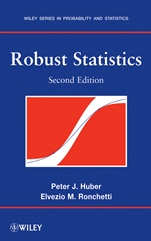
Robust Statistics
ISBN 9780470129906
Autor: Peter J. Huber, Elvezio M. Ronchetti
Wydawca: Wiley
Dostępność: 3-6 tygodni
Cena: 681,45 zł
Przed złożeniem zamówienia prosimy o kontakt mailowy celem potwierdzenia ceny.
ISBN13: |
9780470129906 |
ISBN10: |
0470129905 |
Autor: |
Peter J. Huber, Elvezio M. Ronchetti |
Oprawa: |
Hardback |
Rok Wydania: |
2009-03-06 |
Numer Wydania: |
2nd Edition |
Ilość stron: |
384 |
Wymiary: |
234x156 |
Tematy: |
PB |
A new edition of the classic, groundbreaking book on robust statistics
Over twenty–five years after the publication of its predecessor, Robust Statistics, Second Edition continues to provide an authoritative and systematic treatment of the topic. This new edition has been thoroughly updated and expanded to reflect the latest advances in the field while also outlining the established theory and applications for building a solid foundation in robust statistics for both the theoretical and the applied statistician.
A comprehensive introduction and discussion on the formal mathematical background behind qualitative and quantitative robustness is provided, and subsequent chapters delve into basic types of scale estimates, asymptotic minimax theory, regression, robust covariance, and robust design. In addition to an extended treatment of robust regression, the Second Edition features four new chapters covering:
Robust Tests
Small Sample Asymptotics
Breakdown Point
Bayesian Robustness
An expanded treatment of robust regression and pseudo–values is also featured, and concepts, rather than mathematical completeness, are stressed in every discussion. Selected numerical algorithms for computing robust estimates and convergence proofs are provided throughout the book, along with quantitative robustness information for a variety of estimates. A General Remarks section appears at the beginning of each chapter and provides readers with ample motivation for working with the presented methods and techniques.
Robust Statistics, Second Edition is an ideal book for graduate–level courses on the topic. It also serves as a valuable reference for researchers and practitioners who wish to study the statistical research associated with robust statistics.
Spis treści:
Preface.
Preface to First Edition.
1. Generalities.
1.1 Why Robust Procedures?
1.2 What Should a
Robust Procedure Achieve?
1.3 Qualitative Robustness.
1.4 Quantitative Robustness.
1.5 Infinitesimal Aspects.
1.6 Optimal Robustness.
1.7 Computation of Robust Estimates.
1.8 Limitations to Robustness Theory.
2. The Weak Topology and its Metrization.
2.1 General Remarks.
2.2 The Weak Topology.
2.3 Lévy and Prohorov Metrics.
2.4 The Bounded Lipschitz Metric.
2.5 Fréechet and Gâteaux Derivatives.
2.6 Hampel’s Theorem.
3. The Basic Types of Estimates.
3.1 General Remarks.
3.2 Maximum Likelihood Type Estimates (MEstimates).
3.3 Linear Combinations of Order Statistics (LEstimates).
3.4 Estimates Derived from Rank Tests (REstimates).
3.5 Asymptotically Efficient M, L, and REstimates.
4. Asymptotic Minimax Theory for Estimating Location.
4.1 General Remarks.
4.2 Minimax Bias.
4.3 Minimax Variance: Preliminaries.
4.4 Distributions Minimizing Fisher Information.
4.5 Determination of F0 by Variational Methods.
4.6 Asymptotically Minimax MEstimates.
4.7 On the Minimax Property for Land REstimates.
4.8 Redescending MEstimates.
4.9 Questions of Asymmetric Contamination.
5. Scale Estimates.
5.1 General Remarks.
5.2 MEstimates of Scale.
5.3 LEstimates of Scale.
5.4 REstimates of Scale.
5.5 Asymptotically Efficient Scale Estimates.
5.6 Distributions Minimizing Fisher Information for Scale.
5.7 Minimax Properties.
6. Multiparameter Problems, in Particular Joint Estimation of Location and Scale.
6.1 General Remarks.
6.2 Consistency of MEstimates.
6.3 Asymptotic Normality of MEstimates.
6.4 Simultaneous MEstimates of Location and Scale.
6.5 MEstimates with Preliminary Estimates of Scale.
6.6 Quantitative Robustness of Joint Estimates of Location and Scale.
6.7 The Computation of MEstimates of Scale.
6.8 Studentizing.
7. Regression.
7.1 General Remarks.
7.2 The Classical Linear
Least Squares Case.
7.2.1 Residuals and Outliers.
7.3 Robustizing the Least Squares Approach.
7.4 Asymptotics of Robust Regression Estimates.
7.5 Conjectures and Empirical Results.
7.6 Asymptotic Covariances and Their Estimation.
7.7 Concomitant Scale Estimates.
7.8 Computation of Regression MEstimates.
7.9 The Fixed Carrier Case: what size hi?
7.10 Analysis of Variance.
7.11 L1estimates and Median Polish.
7.12 Other Approaches to Robust Regression.
8. Robust Covariance and Correlation Matrices.
8.1 General Remarks.
8.2 Estimation of Matrix Elements Through Robust Variances.
8.3 Estimation of Matrix Elements Through Robust Correlation.
8.4 An Affinely Equivariant Approach.
8.5 Estimates Determined by Implicit Equations.
8.6 Existence and Uniqueness of Solutions.
8.7 Influence Functions and Qualitative Robustness.
8.8 Consistency and Asymptotic Normality.
8.9 Breakdown Point.
8.10 Least Informative Distributions.
8.11 Some Notes on Computation.
9. Robustness of Design.
9.1 General Remarks.
9.2 Minimax Global Fit.
9.3 Minimax Slope.
10. Exact Finite Sample Results.
10.1 General Remarks.
10.2 Lower and Upper Probabilities and Capacities.
10.3 Robust Tests.
10.4 Sequential Tests.
10.5 The NeymanPearson Lemma for 2Alternating Capacities.
10.6 Estimates Derived From Tests.
10.7 Minimax Interval Estimates.
11. Finite Sample Breakdown Point.
11.1 General Remarks.
11.2 Definition and Examples.
11.3 Infinitesimal Robustness and Breakdown.
11.4 Malicious versus Stochastic Breakdown.
12. Infinitesimal Robustness.
12.1 General Remarks.
12.2 Hampel’s Infinitesimal Approach.
12.3 Shrinking Neighborhoods.
13. Robust Tests.
13.1 General Remarks.
13.2 Local Stability of a Test.
13.3 Tests for General Parametric Models in the Multivariate Case.
13.4 Robust Tests for Regression and
Generalized Linear Models.
14. Small Sample Asymptotics.
14.1 General Remarks.
14.2 Saddlepoint Approximation for the Mean.
14.3 Saddlepoint Approximation of the Density of Mestimators.
14.4 Tail Probabilities.
14.5 Marginal Distributions.
14.6 Saddlepoint Test.
14.7 Relationship with Nonparametric Techniques.
15. Bayesian Robustness.
15.1 General Remarks.
15.2 Disparate Data and Problems with the Prior.
15.3 Maximum Likelihood and Bayes Estimates.
15.4 Some Asymptotic Theory.
15.5 Minimax Asymptotic Robustness Aspects.
15.6 Nuisance Parameters.
15.7 Why there is no Finite Sample Bayesian Robustness Theory.
References.
Index.
Nota biograficzna:
Peter J. Huber, PhD, has over thirty–five years of academic experience and has previously served as professor of statistics at ETH Zurich (Switzerland), Harvard University, Massachusetts Institute of Technology, and the University of Bayreuth (Germany). An established authority in the field of robust statistics, Dr. Huber is the author or coauthor of four books and more than seventy journal articles in the areas of statistics and data analysis. Elvezio M. Ronchetti, PhD, is Professor of Statistics in the Department of Econometrics at the University of Geneva in Switzerland. Dr. Ronchetti is a Fellow of the American Statistical Association and coauthor of Robust Statistics: The Approach Based on Influence Functions, also published by Wiley.
Okładka tylna:
A new edition of the classic, groundbreaking book on robust statistics
Over twenty–five years after the publication of its predecessor, Robust Statistics, Second Edition continues to provide an authoritative and systematic treatment of the topic. This new edition has been thoroughly updated and expanded to reflect the latest advances in the field while also outlining the established theory and applications for building a solid foundation in rob
Koszyk
Książek w koszyku: 0 szt.
Wartość zakupów: 0,00 zł
Informacje


Kontakt
Gambit
Centrum Oprogramowania
i Szkoleń Sp. z o.o.
Al. Pokoju 29b/22-24
31-564 Kraków
Siedziba Księgarni
ul. Kordylewskiego 1
31-542 Kraków
+48 12 410 5991
+48 12 410 5987
+48 12 410 5989
Subskrypcje
Administratorem danych osobowych jest firma Gambit COiS Sp. z o.o. Na podany adres będzie wysyłany wyłącznie biuletyn informacyjny.
Autoryzacja płatności

Informacje na temat autoryzacji płatności poprzez PayU.

© Copyright 2012: GAMBIT COiS Sp. z o.o. Wszelkie prawa zastrzeżone.
Projekt i wykonanie: Alchemia Studio Reklamy