


Wydawcy
Katalog tematyczny
- Archeologia (109)
- Ekonomia, finanse, business (13704)
- Filozofia (1445)
- Historia (3040)
- Języki i językoznawstwo (2356)
- Lifestyle, hobby i rozrywka (475)
- Medycyna (9704)
- Nauki humanistyczne (4)
- Nauki o Ziemi i środowisku (2638)
- Nauki ścisłe (20412)
- Nauki społeczne (8486)
- Nauki techniczne (13450)
- Prawo (1696)
- Publikacje informacyjne i interdyscyplinarne (1288)
- Religia i wierzenia (917)
- Technika komputerowa (4067)
- Bazy danych (75)
- Bezpieczeństwo komputerowe (454)
- Certyfikacja komputerowa (1)
- Grafika i media cyfrowe (32)
- Informatyka (779)
- Komputery, ogólnie (74)
- Programowanie (351)
- Programy komercyjne (49)
- Sieci komputerowe (350)
- Sprzęt komputerowy (4)
- Systemy operacyjne (32)
- Technika cyfrowa na co dzień (7)
- Zdrowie, relacje międzyludzkie i rozwój osobisty (657)





Informacje szczegółowe o książce
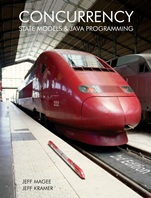
Concurrency: State Models and Java Programs
ISBN 9780470093559
Autor: Jeff Magee, Jeff Kramer
Wydawca: Wiley
Dostępność: 3-6 tygodni
Cena: 336,00 zł
Przed złożeniem zamówienia prosimy o kontakt mailowy celem potwierdzenia ceny.
ISBN13: |
9780470093559 |
ISBN10: |
0470093552 |
Autor: |
Jeff Magee, Jeff Kramer |
Oprawa: |
Hardback |
Rok Wydania: |
2006-04-21 |
Numer Wydania: |
2nd Edition |
Ilość stron: |
434 |
Wymiary: |
235x189 |
Tematy: |
UP |
I love this book! It is beautifully written and the combinedFSP/Java approach to model–based development is leading–edge. The supporting materials, including the LTSA software and thelecture slides, are superb. ( Scott Smolka, SUNY at StonyBrook)
This book provides a systematic and practical approach todesigning, analyzing and implementing concurrent programs, usingboth state models and Java programs to introduce and illustrate keyconcepts and techniques. Topics covered include:
threads and interaction interference, exclusion and synchronization deadlock, safety and liveness properties message passing concurrent software architectures dynamic and timed systems.Established as a key learning resource for computer sciencegraduate and undergraduate students, this second edition includesnew coverage of Program Verification and Logical Properties. Theaccompanying website contains an updated version of the LTSA toolfor modeling concurrency, model animation and model checking. Thewebsite also includes the full set of state models, Java examplesand demonstration programs and a comprehensive series of overheadslides for course presentation.
Ideal for classroom use or self–study, this book providesreaders with the means to understand the fundamentals and practiceof concurrency.
Preface.
Acknowledgments.
1. Introduction.
1.1 Concurrent Programs.
1.2 The Modeling Approach.
1.3 Practice.
1.4 Content Overview.
Summary.
Notes and Further Reading.
2. Processes and Threads.
2.1 Modeling Processes.
2.2 Implementing Processes.
Summary.
Notes and Further Reading.
Exercises.
3. Concurrent Execution.
3.1 Modeling Concurrency.
3.2 Multi–Threaded Programs.
Summary.
Notes and Further Reading.
Exercises.
4. Shared Objects and Mutual Exclusion.
4.1 Interference.
4.2 Mutual Exclusion in Java.
4.3 Modeling Mutual Exclusion.
Summary.
Notes and Further Reading.
Exercises.
5. Monitors and Condition Synchronization.
5.1 Condition Synchronization.
5.2 Semaphores.
5.3 Bounded Buffers.
5.4 Nested Monitors.
5.5 Monitor Invariants.
Summary.
Notes and Further Reading.
Exercises.
6. Deadlock.
6.1 Deadlock Analysis.
6.2 Dining Philosophers Problem.
Summary.
Notes and Further Reading.
Exercises.
7. Safety and Liveness Properties.
7.1 Safety.
7.2 Single–Lane Bridge Problem.
7.3 Liveness.
7.4 Liveness of the Single–Lane Bridge.
7.5 Readers Writers Problem.
Summary.
Notes and Further Reading.
Exercises.
8. Model–Based Design.
8.1 From Requirements to Models.
8.2 From Models to Implementation.
Summary.
Notes and Further Reading
Exercises.
9. Dynamic Systems.
9.1 Golf Club Program.
9.2 Golf Club Model.
9.3 Fair Allocation.
9.4 Revised Golf Ball Allocator.
9.5 Bounded Overtaking.
9.6 Bounded Overtaking Golf Ball Allocator.
9.7 Master Slave Program.
9.8 Master Slave Model.
Summary.
Notes and Further Reading.
Exercises.
10. Message Passing.
10.1 Synchronous Message Passing.
10.2 Asynchronous Message Passing.
10.3 Rendezvous.
Summary.
Notes and Further Reading.
Exercises.
11. Concurrent Architectures.
11.1 Filter Pipeline.
11.2 Supervisor Worker.
11.3 Announcer Listener.
Summary.
Notes and Further Reading.
Exercises.
12. Timed Systems.
12.1 Modeling Timed Systems.
12.2 Implementing Timed Systems.
12.3 Parcel Router Problem.
12.4 Space Invaders.
Summary.
Notes and Further Reading.
Exercises.
13.ihl Program Verification.
13.1 Sequential Processes.
13.2 Modeling Condition Synchronization.
13.3 Modeling Variables and Synchronized Methods.
13.4 Bounded Buffer Example.
13.5 Readers Writers Example.
Summary.
Notes and Further Reading.
Exercises.
14. Logical Properties.
14.1 Fluent Propositions.
14.2 Temporal Propositions.
14.3 Fluent Linear Temporal Logic (FLTL).
14.4 Database Ring Problem.
Summary.
Notes and Further Reading.
Exercises.
Appendix A: FSP Quick Reference.
Appendix B: FSP Language Specification.
Appendix C: FSP Semantics.
Appendix D: UML Class Diagrams.
Bibliography.
Index.
Jeff Magee and Jeff Kramer are both of Imperial College of Science, Technology and Medicine, London, UK
Koszyk
Książek w koszyku: 0 szt.
Wartość zakupów: 0,00 zł
Informacje


Kontakt
Gambit
Centrum Oprogramowania
i Szkoleń Sp. z o.o.
Al. Pokoju 29b/22-24
31-564 Kraków
Siedziba Księgarni
ul. Kordylewskiego 1
31-542 Kraków
+48 12 410 5991
+48 12 410 5987
+48 12 410 5989
Subskrypcje
Administratorem danych osobowych jest firma Gambit COiS Sp. z o.o. Na podany adres będzie wysyłany wyłącznie biuletyn informacyjny.
Autoryzacja płatności

Informacje na temat autoryzacji płatności poprzez PayU.

© Copyright 2012: GAMBIT COiS Sp. z o.o. Wszelkie prawa zastrzeżone.
Projekt i wykonanie: Alchemia Studio Reklamy