


Wydawcy
Katalog tematyczny
- Archeologia (109)
- Ekonomia, finanse, business (13704)
- Filozofia (1445)
- Historia (3040)
- Języki i językoznawstwo (2356)
- Lifestyle, hobby i rozrywka (475)
- Medycyna (9704)
- Nauki humanistyczne (4)
- Nauki o Ziemi i środowisku (2638)
- Nauki ścisłe (20412)
- Nauki społeczne (8486)
- Nauki techniczne (13450)
- Prawo (1696)
- Publikacje informacyjne i interdyscyplinarne (1288)
- Religia i wierzenia (917)
- Technika komputerowa (4067)
- Bazy danych (75)
- Bezpieczeństwo komputerowe (454)
- Certyfikacja komputerowa (1)
- Grafika i media cyfrowe (32)
- Informatyka (779)
- Komputery, ogólnie (74)
- Programowanie (351)
- Programy komercyjne (49)
- Sieci komputerowe (350)
- Sprzęt komputerowy (4)
- Systemy operacyjne (32)
- Technika cyfrowa na co dzień (7)
- Zdrowie, relacje międzyludzkie i rozwój osobisty (657)





Informacje szczegółowe o książce
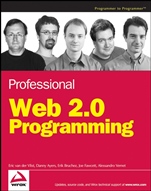
Professional Web 2.0 Programming
ISBN 9780470087886
Autor: Eric van der Vlist, Danny Ayers, Erik Bruchez, Joe Fawcett, Alessandro Vernet
Wydawca: Wiley
Dostępność: 3-6 tygodni
Cena: 190,05 zł
Przed złożeniem zamówienia prosimy o kontakt mailowy celem potwierdzenia ceny.
ISBN13: |
9780470087886 |
ISBN10: |
0470087889 |
Autor: |
Eric van der Vlist, Danny Ayers, Erik Bruchez, Joe Fawcett, Alessandro Vernet |
Oprawa: |
Paperback |
Rok Wydania: |
2006-11-24 |
Ilość stron: |
552 |
Wymiary: |
234x193 |
Tematy: |
UV |
Web 2.0 architecture opens up an incredible number of options for flexible web design, creative reuse, and easier updates. Along with covering the key languages and techniques of Web 2.0, this unique book introduces you to all of the technologies that make up Web 2.0 at a professional level. Throughout the chapters, you′ll find code for several example applications built with popular frameworks that you′ll be able to utilize.
You′ll first explore the technologies that are used to create Web 2.0 applications. This includes an in–depth look at XHTML, Cascading Style Sheets (CSS), JavaScript, and Ajax. Next, you′ll gain a better understanding of the protocols and formats that enable the exchange of information between web clients and servers. Ultimately, you′ll discover exactly what you need to know about server–side programming in order to implement new ideas and develop your own robust applications.
What you will learn from this bookHow Web 2.0 applications are developedNew ways to get the major client–side technologies to work togetherThe new class of emerging toolsAll about HTTP and URIs, XML, syndication, microformats, and Web ServicesTechniques for implementing and maintaining your URI spaceHow to serve XML over HTTPSteps for building mashups to aggregate information from multiple sourcesMethods for enhancing security in your applications
Who this book is for
This book is for professional developers who have a basic understanding of HTML, CSS, JavaScript, and XML.
Wrox Professional guides are planned and written by working programmers to meet the real–world needs of programmers, developers, and IT professionals. Focused and relevant, they address the issues technology professionals face every day. They provide examples, practical solutions, and expert education in new technologies, all designed to help programmers do a better
job.
Spis treści:
Foreword.
Acknowledgments.
Introduction.
Chapter 1: Hello Web 2.0 World.
Introducing BuzzWatch.
Charting the Landscape.
Exploring Behind the Scene.
Making BuzzWatch a Better Web Citizen.
Making BuzzWatch More Maintainable.
Applying the Final Touch.
Conclusion.
Chapter 2: Page Presentation.
Creating Clean and Simple Pages.
From HTML to XHTML.
The Document Object Model.
Cascading Style Sheets.
Tools.
Summary.
Chapter 3: JavaScript and Ajax.
JavaScript: Understanding Lesser–Known but Crucial Features.
JavaScript Optimizations.
Ajax.
Summary.
Chapter 4: Design Principles.
Common Design Issues.
Summary 109
Chapter 5: What’s Next for Web 2.0?
XSLT and XPath.
SVG.
XForms.
What’s Next for HTML.
Summary.
Chapter 6: Rich Client Alternatives.
From Browsers to Rich Clients.
Comparing Rich Client Frameworks.
Summary.
Chapter 7: HTTP and URIs.
How the Web Was Won.
Web 1.0: HTML, URLs, and HTTP.
The Web Model and REST.
Considerations for Building an HTTP Service.
What’s on the Wire?
More Representations.
Summary.
Chapter 8: XML and Its Alternatives.
XML.
Alternatives to XML.
Summary.
Chapter 9: Syndication.
Some Syndication Basics.
The Syndication Process.
Syndication Formats.
Summary.
Chapter 10: Microformats.
The Basics of Microformats.
Creating Microformat Documents.
Summary.
Chapter 11: Combining Protocols to Build Web Services.
Clarifying Web Services.
REST Services.
WS–∗ Services.
REST versus WS–∗.
Summary.
Chapter 12: Serving XML over HTTP.
How Is Serving HTML Different?
Serving Static Content.
Serving Dynamic Content.
XQuery and XML Databases.
Serving JSON.
Summary.
Chapter 13: Databases and No
n–XML Sources.
Dealing with Non–XML Sources.
Converting Relational Data to XML.
Converting Binary Data to XML.
Summary.
Chapter 14: Creating Syndication Channels.
A Simple Atom Service.
Running the Application.
Adding E–mail Support.
Summary.
Chapter 15: Mashups, HTML Scraping, and Web Services.
Popular Examples: Mapping Mashups.
Why Use Mashups?
The Business Model of Mashups.
Screen Scraping.
Creating Feeds.
Mapping and Badges.
Summary.
Chapter 16: Implementing and Maintaining Your URI Space.
Future–Proofing Your URIs.
Managing Change in Your URI Space.
Your URI Mapping Toolbox.
Summary.
Chapter 17: Podcasting and Serving Multimedia.
The Formats Labyrinth.
Protocols.
Summary.
Chapter 18: Security.
What Is Security?
Lessons Learned from History.
The Layered Approach.
Authentication and Authorization.
Message Encryption.
Message Digests.
Digital Certificates.
Secure Sockets Layer.
Code Security.
Web Services Security.
Summary.
Index.
Nota biograficzna:
Eric van der Vlist is an independent consultant and trainer. His domain of expertise includes Web development and XML technologies. He is the creator and main editor of XMLfr.org, the main site dedicated to XML technologies in French, the author of the O’Reilly books XML Schema and RELAX NG, and a member or the ISO DSDL (http://dsdl.org) working group, which focuses on XML schema languages. He is based in Paris and you can reach him by mail (vdv@dyomedea.com) or meet him at one of the many conferences where he presents his projects.
Alessandro Vernet has been involved with web and XML technologies from day one. Prior to co–founding Orbeon, he worked at Symantec Corporation as part of the VisualCafe team, working on the next–generation RAD for web applications. He is the
co–author of The Best of Java, received the 1998 Logitech Award for his master’s thesis on Jaskell, and is one of the architects of the open source Orbeon PresentationServer (OPS) project. His current interests lie in XML technologies and web applications. He recently implemented an XForms engine using Ajax/JavaScript, co–authored the XML Pipeline Language specification published by the W3C, and is active in two W3C Working Groups: the XForms and XML Processing Model Working Groups. He holds an MS/CS from the Swiss Institute of Technology (EPFL) in Lausanne, Switzerland.
Erik Bruchez has extensive experience in the software industry as a software architect and consultant. As a former employee of Symantec Corporation, he contributed to the VisualCafe for Java product line. In 1999, he co–founded Orbeon, Inc. (www.orbeon.com), where he is now an architect of Orbeon PresentationServer (OPS), an open source web platform for form–based applications that builds on technologies such as XForms and Ajax. Erik participates in the W3C’s XForms and XML Processing Model working groups. He is the author of articles about web applications and XML technologies and has been a speaker at conferences such as JavaOne, ObjectWebCon, and XTech. Erik holds an MS/CS degree from the Swiss Institute of Technology (EPFL) in Lausanne, Switzerland. He spends most of his time between Switzerland and California and can be reached by email at ebruchez@orbeon.com.
Joe Fawcett started programming in the seventies and briefly worked in IT after leaving full–time education. He then pursued a more checkered career before returning to software development in 1994. In 2003 he was awarded the title of Microsoft Most Valuable Professional in XML for community contributions and technical expertise. He currently works in London as senior developer for FTC Kaplan Ltd, a leading international provider of accountancy and business training.
Koszyk
Książek w koszyku: 0 szt.
Wartość zakupów: 0,00 zł
Informacje


Kontakt
Gambit
Centrum Oprogramowania
i Szkoleń Sp. z o.o.
Al. Pokoju 29b/22-24
31-564 Kraków
Siedziba Księgarni
ul. Kordylewskiego 1
31-542 Kraków
+48 12 410 5991
+48 12 410 5987
+48 12 410 5989
Subskrypcje
Administratorem danych osobowych jest firma Gambit COiS Sp. z o.o. Na podany adres będzie wysyłany wyłącznie biuletyn informacyjny.
Autoryzacja płatności

Informacje na temat autoryzacji płatności poprzez PayU.

© Copyright 2012: GAMBIT COiS Sp. z o.o. Wszelkie prawa zastrzeżone.
Projekt i wykonanie: Alchemia Studio Reklamy