


Wydawcy
Katalog tematyczny
- Archeologia (109)
- Ekonomia, finanse, business (13704)
- Filozofia (1445)
- Historia (3040)
- Języki i językoznawstwo (2356)
- Lifestyle, hobby i rozrywka (475)
- Medycyna (9704)
- Nauki humanistyczne (4)
- Nauki o Ziemi i środowisku (2638)
- Nauki ścisłe (20412)
- Astronomia (294)
- Biologia (5119)
- Chemia (6540)
- Fizyka (3309)
- Matematyka (4574)
- Algebra (171)
- Analiza matematyczna (902)
- Filozofia matematyki (1)
- Geometria (237)
- Historia matematyki (57)
- Kombinatoryka, teoria grafów (67)
- Matematyka dyskretna (35)
- Matematyka stosowana (555)
- Optymalizacja (104)
- Podstawy matematyki (129)
- Statystyka, prawdopodobieństwo (296)
- Teoria grup (63)
- Teoria liczb (77)
- Topologia (66)
- Nauki ścisłe, ogólnie (503)
- Nauki społeczne (8486)
- Nauki techniczne (13450)
- Prawo (1696)
- Publikacje informacyjne i interdyscyplinarne (1288)
- Religia i wierzenia (917)
- Technika komputerowa (4067)
- Zdrowie, relacje międzyludzkie i rozwój osobisty (657)





Informacje szczegółowe o książce
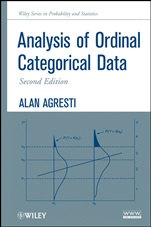
Analysis of Ordinal Categorical Data
ISBN 9780470082898
Autor: Alan Agresti
Wydawca: Wiley
Dostępność: 3-6 tygodni
Cena: 687,75 zł
Przed złożeniem zamówienia prosimy o kontakt mailowy celem potwierdzenia ceny.
ISBN13: |
9780470082898 |
ISBN10: |
0470082895 |
Autor: |
Alan Agresti |
Oprawa: |
Hardback |
Rok Wydania: |
2010-05-14 |
Numer Wydania: |
2nd Edition |
Ilość stron: |
424 |
Wymiary: |
249x159 |
Tematy: |
PB |
Praise for the First Edition:
"The author has a fluent, easy–to–read style, and well–chosen interesting material to present and illustrate the ideas to the newcomer and the old hand alike."
—Journal of the Royal Statistical Society
Categorical data having ordered categories are common in practice, especially in applications throughout the biomedical and social sciences. Thoroughly updated to reflect developments since the publication of its predecessor, Analysis of Ordinal Categorical Data, Second Edition presents a comprehensive survey of methods for analyzing ordinal categorical data, complete with coverage of the most recent research.
The author highlights various modeling techniques, including cumulative logit models with and without proportional odds structure, adjacent–categories logit and continuation–ratio logit models, stereotype models, association models for ordinal odds ratios, and models for clustered ordinal data. Additional features of this Second Edition include:
A new chapter on marginal models for multivariate ordinal responses, using maximum likelihood and generalized estimating equations for model fitting
A new chapter on random effects models for clustered ordinal data
A new chapter on Bayesian approaches for analyzing ordinal data
Models and order–restricted inference methods for various types of ordinal odds ratios, including local odds ratios, cumulative odds ratios, and global odds ratios
Presentation of non–model–based methods, such as nonparametric rank methods that also apply to ordered categorical data
Each chapter concludes with notes on relevant research literature as well as exercises that allow readers to test their comprehension of the presented concepts. A detailed appendix discusses the use of the latest software such as SAS, R, SPSS, and Stata, and the book′s related Web site provides
further instructions for the use of these software packages along with complete data sets.
Analysis of Ordinal Categorical Data, Second Edition is an excellent book for courses on categorical data analysis at the upper–undergraduate and graduate levels. It is also an invaluable resource for researchers and practitioners who conduct data analysis in the areas of public health, business, medicine, and the social and behavioral sciences.
Spis treści:
Preface.
1. Introduction.
1.1. Ordinal Categorical Scales.
1.2. Advantages of Using Ordinal Methods.
1.3. Ordinal Modeling Versus Ordinary Regession Analysis.
1.4. Organization of This Book.
2. Ordinal Probabilities, Scores, and Odds Ratios.
2.1. Probabilities and Scores for an Ordered Categorical Scale.
2.2. Ordinal Odds Ratios for Contingency Tables.
2.3. Confidence Intervals for Ordinal Association Measures.
2.4. Conditional Association in Three–Way Tables.
2.5. Category Choice for Ordinal Variables.
Chapter Notes.
Exercises.
3. Logistic Regression Models Using Cumulative Logits.
3.1. Types of Logits for An Ordinal Response.
3.2. Cumulative Logit Models.
3.3. Proportional Odds Models: Properties and Interpretations.
3.4. Fitting and Inference for Cumulative Logit Models.
3.5. Checking Cumulative Logit Models.
3.6. Cumulative Logit Models Without Proportional Odds.
3.7. Connections with Nonparametric Rank Methods.
Chapter Notes.
Exercises.
4. Other Ordinal Logistic Regression Models.
4.1. Adjacent–Categories Logit Models.
4.2. Continuation–Ratio Logit Models.
4.3. Stereotype Model: Multiplicative Paired–Category Logits.
Chapter Notes.
Exercises.
5. Other Ordinal Multinomial Response Models.
5.1. Cumulative Link Models.
5.2. Cumulative Probit Models.
5.3. Cumulative Log–Log Links: Proportional Hazards Modeling.
5.4. Modeling Location and Dispersion Effects.
5.5. Ordinal ROC Curve Estimation.
5.6. Mean Response Models.
Chapter Notes.
Exercises.
6. Modeling Ordinal Association Structure.
6.1. Ordinary Loglinear Modeling.
6.2. Loglinear Model of Linear–by–Linear Association.
6.3. Row or Column Effects Association Models.
6.4. Association Models for Multiway Tables.
6.5. Multiplicative Association and Correlation Models.
6.6. Modeling Global Odds Ratios and Other Associations.
Chapter Notes.
Exercises.
7. Non–Model–Based Analysis of Ordinal Association.
7.1. Concordance and Discordance Measures of Association.
7.2. Correlation Measures for Contingency Tables.
7.3. Non–Model–Based Inference for Ordinal Association Measures.
7.4. Comparing Singly Ordered Multinomials.
7.5. Order–Restricted Inference with Inequality Constraints.
7.6. Small–Sample Ordinal Tests of Independence.
7.7. Other Rank–Based Statistical Methods for Ordered Categories.
Appendix: Standard Errors for Ordinal Measures.
Chapter Notes.
Exercises.
8. Matched–Pairs Data with Ordered Categories.
8.1. Comparing Marginal Distributions for Matched Pairs.
8.2. Models Comparing Matched Marginal Distributions.
8.3. Models for The Joint Distribution in A Square Table.
8.4. Comparing Marginal Distributions for Matched Sets.
8.5. Analyzing Rater Agreement on an Ordinal Scale.
8.6. Modeling Ordinal Paired Preferences.
Chapter Notes.
Exercises.
9. Clustered Ordinal Responses: Marginal Models.
9.1. Marginal Ordinal Modeling with Explanatory Variables.
9.2. Marginal Ordinal Modeling: GEE Methods.
9.3. Transitional Ordinal Modeling, Given the Past.
Chapter Notes.
Exercises.
10. Clustered Ordinal Responses: Random Effects Models.
10.1. Ordinal Generalized Linear Mixed Models.
10.2. Examples of Ordinal Random Int
ercept Models.
10.3. Models with Multiple Random Effects.
10.4. Multilevel (Hierarchical) Ordinal Models.
10.5. Comparing Random Effects Models and Marginal Models.
Chapter Notes.
Exercises.
11. Bayesian Inference for Ordinal Response Data.
11.1. Bayesian Approach to Statistical Inference.
11.2. Estimating Multinomial Parameters.
11.3. Bayesian Ordinal Regression Modeling.
11.4. Bayesian Ordinal Association Modeling.
11.5. Bayesian Ordinal Multivariate Regression Modeling.
11.6. Bayesian Versus Frequentist Approaches to Analyzing Ordinal Data.
Chapter Notes.
Exercises.
Appendix Software for Analyzing Ordinal Categorical Data.
Bibliography.
Example Index.
Subject Index.
Nota biograficzna:
ALAN AGRESTI, PhD, is Distinguished Professor Emeritus in the Department of Statistics at the University of Florida and Visiting Professor in the Department of Statistics at Harvard University. A Fellow of the American Statistical Association and the Institute of Mathematical Statistics, Dr. Agresti has published extensively on the topic of categorical data analysis and has presented lectures and short courses on the subject in more than thirty countries. He is the author of Categorical Data Analysis, Second Edition and An Introduction to Categorical Data Analysis, Second Edition, both published by Wiley.
Okładka tylna:
Praise for the First Edition:
"The author has a fluent, easy–to–read style, and well–chosen interesting material to present and illustrate the ideas to the newcomer and the old hand alike."
—Journal of the Royal Statistical Society
Categorical data having ordered categories are common in practice, especially in applications throughout the biomedical and social sciences. Thoroughly updated to reflect developments since the publication of its predecessor, Analysis o
f Ordinal Categorical Data, Second Edition presents a comprehensive survey of methods for analyzing ordinal categorical data, complete with coverage of the most recent research.
The author highlights various modeling techniques, including cumulative logit models with and without proportional odds structure, adjacent–categories logit and continuation–ratio logit models, stereotype models, association models for ordinal odds ratios, and models for clustered ordinal data. Additional features of this Second Edition include:
A new chapter on marginal models for multivariate ordinal responses, using maximum likelihood and generalized estimating equations for model fitting
A new chapter on random effects models for clustered ordinal data
A new chapter on Bayesian approaches for analyzing ordinal data
Models and order–restricted inference methods for various types of ordinal odds ratios, including local odds ratios, cumulative odds ratios, and global odds ratios
Presentation of non–model–based methods, such as nonparametric rank methods that also apply to ordered categorical data
Each chapter concludes with notes on relevant research literature as well as exercises that allow readers to test their comprehension of the presented concepts. A detailed appendix discusses the use of the latest software such as SAS, R, SPSS, and Stata, and the book′s related Web site provides further instructions for the use of these software packages along with complete data sets.
Analysis of Ordinal Categorical Data, Second Edition is an excellent book for courses on categorical data analysis at the upper–undergraduate and graduate levels. It is also an invaluable resource for researchers and practitioners who conduct data analysis in the areas of public health, business, medicine, and the social and behavioral sciences.
Koszyk
Książek w koszyku: 0 szt.
Wartość zakupów: 0,00 zł
Informacje


Kontakt
Gambit
Centrum Oprogramowania
i Szkoleń Sp. z o.o.
Al. Pokoju 29b/22-24
31-564 Kraków
Siedziba Księgarni
ul. Kordylewskiego 1
31-542 Kraków
+48 12 410 5991
+48 12 410 5987
+48 12 410 5989
Subskrypcje
Administratorem danych osobowych jest firma Gambit COiS Sp. z o.o. Na podany adres będzie wysyłany wyłącznie biuletyn informacyjny.
Autoryzacja płatności

Informacje na temat autoryzacji płatności poprzez PayU.

© Copyright 2012: GAMBIT COiS Sp. z o.o. Wszelkie prawa zastrzeżone.
Projekt i wykonanie: Alchemia Studio Reklamy