


Wydawcy
Katalog tematyczny
- Archeologia (109)
- Ekonomia, finanse, business (13704)
- Filozofia (1445)
- Historia (3040)
- Języki i językoznawstwo (2356)
- Lifestyle, hobby i rozrywka (475)
- Medycyna (9704)
- Nauki humanistyczne (4)
- Nauki o Ziemi i środowisku (2638)
- Nauki ścisłe (20412)
- Nauki społeczne (8486)
- Nauki techniczne (13450)
- Prawo (1696)
- Publikacje informacyjne i interdyscyplinarne (1288)
- Religia i wierzenia (917)
- Technika komputerowa (4067)
- Bazy danych (75)
- Bezpieczeństwo komputerowe (454)
- Certyfikacja komputerowa (1)
- Grafika i media cyfrowe (32)
- Informatyka (779)
- Komputery, ogólnie (74)
- Programowanie (351)
- Programy komercyjne (49)
- Sieci komputerowe (350)
- Bezpieczeństwo sieciowe (3)
- Protokoły sieciowe (7)
- Sieci komputerowe, zarządzanie (2)
- Systemy rozproszone (13)
- Technologia Client-Server (1)
- WAP (1)
- Sprzęt komputerowy (4)
- Systemy operacyjne (32)
- Technika cyfrowa na co dzień (7)
- Zdrowie, relacje międzyludzkie i rozwój osobisty (657)





Informacje szczegółowe o książce
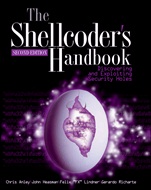
The Shellcoders Handbook: Discovering and Exploiting Security Holes
ISBN 9780470080238
Autor: Chris Anley, John Heasman, Felix Lindner, Gerardo Richarte
Wydawca: Wiley
Dostępność: 3-6 tygodni
Cena: 216,30 zł
Przed złożeniem zamówienia prosimy o kontakt mailowy celem potwierdzenia ceny.
ISBN13: |
9780470080238 |
ISBN10: |
047008023X |
Autor: |
Chris Anley, John Heasman, Felix Lindner, Gerardo Richarte |
Oprawa: |
Paperback |
Rok Wydania: |
2007-08-10 |
Numer Wydania: |
2nd Edition |
Ilość stron: |
752 |
Wymiary: |
232x190 |
Tematy: |
UT |
The black hats have kept up with security enhancements. Have you?
In the technological arena, three years is a lifetime. Since the first edition of this book was published in 2004, built–in security measures on compilers and operating systems have become commonplace, but are still far from perfect. Arbitrary–code execution vulnerabilities still allow attackers to run code of their choice on your system—with disastrous results.
In a nutshell, this book is about code and data and what happens when the two become confused. You′ll work with the basic building blocks of security bugs—assembler, source code, the stack, the heap, and so on. You′ll experiment, explore, and understand the systems you′re running—and how to better protect them.
Become familiar with security holes in Windows, Linux, Solaris, Mac OS X, and Cisco′s IOS
Learn how to write customized tools to protect your systems, not just how to use ready–made ones
Use a working exploit to verify your assessment when auditing a network
Use proof–of–concept exploits to rate the significance of bugs in software you′re developing
Assess the quality of purchased security products by performing penetration tests based on the information in this book
Understand how bugs are found and how exploits work at the lowest level
Spis treści:
About the Authors.
Acknowledgments.
Introduction to the Second Edition.
Part I: Introduction to Exploitation: Linux on x86.
Chapter 1: Before You Begin.
Chapter 2: Stack Overflows.
Chapter 3: Shellcode.
Chapter 4: Introduction to Format String Bugs.
Chapter 5: Introduction to Heap Overflows.
Part II: Other Platforms—Windows, Solaris, OS/X, and Cisco.
Chapter 6: The Wild World of Windows.
Chapter 7: Windows Shellcode.
Chapter 8: Windows Overflows.
Chapter 9: Overcoming Fi
lters.
Chapter 10: Introduction to Solaris Exploitation.
Chapter 11: Advanced Solaris Exploitation.
Chapter 12: OS X Shellcode.
Chapter 13: Cisco IOS Exploitation.
Chapter 14: Protection Mechanisms.
Part III: Vulnerability Discovery.
Chapter 15: Establishing a Working Environment.
Chapter 16: Fault Injection.
Chapter 17: The Art of Fuzzing.
Chapter 18: Source Code Auditing: Finding Vulnerabilities in C–Based Languages.
Chapter 19: Instrumented Investigation: A Manual Approach.
Chapter 20: Tracing for Vulnerabilities.
Chapter 21: Binary Auditing: Hacking Closed Source Software.
Part IV: Advanced Materials.
Chapter 22: Alternative Payload Strategies.
Chapter 23: Writing Exploits that Work in the Wild.
Chapter 24: Attacking Database Software.
Chapter 25: Unix Kernel Overflows.
Chapter 26: Exploiting Unix Kernel Vulnerabilities.
Chapter 27: Hacking the Windows Kernel.
Index.
Nota biograficzna:
Chris Anley is a founder and director of NGSSoftware, a security software, consultancy, and research company based in London, England. He is actively involved in vulnerability research and has discovered security flaws in a wide variety of platforms including Microsoft Windows, Oracle, SQL Server, IBM DB2, Sybase ASE, MySQL, and PGP.
John Heasman is the Director of Research at NGSSoftware. He is a prolific security researcher and has published many security advisories in enterprise level software. He has a particular interest in rootkits and has authored papers on malware persistence via device firmware and the BIOS. He is also a co–author of The Database Hacker’s Handbook: Defending Database Servers (Wiley 2005).
Felix “FX” Linder leads SABRE Labs GmbH, a Berlin–based professional consulting company specializing in security analysis, system design creation, and verification work. Felix looks back at 18 years of
programming and over a decade of computer security consulting for enterprise, carrier, and software vendor clients. This experience allows him to rapidly dive into complex systems and evaluate them from a security and robustness point of view, even in atypical scenarios and on arcane platforms. In his spare time, FX works with his friends from the Phenoelit hacking group on different topics, which have included Cisco IOS, SAP, HP printers, and RIM BlackBerry in the past.
Gerardo Richarte has been doing reverse engineering and exploit development for more than 15 years non–stop. In the past 10 years he helped build the technical arm of Core Security Technologies, where he works today. His current duties include developing exploits for Core IMPACT, researching new exploitation techniques and other low–level subjects, helping other exploit writers when things get hairy, and teaching internal and external classes on assembly and exploit writing. As result of his research and as a humble thank you to the community, he has published some technical papers and open source projects, presented in a few conferences, and released part of his training material. He really enjoys solving tough problems and reverse engineering any piece of code that falls in his reach just for the fun of doing it.
Okładka tylna:
The black hats have kept up with security enhancements. Have you?
In the technological arena, three years is a lifetime. Since the first edition of this book was published in 2004, built–in security measures on compilers and operating systems have become commonplace, but are still far from perfect. Arbitrary–code execution vulnerabilities still allow attackers to run code of their choice on your system—with disastrous results.
In a nutshell, this book is about code and data and what happens when the two become confused. You′ll work with the basic building blocks of security bugs—assembl
er, source code, the stack, the heap, and so on. You′ll experiment, explore, and understand the systems you′re running—and how to better protect them.
Become familiar with security holes in Windows, Linux, Solaris, Mac OS X, and Cisco′s IOS
Learn how to write customized tools to protect your systems, not just how to use ready–made ones
Use a working exploit to verify your assessment when auditing a network
Use proof–of–concept exploits to rate the significance of bugs in software you′re developing
Assess the quality of purchased security products by performing penetration tests based on the information in this book
Understand how bugs are found and how exploits work at the lowest level
Koszyk
Książek w koszyku: 0 szt.
Wartość zakupów: 0,00 zł
Informacje


Kontakt
Gambit
Centrum Oprogramowania
i Szkoleń Sp. z o.o.
Al. Pokoju 29b/22-24
31-564 Kraków
Siedziba Księgarni
ul. Kordylewskiego 1
31-542 Kraków
+48 12 410 5991
+48 12 410 5987
+48 12 410 5989
Subskrypcje
Administratorem danych osobowych jest firma Gambit COiS Sp. z o.o. Na podany adres będzie wysyłany wyłącznie biuletyn informacyjny.
Autoryzacja płatności

Informacje na temat autoryzacji płatności poprzez PayU.

© Copyright 2012: GAMBIT COiS Sp. z o.o. Wszelkie prawa zastrzeżone.
Projekt i wykonanie: Alchemia Studio Reklamy