


Wydawcy
Katalog tematyczny
- Archeologia (109)
- Ekonomia, finanse, business (13704)
- Filozofia (1445)
- Historia (3040)
- Języki i językoznawstwo (2356)
- Lifestyle, hobby i rozrywka (475)
- Medycyna (9704)
- Nauki humanistyczne (4)
- Nauki o Ziemi i środowisku (2638)
- Nauki ścisłe (20412)
- Astronomia (294)
- Biologia (5119)
- Chemia (6540)
- Fizyka (3309)
- Matematyka (4574)
- Algebra (171)
- Analiza matematyczna (902)
- Filozofia matematyki (1)
- Geometria (237)
- Historia matematyki (57)
- Kombinatoryka, teoria grafów (67)
- Matematyka dyskretna (35)
- Matematyka stosowana (555)
- Optymalizacja (104)
- Podstawy matematyki (129)
- Statystyka, prawdopodobieństwo (296)
- Teoria grup (63)
- Teoria liczb (77)
- Topologia (66)
- Nauki ścisłe, ogólnie (503)
- Nauki społeczne (8486)
- Nauki techniczne (13450)
- Prawo (1696)
- Publikacje informacyjne i interdyscyplinarne (1288)
- Religia i wierzenia (917)
- Technika komputerowa (4067)
- Zdrowie, relacje międzyludzkie i rozwój osobisty (657)





Informacje szczegółowe o książce
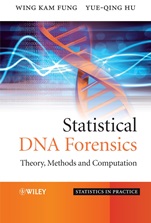
Statistical DNA Forensics: Theory, Methods and Computation
ISBN 9780470066362
Autor: Wing Kam Fung, Yue–Qing Hu
Wydawca: Wiley
Dostępność: 3-6 tygodni
Cena: 510,30 zł
Przed złożeniem zamówienia prosimy o kontakt mailowy celem potwierdzenia ceny.
ISBN13: |
9780470066362 |
ISBN10: |
0470066369 |
Autor: |
Wing Kam Fung, Yue–Qing Hu |
Oprawa: |
Hardback |
Rok Wydania: |
2008-01-25 |
Ilość stron: |
264 |
Wymiary: |
250x179 |
Tematy: |
PB |
Since the introduction of DNA evidence to the criminal justice system in the late 1980s, statistical methodologies have governed the collection, analysis and interpretation of forensic data. The employment of advanced computer technologies has enabled DNA evidence to be employed in increasingly complex procedures, and this, in turn, has facilitated the use of more intricate and specialized statistical techniques.
Statistical DNA Forensics sets out to provide a practical guide to the analysis of DNA evidence. The authors present an overview of the essential statistical methodology and computational techniques used in analyzing DNA evidence. Basic genetics and elementary statistics are introduced, enabling readers from either discipline to understand complex forensic cases and make use of the advanced topics presented.
The book:
Presents a systematic, case study–based, analysis of key forensic DNA application areas.
Focuses on fundamental areas of DNA profiling; paternity and kinship testing, single source forensic DNA, and mixed DNA stains.
Provides a comprehensive summary of the associated formulae in table form.
Discusses the database search method in forensic DNA, and the presentation and interpretation of the evidence.
Is supported by a supplementary website, containing illustrated examples and solutions, as well as specially developed software enabling readers to analyze real case studies.
Statistical DNA Forensics: Theory, Methods and Computation takes a software–based approach to the subject, and makes essential reading for students, researchers and practitioners in forensic science, genetics and applied statistics.
Spis treści:
Preface.
List of figures.
List of tables.
1. Introduction.
1.1 Statistics, forensic science and the law.
1.2 The use of statistics in forensic DNA.
1.3 Genetic basis of DNA profiling and typing technology.
1.3.1 Genetic basis.
1.3.2 Typing technology.
1.4 About the book.
2. Probability and statistics.
2.1 Probability.
2.2 Dependent events and conditional probability.
2.3 Law of total probability.
2.4 Bayes’ Theorem.
2.5 Binomial probability distribution.
2.6 Multinomial distribution.
2.7 Poisson distribution.
2.8 Normal distribution.
2.9 Likelihood ratio.
2.10 Statistical inference.
2.10.1 Test of hypothesis.
2.10.2 Estimation and testing.
2.11 Problems.
3. Population genetics.
3.1 Hardy–Weinberg equilibrium.
3.2 Test for Hardy–Weinberg equilibrium.
3.2.1 Observed and expected heterozygosities.
3.2.2 Chi–square test.
3.2.3 Fisher’s exact test.
3.2.4 Computer software.
3.3 Other statistics for analysis of a population database.
3.3.1 Linkage equilibrium.
3.3.2 Power of discrimination.
3.4 DNA profiling.
3.5 Subpopulation models.
3.6 Relatives.
3.7 Problems.
4. Parentage testing.
4.1 Standard trio.
4.1.1 Paternity index.
4.1.2 An example.
4.1.3 Posterior odds and probability of paternity.
4.2 Paternity computer software.
4.2.1 Steps in running the software.
4.2.2 The software to deal with an incest case.
4.3 A relative of the alleged father is the true father.
4.4 Alleged father unavailable but his relative is.
4.5 Motherless case.
4.5.1 Paternity index.
4.5.2 Computer software and example.
4.6 Motherless case: relatives involved.
4.6.1 A relative of the alleged father is the true father.
4.6.2 Alleged father unavailable but his relative is.
4.6.3 Computer software and example.
4.7 Determination of both parents.
4.8 Probability of excluding a random man from paternity.
4.9 Power of exclusion.
4.9.1 A random man case.
4.9.2 A relative case.
4.9.3 An elder brother case: mother available.
4.10 Other issues.
4.10.1 Reverse parentage.
4.10.2 Mutation.
4.11 Problems.
5. Test
ing for kinship.
5.1 Kinship testing of any two persons: HWE.
5.2 Computer software.
5.3 Kinship testing of two persons: subdivided populations.
5.3.1 Joint genotype probability.
5.3.2 Relatives involved.
5.4 Examples with software.
5.5 Three persons situation: HWE.
5.6 Computer software and example.
5.7 Three persons situation: subdivided populations.
5.7.1 Standard trio.
5.7.2 A relative of the alleged father is the true father.
5.7.3 Alleged father unavailable but his relative is.
5.7.4 Example.
5.7.5 General method and computer software.
5.8 Complex kinship determinations: method and software.
5.8.1 EasyPA—In—1—Minute software and the method.
5.8.2 EasyPAnt—In—1—Minute.
5.8.3 EasyIN—In—1—Minute.
5.8.4 EasyMISS—In—1—Minute.
5.8.5 Other considerations: probability of paternity and mutation.
5.9 Problems.
6. Interpreting mixtures.
6.1 An illustrative example.
6.2 Some common cases and a case example.
6.2.1 One victim, one suspect and one unknown.
6.2.2 One suspect and two unknowns.
6.2.3 Two suspects and two unknowns.
6.2.4 Case example.
6.2.5 Exclusion probability.
6.3 A general approach.
6.4 Population in Hardy–Weinberg equilibrium.
6.5 Population with multiple ethnic groups.
6.6 Subdivided population.
6.6.1 Single ethnic group: simple cases.
6.6.2 Single ethnic group: general situations.
6.6.3 Multiple ethnic groups.
6.7 Computer software and example.
6.8 NRC II Recommendation 4.1.
6.8.1 Single ethnic group.
6.8.2 Multiple ethnic groups.
6.9 Proofs.
6.9.1 The proof of Equation (6.6).
6.9.2 The proof of Equation (6.8).
6.9.3 The proof of Equation (6.9).
6.9.4 The proofs of Equations (6.11) and (6.12).
6.9.5 The proofs of Equations (6.14) and (6.15).
6.10 Problems.
7. Interpreting mixtures in the presence of relatives.
7.1 O
ne pair of relatives: HWE.
7.1.1 Motivating example.
7.1.2 A probability formula.
7.1.3 Tested suspect with an unknown relative.
7.1.4 Unknown suspect with a tested relative.
7.1.5 Two related persons were unknown contributors.
7.1.6 An application.
7.2 Two pairs of relatives: HWE.
7.2.1 Two unknowns related respectively to two typed persons.
7.2.2 One unknown is related to a typed person and two other.
unknowns are related.
7.2.3 Two pairs of related unknowns.
7.2.4 Examples.
7.2.5 Extension.
7.3 Related people from the same subdivided population.
7.3.1 Introductory example.
7.3.2 A simple case with one victim, one suspect and one relative.
7.3.3 General formulas.
7.3.4 An example analyzed by the software.
7.4 Proofs.
7.4.1 Preliminary.
7.4.2 The proof of Equation (7.5).
7.4.3 The proof of Equation (7.7).
7.4.4 The proof of Equation (7.9).
7.4.5 The proof of Equation (7.11).
7.4.6 The proof of Equation (7.13).
7.4.7 The proofs of Equations (7.18) and (7.20).
7.5 Problems.
8. Other issues.
8.1 Lineage markers.
8.2 Haplotypic genetic markers for mixture.
8.3 Bayesian network.
8.4 Peak information.
8.5 Mass disaster.
8.6 Database search.
Solutions to Problems.
Appendix A: The standard normal distribution.
Appendix B: Upper 1% and 5% points of w2 distributions.
Bibliography.
Index.
Nota biograficzna:
Wing Kam Fung – Department of Statistics and Actuarial Science, University of Hong Kong
With 20 years of lecturing and research experience, Professor Fung has been invited many times to give talks at workshops and international conferences. He has written over 130 papers in statistics, DNA profiling and forensic science, and is currently an Associate Editor for 4 statistical journals.
Yue–Qing Hu – Department of Mathematics, Southeast University
An Associate Professor, Yue–Qing Hu has published
Koszyk
Książek w koszyku: 0 szt.
Wartość zakupów: 0,00 zł
Informacje


Kontakt
Gambit
Centrum Oprogramowania
i Szkoleń Sp. z o.o.
Al. Pokoju 29b/22-24
31-564 Kraków
Siedziba Księgarni
ul. Kordylewskiego 1
31-542 Kraków
+48 12 410 5991
+48 12 410 5987
+48 12 410 5989
Subskrypcje
Administratorem danych osobowych jest firma Gambit COiS Sp. z o.o. Na podany adres będzie wysyłany wyłącznie biuletyn informacyjny.
Autoryzacja płatności

Informacje na temat autoryzacji płatności poprzez PayU.

© Copyright 2012: GAMBIT COiS Sp. z o.o. Wszelkie prawa zastrzeżone.
Projekt i wykonanie: Alchemia Studio Reklamy