


Wydawcy
Katalog tematyczny
- Archeologia (109)
- Ekonomia, finanse, business (13704)
- Filozofia (1445)
- Historia (3040)
- Języki i językoznawstwo (2356)
- Lifestyle, hobby i rozrywka (475)
- Medycyna (9704)
- Nauki humanistyczne (4)
- Nauki o Ziemi i środowisku (2638)
- Nauki ścisłe (20412)
- Astronomia (294)
- Biologia (5119)
- Chemia (6540)
- Fizyka (3309)
- Matematyka (4574)
- Algebra (171)
- Analiza matematyczna (902)
- Filozofia matematyki (1)
- Geometria (237)
- Historia matematyki (57)
- Kombinatoryka, teoria grafów (67)
- Matematyka dyskretna (35)
- Matematyka stosowana (555)
- Optymalizacja (104)
- Podstawy matematyki (129)
- Statystyka, prawdopodobieństwo (296)
- Teoria grup (63)
- Teoria liczb (77)
- Topologia (66)
- Nauki ścisłe, ogólnie (503)
- Nauki społeczne (8486)
- Nauki techniczne (13450)
- Prawo (1696)
- Publikacje informacyjne i interdyscyplinarne (1288)
- Religia i wierzenia (917)
- Technika komputerowa (4067)
- Zdrowie, relacje międzyludzkie i rozwój osobisty (657)





Informacje szczegółowe o książce
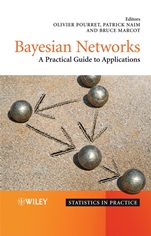
Bayesian Networks: A Practical Guide to Applications
ISBN 9780470060308
Autor: Olivier Pourret, Patrick Naïm, Bruce Marcot
Wydawca: Wiley
Dostępność: 3-6 tygodni
Cena: 491,40 zł
Przed złożeniem zamówienia prosimy o kontakt mailowy celem potwierdzenia ceny.
ISBN13: |
9780470060308 |
ISBN10: |
0470060301 |
Autor: |
Olivier Pourret, Patrick Naïm, Bruce Marcot |
Oprawa: |
Hardback |
Rok Wydania: |
2008-03-20 |
Ilość stron: |
446 |
Wymiary: |
242x161 |
Tematy: |
PB |
Bayesian Networks, the result of the convergence of artificial intelligence with statistics, are growing in popularity. Their versatility and modelling power is now employed across a variety of fields for the purposes of analysis, simulation, prediction and diagnosis.
This book provides a general introduction to Bayesian networks, defining and illustrating the basic concepts with pedagogical examples and twenty real–life case studies drawn from a range of fields including medicine, computing, natural sciences and engineering.
Designed to help analysts, engineers, scientists and professionals taking part in complex decision processes to successfully implement Bayesian networks, this book equips readers with proven methods to generate, calibrate, evaluate and validate Bayesian networks.
The book:
Provides the tools to overcome common practical challenges such as the treatment of missing input data, interaction with experts and decision makers, determination of the optimal granularity and size of the model.
Highlights the strengths of Bayesian networks whilst also presenting a discussion of their limitations.
Compares Bayesian networks with other modelling techniques such as neural networks, fuzzy logic and fault trees.
Describes, for ease of comparison, the main features of the major Bayesian network software packages: Netica, Hugin, Elvira and Discoverer, from the point of view of the user.
Offers a historical perspective on the subject and analyses future directions for research.
Written by leading experts with practical experience of applying Bayesian networks in finance, banking, medicine, robotics, civil engineering, geology, geography, genetics, forensic science, ecology, and industry, the book has much to offer both practitioners and researchers involved in statistical analysis or modelling in any of these fields.
Spis treści:
Foreword.
Preface.
1 Introduction to Bayesian networks.
1.1 Models.
1.2 Probabilistic vs. deterministic models.
1.3 Unconditional and conditional independence.
1.4 Bayesian networks.
2 Medical diagnosis.
2.1 Bayesian networks in medicine.
2.2 Context and history.
2.3 Model construction.
2.4 Inference.
2.5 Model validation.
2.6 Model use.
2.7 Comparison to other approaches.
2.8 Conclusions and perspectives.
3 Clinical decision support.
3.1 Introduction.
3.2 Models and methodology.
3.3 The Busselton network.
3.4 The PROCAMnetwork.
3.5 The PROCAMBusselton network.
3.6 Evaluation.
3.7 The clinical support tool: TakeHeartII.
3.8 Conclusion.
4 Complex genetic models.
4.1 Introduction.
4.2 Historical perspectives.
4.3 Complex traits.
4.4 Bayesian networks to dissect complex traits.
4.5 Applications.
4.6 Future challenges.
5 Crime risk factors analysis.
5.1 Introduction.
5.2 Analysis of the factors affecting crime risk.
5.3 Expert probabilities elicitation.
5.4 Data preprocessing.
5.5 A Bayesian network model.
5.6 Results.
5.7 Accuracy assessment.
5.8 Conclusions.
6 Spatial dynamics in the coastal region.
6.1 Introduction.
6.2 An indicator–based analysis.
6.3 The Bayesian network model.
6.4 Conclusions.
7 Inference problems in forensic science.
7.1 Introduction.
7.2 Building Bayesian networks for inference.
7.3 Applications of Bayesian networks in forensic science.
7.4 Conclusions.
8 Conservation of marbled murrelets in British Columbia.
8.1 Context/history.
8.2 Model construction.
8.3 Model calibration, validation and use.
8.4 Conclusions/perspectives.
9 Classifiers for modeling of mineral potential.
9.1 Mineral potential mapping.
9.2 Classifiers for mineral potential mapping.
9.3 Bayesian network mapping of base metal deposit.
9.4 Discussion.
9.5 Conclusions.
10 Student modeling.
10.1 Int
roduction.
10.2 Probabilistic relational models.
10.3 Probabilistic relational student model.
10.4 Case study.
10.5 Experimental evaluation.
10.6 Conclusions and future directions.
11 Sensor validation.
11.1 Introduction.
11.2 The problem of sensor validation.
11.3 Sensor validation algorithm.
11.4 Gas turbines.
11.5 Models learned and experimentation.
11.6 Discussion and conclusion.
12 An information retrieval system.
12.1 Introduction.
12.2 Overview.
12.3 Bayesian networks and information retrieval.
12.4 Theoretical foundations.
12.5 Building the information retrieval system.
12.6 Conclusion.
13 Reliability analysis of systems.
13.1 Introduction.
13.2 Dynamic fault trees.
13.3 Dynamic Bayesian networks.
13.4 A case study: The Hypothetical Sprinkler System.
13.5 Conclusions.
14 Terrorism risk management.
14.1 Introduction.
14.2 The Risk Influence Network.
14.3 Software implementation.
14.4 Site Profiler deployment.
14.5 Conclusion.
15 Credit–rating of companies..
15.1 Introduction.
15.2 Naive Bayesian classifiers.
15.3 Example of actual credit–ratings systems.
15.4 Credit–rating data of Japanese companies.
15.5 Numerical experiments.
15.6 Performance comparison of classifiers.
15.7 Conclusion.
16 Classification of Chilean wines.
16.1 Introduction.
16.2 Experimental setup.
16.3 Feature extraction methods.
16.4 Classification results.
16.5 Conclusions.
17 Pavement and bridge management.
17.1 Introduction.
17.2 Pavement management decisions.
17.3 Bridge management.
17.4 Bridge approach embankment – case study.
17.5 Conclusion.
18 Complex industrial process operation.
18.1 Introduction.
18.2 A methodology for Root Cause Analysis.
18.3 Pulp and paper application.
18.4 The ABB Industrial IT platform.
18.5 Conclusion.
19 Probability of default for large corporates.
19.1 Int
roduction.
19.2 Model construction.
19.3 BayesCredit.
19.4 Model benchmarking.
19.5 Benefits from technology and software.
19.6 Conclusion.
20 Risk management in robotics.
20.1 Introduction.
20.2 DeepC.
20.3 The ADVOCATE II architecture.
20.4 Model development.
20.5 Model usage and examples.
20.6 Benefits from using probabilistic graphical models.
20.7 Conclusion.
21 Enhancing Human Cognition.
21.1 Introduction.
21.2 Human foreknowledge in everyday settings.
21.3 Machine foreknowledge.
21.4 Current application and future research needs.
21.5 Conclusion.
22 Conclusion.
22.1 An artificial intelligence perspective.
22.2 A rational approach of knowledge.
22.3 Future challenges.
Bibliography.
Index.
Nota biograficzna:
Olivier Pourret is a research engineer at Électricité de France (EDF) and an analyst at EDF Trading. He has published a number of papers describing his use of Bayesian Belief Networks (BBNs), and co–authors a book on the subject. He also taught reliability modeling at the University of Marne–la–Vallée from 1998 to 2002, and initiated the BBN course at EDF R&D Training Institute in 1999.
Patrick Naïm is the founder and CEO of Elsewhere, an engineering company specialized in knowledge technologies and quantitative modeling. He also works as a consultant in operational risk modeling for a major French bank, and in design risk modeling for a major US oil company. He is the author or co–author of four books (2 Wiley titles) in data mining, data modeling and BBNs, and he teaches data modeling and Bayesian networks at three Parisian schools.
Bruce Marcot is a research wildlife ecologist with the Ecosystems Processes Research Program in the US. He conducts applied scientific research and technology application projects for risk assessment and decision modeling in forest
Koszyk
Książek w koszyku: 0 szt.
Wartość zakupów: 0,00 zł
Informacje


Kontakt
Gambit
Centrum Oprogramowania
i Szkoleń Sp. z o.o.
Al. Pokoju 29b/22-24
31-564 Kraków
Siedziba Księgarni
ul. Kordylewskiego 1
31-542 Kraków
+48 12 410 5991
+48 12 410 5987
+48 12 410 5989
Subskrypcje
Administratorem danych osobowych jest firma Gambit COiS Sp. z o.o. Na podany adres będzie wysyłany wyłącznie biuletyn informacyjny.
Autoryzacja płatności

Informacje na temat autoryzacji płatności poprzez PayU.

© Copyright 2012: GAMBIT COiS Sp. z o.o. Wszelkie prawa zastrzeżone.
Projekt i wykonanie: Alchemia Studio Reklamy