


Wydawcy
Katalog tematyczny
- Archeologia (109)
- Ekonomia, finanse, business (13704)
- Filozofia (1445)
- Historia (3040)
- Języki i językoznawstwo (2356)
- Lifestyle, hobby i rozrywka (475)
- Medycyna (9704)
- Nauki humanistyczne (4)
- Nauki o Ziemi i środowisku (2638)
- Nauki ścisłe (20412)
- Nauki społeczne (8486)
- Nauki techniczne (13450)
- Prawo (1696)
- Publikacje informacyjne i interdyscyplinarne (1288)
- Religia i wierzenia (917)
- Technika komputerowa (4067)
- Bazy danych (75)
- Bezpieczeństwo komputerowe (454)
- Certyfikacja komputerowa (1)
- Grafika i media cyfrowe (32)
- Informatyka (779)
- Komputery, ogólnie (74)
- Programowanie (351)
- Programy komercyjne (49)
- Sieci komputerowe (350)
- Sprzęt komputerowy (4)
- Systemy operacyjne (32)
- Technika cyfrowa na co dzień (7)
- Zdrowie, relacje międzyludzkie i rozwój osobisty (657)





Informacje szczegółowe o książce
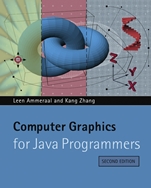
Computer Graphics for Java Programmers
ISBN 9780470031605
Autor: Leen Ammeraal, Kang Zhang
Wydawca: Wiley
Dostępność: 3-6 tygodni
Cena: 319,20 zł
Przed złożeniem zamówienia prosimy o kontakt mailowy celem potwierdzenia ceny.
ISBN13: |
9780470031605 |
ISBN10: |
0470031603 |
Autor: |
Leen Ammeraal, Kang Zhang |
Oprawa: |
Paperback |
Rok Wydania: |
2007-01-12 |
Numer Wydania: |
2nd Edition |
Ilość stron: |
396 |
Wymiary: |
239x192 |
Tematy: |
US |
A great many varied and interesting visual effects can be achieved with computer graphics, for which a fundamental understanding of the underlying mathematical concepts – and a knowledge of how they can be implemented in a particular programming language – is essential.
Computer Graphics for Java Programmers, 2nd edition covers elementary concepts in creating and manipulating 2D and 3D graphical objects, covering topics from classic graphics algorithms to perspective drawings and hidden–line elimination.
Completely revised and updated throughout, the second edition of this highly popular textbook contains a host of ready–to–run–programs and worked examples, illuminating general principles and geometric techniques. Ideal for classroom use or self–study, it provides a perfect foundation for programming computer graphics using Java.
Spis treści:
Preface.
Chapter 1: Elementary Concepts.
1.1 Lines, Coordinates and Pixels.
1.2 The Boundaries of Filled Regions.
1.3 Logical Coordinates.
1.4 Anisotropic and Isotropic Mapping Modes.
1.5 Defining a Polygon by Using the Mouse.
Exercises.
Chapter 2: Applied Geometry.
2.1 Vectors.
2.2 Inner Product.
2.3 Determinants.
2.4 Vector Product.
2.5 The Orientation of Three Points.
2.6 Polygons.
2.7 The Area of a Polygon.
2.8 Point–in–Triangle Test.
2.9 Point–in–Polygon Test.
2.10 Point–on–Line Test.
2.11 Distance Between a Point and a Line.
2.12 Projection of a Point on a Line.
2.13 Triangulation of Polygons.
Exercises.
Chapter 3: Geometrical Transformations.
3.1 Matrix Multiplication.
3.2 Linear Transformations.
3.3 Translations.
3.4 Homogeneous Coordinates.
3.5 Inverse Transformations and Matrix Inversion.
3.6 Rotation About an Arbitrary Point.
3.7 Changing the Coordinate System.
3.8 Rota
tions About 3D Coordinate Axes.
3.9 Rotation About an Arbitrary Axis.
Exercises.
Chapter 4: Some Classic Algorithms.
4.1 Bresenham’s Algorithm for Line Drawing.
4.2 Doubling the Line–Drawing Speed.
4.3 Circles.
4.4 Cohen–Sutherland Line Clipping.
4.5 Sutherland–Hodgman Polygon Clipping.
4.6 B´ezier Curves.
4.7 B–Spline Curve Fitting.
Exercises.
Chapter 5: Perspective.
5.1 Introduction.
5.2 The Viewing Transformation.
5.3 The Perspective Transformation.
5.4 A Cube in Perspective.
5.5 Some Useful Classes.
5.6 A General Program for Wire–Frame Models.
Exercises.
Chapter 6: Hidden–Line Elimination.
6.1 Line Segments and Triangles.
6.2 Tests for Visibility.
6.3 Specification and Representation of 3D Objects.
6.4 Holes and Invisible Line Segments.
6.5 Individual Faces and Line Segments.
6.6 Automatic Generation of Object Specification.
6.7 Hidden–Line Elimination with HP–GL Output.
6.8 Implementation.
Exercises.
Chapter 7: Hidden–Face Elimination.
7.1 Back–Face Culling.
7.2 Coloring Individual Faces.
7.3 Painter’s Algorithm.
7.4 Z–Buffer Algorithm.
Exercises.
Chapter 8: Fractals.
8.1 Introduction.
8.2 Koch Curves.
8.3 String Grammars.
8.4 Mandelbrot and Julia Sets.
Exercises.
Appendix A – Linear Interpolation of 1/z.
Appendix B – A Note on Event Handling.
Appendix C – File Obj3D.java.
Appendix D – Class CvHLines.java.
Appendix E – Some Applications.
Appendix F – Hints and Solutions to Exercises.
Bibliography.
Index.
Nota biograficzna:
Leen Ammeraal is a retired lecturer of Hogeschool Utrecht, The Netherlands, where he was employed from 1977 to 1998. He has a degree (ir.) in mathematics at Universit
y of Technology Delft, The Netherlands. He worked as a programmer and mathematician at Akzo Research and Engineering, Arnhem, The Netherlands, from 1961 to 1972 and did research work on compilers from 1972 to 1977 at Mathematical Centre, Amsterdam. He wrote many books for Wiley (as well as for the Dutch publisher Academic Service). Some of his Wiley books have been translated into other languages (Japanese, Russian, Italian, French, German, Greek, Danish, Portuguese, Bulgarian).
Kang Zhang is a Professor in Computer Science and Director of Visual Computing Lab at the University of Texas at Dallas. He received his B.Eng. in Computer Engineering from the University of Electronic Science and Technology, China, in 1982; and Ph.D. from the University of Brighton, UK, in 1990. He held academic positions in the UK and Australia, prior to joining UTD. Zhang′s current research interests are in the areas of visual languages, graphical visualization, and Web engineering; and has published over 130 papers in these areas. He has taught computer graphics and related subjects at both graduate and undergraduate levels for many years. Zhang was also an editor of two books on software visualization.
Okładka tylna:
A great many varied and interesting visual effects can be achieved with computer graphics, for which a fundamental understanding of the underlying mathematical concepts – and a knowledge of how they can be implemented in a particular programming language – is essential.
Computer Graphics for Java Programmers, 2nd edition covers elementary concepts in creating and manipulating 2D and 3D graphical objects, covering topics from classic graphics algorithms to perspective drawings and hidden–line elimination.
Completely revised and updated throughout, the second edition of this highly popular textbook contains a host of ready–to–run–programs and worked examples, illuminating general pri
nciples and geometric techniques. Ideal for classroom use or self–study, it provides a perfect foundation for programming computer graphics using Java.
Koszyk
Książek w koszyku: 0 szt.
Wartość zakupów: 0,00 zł
Informacje


Kontakt
Gambit
Centrum Oprogramowania
i Szkoleń Sp. z o.o.
Al. Pokoju 29b/22-24
31-564 Kraków
Siedziba Księgarni
ul. Kordylewskiego 1
31-542 Kraków
+48 12 410 5991
+48 12 410 5987
+48 12 410 5989
Subskrypcje
Administratorem danych osobowych jest firma Gambit COiS Sp. z o.o. Na podany adres będzie wysyłany wyłącznie biuletyn informacyjny.
Autoryzacja płatności

Informacje na temat autoryzacji płatności poprzez PayU.

© Copyright 2012: GAMBIT COiS Sp. z o.o. Wszelkie prawa zastrzeżone.
Projekt i wykonanie: Alchemia Studio Reklamy