


Wydawcy
Katalog tematyczny
- Archeologia (109)
- Ekonomia, finanse, business (13704)
- Filozofia (1445)
- Historia (3040)
- Języki i językoznawstwo (2356)
- Lifestyle, hobby i rozrywka (475)
- Medycyna (9704)
- Nauki humanistyczne (4)
- Nauki o Ziemi i środowisku (2638)
- Nauki ścisłe (20412)
- Astronomia (294)
- Biologia (5119)
- Chemia (6540)
- Fizyka (3309)
- Matematyka (4574)
- Algebra (171)
- Analiza matematyczna (902)
- Filozofia matematyki (1)
- Geometria (237)
- Historia matematyki (57)
- Kombinatoryka, teoria grafów (67)
- Matematyka dyskretna (35)
- Matematyka stosowana (555)
- Optymalizacja (104)
- Podstawy matematyki (129)
- Statystyka, prawdopodobieństwo (296)
- Teoria grup (63)
- Teoria liczb (77)
- Topologia (66)
- Nauki ścisłe, ogólnie (503)
- Nauki społeczne (8486)
- Nauki techniczne (13450)
- Prawo (1696)
- Publikacje informacyjne i interdyscyplinarne (1288)
- Religia i wierzenia (917)
- Technika komputerowa (4067)
- Zdrowie, relacje międzyludzkie i rozwój osobisty (657)





Informacje szczegółowe o książce
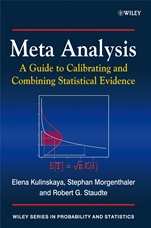
Meta Analysis: A Guide to Calibrating and Combining Statistical Evidence
ISBN 9780470028643
Autor: Elena Kulinskaya, Stephan Morgenthaler, Robert G. Staudte
Wydawca: Wiley
Dostępność: 3-6 tygodni
Cena: 355,95 zł
Przed złożeniem zamówienia prosimy o kontakt mailowy celem potwierdzenia ceny.
ISBN13: |
9780470028643 |
ISBN10: |
0470028645 |
Autor: |
Elena Kulinskaya, Stephan Morgenthaler, Robert G. Staudte |
Oprawa: |
Paperback |
Rok Wydania: |
2008-02-29 |
Ilość stron: |
282 |
Wymiary: |
229x156 |
Tematy: |
PB |
Studies based on small sample sizes often suffer from low power in detecting effects of interest, but this can be overcome by a meta analysis: the combination and analysis of results from a number of studies. This procedure allows for a more accurate estimation of effects, while taking into account differences between study conditions.
In Meta Analysis the results from different studies are transformed to a common calibration scale, where it is simpler to combine and interpret them. This unique approach, developed by the authors, is applicable to many study designs and conditions, and also leads to a deeper understanding of statistical evidence. The book is presented in two parts: Part 1 illustrates the methods required to combine and interpret statistical evidence, while Part 2 provides the motivation, theory and simulation experiments which justify the methods.
The book:
Provides a user–friendly guide for readers wishing to combine evidence from different statistical experiments.
Examines methods of continuous and discrete measurement, and regression, before presenting alternative methods for combining evidence.
Contains many worked examples throughout.
Is supported by a website containing examples with software instructions for the R environment.
Meta Analysis is ideally suited for statistical consultants and researchers in the fields of medicine, the social sciences and forensic statistics. Medical professionals undertaking basic training in statistics will also find this guide invaluable, as will practitioners of statistics interested in evidentiary statistics and related topics.
Spis treści:
Preface.
Part I The Methods.
1 What can the reader expect from this book?
1.1 A calibration scale for evidence.
1.2 The efficacy of glass ionomer versus resin sealants for prevention of caries.
1.3 Measures of effect size for two populations.
1.4 Summary.
2 Independent measurements with known precision.
2.1 Evidence for one–sided alternatives.
2.2 Evidence for two–sided alternatives.
2.3 Examples.
3 Independent measurements with unknown precision.
3.1 Effects and standardized effects.
3.2 Paired comparisons.
3.3 Examples.
4 Comparing treatment to control.
4.1 Equal unknown precision.
4.2 Differing unknown precision.
4.3 Examples.
5 Comparing K treatments.
5.1 Methodology.
5.2 Examples.
6 Evaluating risks.
6.1 Methodology.
6.2 Examples.
7 Comparing risks.
7.1 Methodology.
7.2 Examples.
8 Evaluating Poisson rates.
8.1 Methodology.
8.2 Example.
9 Comparing Poisson rates.
9.1 Methodology.
9.2 Example.
10 Goodness–of–fit testing.
10.1 Methodology.
10.2 Example.
11 Evidence for heterogeneity of effects and transformed effects.
11.1 Methodology.
11.2 Examples.
12 Combining evidence: fixed standardized effects model.
12.1 Methodology.
12.2 Examples.
13 Combining evidence: random standardized effects mode.
13.1 Methodology.
13.2 Example..
14 Meta–regression.
14.1 Methodology.
14.2 Commonly encountered situations.
14.3 Examples.
15 Accounting for publication bias.
15.1 The downside of publishing.
15.2 Examples.
Part II The Theory.
16 Calibrating evidence in a test.
16.1 Evidence for one–sided alternatives.
16.2 Random p–value behavior.
16.3 Publication bias.
16.4 Comparison with a Bayesian calibration.
16.5 Summary.
17 The basics of variance stabilizing transformations.
17.1 Standardizing the sample mean.
17.2 Variance stabilizing transformations.
17.3 Poisson model example.
17.4 Two–sided evidence from one–sided evidence.
17.5 Summary.
18 One–sample binomial tests.
18.1 Variance stabilizing the risk estimator.
18.2 Confidence intervals for p.
18.3 Relative risk and odds ratio.
18.4 Confidence intervals for small risks p.
18.5 Summary.
19 Two–sample binomial tests.
19.1 Evidence for a positive effect.
19.2 Confidence intervals for effect sizes.
19.3 Estimating the risk difference.
19.4 Relative risk and odds ratio.
19.5 Recurrent urinary tract infections.
19.6 Summary.
20 Defining evidence in t–statistics.
20.1 Example.
20.2 Evidence in the Student t–statistic.
20.3 The Key Inferential Function for Student’s model.
20.4 Corrected evidence.
20.5 A confidence interval for the standardized effect.
20.6 Comparing evidence in t– and z–tests.
20.7 Summary.
21 Two–sample comparisons.
21.1 Drop in systolic blood pressure.
21.2 Defining the standardized effect.
21.3 Evidence in the Welch statistic.
21.4 Confidence intervals for d.
21.5 Summary.
22 Evidence in the chi–squared statistic.
22.1 The noncentral chi–squared distribution.
22.2 A vst for the noncentral chi–squared statistic.
22.3 Simulation studies.
22.4 Choosing the sample size.
22.5 Evidence for l > l0.
22.6 Summary.
23 Evidence in F–tests.
23.1 Variance stabilizing transformations for the noncentral F.
23.2 The evidence distribution.
23.3 The Key Inferential Function.
23.4 The random effects model.
23.5 Summary.
24 Evidence in Cochran’s Q for heterogeneity of effects.
24.1 Cochran’s Q: the fixed effects model.
24.2 Simulation studies.
24.3 Cochran’s Q: the random effects model.
24.4 Summary.
25 Combining evidence from K studies.
25.1 Background and preliminary steps.
25.2 Fixed standardized effects.
25.3 Random transformed effects.
25.4 Example: drop in systolic blood pressure.
25.5 Summary.
26 Correcting for publication bias.
26.1 Publication bias.
26.2 The truncated normal distribution.
26.3 Bias correction based on censoring.
26.4 Summa
ry.
27 Large–sample properties of variance stabilizing transformations.
27.1 Existence of the variance stabilizing transformation.
27.2 Tests and effect sizes.
27.3 Power and efficiency.
27.4 Summary.
References.
Index.
Nota biograficzna:
Dr. E. Kulinskaya – Director, Statistical Advisory Service, Imperial College, London.
Professor S. Morgenthaler – Chair of Applied Statistics, Ecole Polytechnique Fédérale de Lausanne, Switzerland. Professor Morgenthaler was Assistant Professor at Yale University prior to moving to EPFL and has chaired various ISI committees.
Professor R. G. Staudte – Department of Statistical Science, La Trobe University, Melbourne. During his career at La Trobe he has served as Head of the Department of Statistical Science for five years and Head of the School of Mathematical and Statistical Sciences for two years. He was an Associate Editor for the Journal of Statistical Planning & Inference for 4 years, and is a member of the American Statistical Association, the Sigma Xi Scientific Research Society and the Statistical Society of Australia.
Okładka tylna:
Studies based on small sample sizes often suffer from low power in detecting effects of interest, but this can be overcome by a meta analysis: the combination and analysis of results from a number of studies. This procedure allows for a more accurate estimation of effects, while taking into account differences between study conditions.
In Meta Analysis the results from different studies are transformed to a common calibration scale, where it is simpler to combine and interpret them. This unique approach, developed by the authors, is applicable to many study designs and conditions, and also leads to a deeper understanding of statistical evidence. The book is presented in two parts: Part 1 illustrates the methods required to combine and interpret statist
Koszyk
Książek w koszyku: 0 szt.
Wartość zakupów: 0,00 zł
Informacje


Kontakt
Gambit
Centrum Oprogramowania
i Szkoleń Sp. z o.o.
Al. Pokoju 29b/22-24
31-564 Kraków
Siedziba Księgarni
ul. Kordylewskiego 1
31-542 Kraków
+48 12 410 5991
+48 12 410 5987
+48 12 410 5989
Subskrypcje
Administratorem danych osobowych jest firma Gambit COiS Sp. z o.o. Na podany adres będzie wysyłany wyłącznie biuletyn informacyjny.
Autoryzacja płatności

Informacje na temat autoryzacji płatności poprzez PayU.

© Copyright 2012: GAMBIT COiS Sp. z o.o. Wszelkie prawa zastrzeżone.
Projekt i wykonanie: Alchemia Studio Reklamy