


Wydawcy
Katalog tematyczny
- Archeologia (109)
- Ekonomia, finanse, business (13704)
- Filozofia (1445)
- Historia (3040)
- Języki i językoznawstwo (2356)
- Lifestyle, hobby i rozrywka (475)
- Medycyna (9704)
- Nauki humanistyczne (4)
- Nauki o Ziemi i środowisku (2638)
- Nauki ścisłe (20412)
- Astronomia (294)
- Biologia (5119)
- Chemia (6540)
- Fizyka (3309)
- Matematyka (4574)
- Algebra (171)
- Analiza matematyczna (902)
- Filozofia matematyki (1)
- Geometria (237)
- Historia matematyki (57)
- Kombinatoryka, teoria grafów (67)
- Matematyka dyskretna (35)
- Matematyka stosowana (555)
- Optymalizacja (104)
- Podstawy matematyki (129)
- Statystyka, prawdopodobieństwo (296)
- Teoria grup (63)
- Teoria liczb (77)
- Topologia (66)
- Nauki ścisłe, ogólnie (503)
- Nauki społeczne (8486)
- Nauki techniczne (13450)
- Prawo (1696)
- Publikacje informacyjne i interdyscyplinarne (1288)
- Religia i wierzenia (917)
- Technika komputerowa (4067)
- Zdrowie, relacje międzyludzkie i rozwój osobisty (657)





Informacje szczegółowe o książce
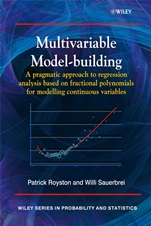
Multivariable Model – Building: A Pragmatic Approach to Regression Anaylsis based on Fractional Polynomials for Modelling Continuous Variables
ISBN 9780470028421
Autor: Patrick Royston, Willi Sauerbrei
Wydawca: Wiley
Dostępność: 3-6 tygodni
Cena: 575,40 zł
Przed złożeniem zamówienia prosimy o kontakt mailowy celem potwierdzenia ceny.
ISBN13: |
9780470028421 |
ISBN10: |
0470028424 |
Autor: |
Patrick Royston, Willi Sauerbrei |
Oprawa: |
Hardback |
Rok Wydania: |
2008-05-09 |
Ilość stron: |
322 |
Wymiary: |
244x170 |
Tematy: |
PB |
Multivariable regression models are widely used in all areas of science in which empirical data are analysed. Using the multivariable fractional polynomials (MFP) approach this book focuses on the selection of important variables and the determination of functional form for continuous predictors. Despite being relatively simple, the selected models often extract most of the important information from the data. The authors have chosen to concentrate on examples drawn from medical statistics, although the MFP method has applications in many other subject–matter areas as well.
Multivariable Model–Building:Focuses on normal–error models for continuous outcomes, logistic regression for binary outcomes and Cox regression for censored time–to–event data.Concentrates on fractional polynomial models and illustrates new approaches to model critisism and stability.Provides comparisons with and discussion of other techniques such as spline models.Features new strategies on modelling interactions with continuous covariates which are important in the context of randomized trials and observational studiesDoes not consider high–dimensional data, such as gene expression data.Is illustrated throughout with working examples from more than 20 substantial real datasets, most data sets and programs in Stata are available on a website enabling the reader to apply techniques directlyIs written in an accessible and informal style making it suitable for researchers from a range of disciplines with minimal mathematical background
This book provides a readable text giving the rationale of, and practical advice on, a unified approach to multivariable modelling. It aims to make multivariable model building simpler, transparent and more effective. This book is aimed at graduate students studying regression modelling and professionals in statistics as well as researchers from medical, physical, soc
ial and many other sciences where regression models play a central role.
Patrick Royston DSc, is a senior statistician and cancer clinical trialist at the MRC Clinical Trials Unit, London, an honorary professor of statistics at University College London, and a fellow of the Royal Statistical Society. He has authored many research papers in biostatistics, and has published over 150 articles in leading statistical journals. Patrick is an experienced statistical consultant, Stata programmer and software author.
Willi Sauerbrei PhD, is a senior statistician and professor in medical biometry at the IMBI, University Medical Center Freiburg. He has authored many research papers in biostatistics, and has published over 100 articles in leading statistical and clinical journals. He worked for more than two decades as an academic biostatistician and has extensive experience of cancer research, with a particular concern for breast cancer.
Spis treści:
Preface.
1. Introduction.
1.1 Real–Life Problems as Motivation for Model Building.
1.2 Issues in Modelling Continuous Predictors.
1.3 Types of Regression Model Considered.
1.4 Role of Residuals.
1.5 Role of Subject–Matter Knowledge in Model Development.
1.6 Scope of Model Building in our Book.
1.7 Modelling Preferences.
1.8 General Notation.
2. Selection of Variables.
2.1 Introduction.
2.2 Background.
2.3 Preliminaries for a Multivariable Analysis.
2.4 Aims of Multivariable Models.
2.5 Prediction: Summary Statistics and Comparisons.
2.6 Procedures for Selecting Variables.
2.7 Comparison of Selection Strategies in Examples.
2.8 Selection and Shrinkage.
2.9 Discussion.
3. Handling Categorical and Continuous Predictors.
3.1 Introduction.
3.2 Types of Predictor.
3.3 Handling Ordinal Predictors.
3.4 Handling Counting and Continuous Predictors: Categorization.
3.5 Example: I
ssues in Model Building with Categorized Variables.
3.6 Handling Counting and Continuous Predictors: Functional Form.
3.7 Empirical Curve Fitting.
3.8 Discussion.
4. Fractional Polynomials for One Variable.
4.1 Introduction.
4.2 Background.
4.3 Definition and Notation.
4.4 Characteristics.
4.5 Examples of Curve Shapes with FP1 and FP2 Functions.
4.6 Choice of Powers.
4.7 Choice of Origin.
4.8 Model Fitting and Estimation.
4.9 Inference.
4.10 Function Selection Procedure.
4.11 Scaling and Centering.
4.12 FP Powers as Approximations to Continuous Powers.
4.13 Presentation of Fractional Polynomial Functions.
4.14 Worked Example.
4.15 Modelling Covariates with a Spike at Zero.
4.16 Power of Fractional Polynomial Analysis.
4.17 Discussion.
5. Some Issues with Univariate Fractional Polynomial Models.
5.1 Introduction.
5.2 Susceptibility to Influential Covariate Observations.
5.3 A Diagnostic Plot for Influential Points in FP Models.
5.4 Dependence on Choice of Origin.
5.5 Improving Robustness by Preliminary Transformation.
5.6 Improving Fit by Preliminary Transformation.
5.7 Higher Order Fractional Polynomials.
5.8 When Fractional Polynomial Models are Unsuitable.
5.9 Discussion.
6. MFP: Multivariable Model–Building with Fractional Polynomials.
6.1 Introduction.
6.2 Motivation.
6.3 The MFP Algorithm.
6.4 Presenting the Model.
6.5 Model Criticism.
6.6 Further Topics.
6.7 Further Examples.
6.8 Simple Versus Complex Fractional Polynomial Models.
6.9 Discussion.
7. Interactions.
7.1 Introduction.
7.2 Background.
7.3 General Considerations.
7.4 The MFPI Procedure.
7.5 Example 1: Advanced Prostate Cancer.
7.6 Example 2: GBSG Breast Cancer Study.
7.7 Categorization.
7.8 STEPP.
7.9 Example 3: Comparison of STEPP with MFPI.
7.10 Comment on Type I Error of MFPI.
7.11 Continuous–by̵
1;Continuous Interactions.
7.12 Multi–Category Variables.
7.13 Discussion.
8. Model Stability.
8.1 Introduction.
8.2 Background.
8.3 Using the Bootstrap to Explore Model Stability.
8.4 Example 1: Glioma Data.
8.5 Example 2: Educational Body–Fat Data.
8.6 Example 3: Breast Cancer Diagnosis.
8.7 Model Stability for Functions.
8.8 Example 4: GBSG Breast Cancer Data.
8.9 Discussion.
9. Some Comparisons of MFP with Splines.
9.1 Introduction.
9.2 Background.
9.3 MVRS: A Procedure for Model Building with Regression Splines.
9.4 MVSS: A Procedure for Model Building with Cubic Smoothing Splines.
9.5 Example 1: Boston Housing Data.
9.6 Example 2: GBSG Breast Cancer Study.
9.7 Example 3: Pima Indians.
9.8 Example 4: PBC.
9.9 Discussion.
10. How To Work with MFP.
10.1 Introduction.
10.2 The Dataset.
10.3 Univariate Analyses.
10.4 MFP Analysis.
10.5 Model Criticism.
10.6 Stability Analysis.
10.7 Final Model.
10.8 Issues to be Aware of .
10.9 Discussion.
11. Special Topics Involving Fractional Polynomials.
11.1 Time–Varying Hazard Ratios in the Cox Model.
11.2 Age–specific Reference Intervals.
11.3 Other Topics.
12. Epilogue.
12.1 Introduction.
12.2 Towards Recommendations for Practice.
12.3 Omitted Topics and Future Directions.
12.4 Conclusion.
Appendix A: Data and Software Resources.
A.1 Summaries of Datasets.
A.2 Datasets used more than once.
A.2.1 Research Body Fat.
A.2.2 GBSG Breast Cancer.
A.2.3 Educational Body Fat.
A.2.4 Glioma.
A.2.5 Prostate Cancer.
A.2.6 Whitehall I.
A.2.7 PBC.
A.2.8 Oral Cancer.
A.2.9 Kidney Cancer.
A.3 Software.
Appendix B: Glossary of Abbreviations.
References.
Index
Nota biograficzna:
Patrick Royston DSc, is a senior statistician and cancer clinical realist at the MRC Cl
Koszyk
Książek w koszyku: 0 szt.
Wartość zakupów: 0,00 zł
Informacje


Kontakt
Gambit
Centrum Oprogramowania
i Szkoleń Sp. z o.o.
Al. Pokoju 29b/22-24
31-564 Kraków
Siedziba Księgarni
ul. Kordylewskiego 1
31-542 Kraków
+48 12 410 5991
+48 12 410 5987
+48 12 410 5989
Subskrypcje
Administratorem danych osobowych jest firma Gambit COiS Sp. z o.o. Na podany adres będzie wysyłany wyłącznie biuletyn informacyjny.
Autoryzacja płatności

Informacje na temat autoryzacji płatności poprzez PayU.

© Copyright 2012: GAMBIT COiS Sp. z o.o. Wszelkie prawa zastrzeżone.
Projekt i wykonanie: Alchemia Studio Reklamy