


Wydawcy
Katalog tematyczny
- Archeologia (109)
- Ekonomia, finanse, business (13704)
- Filozofia (1445)
- Historia (3040)
- Języki i językoznawstwo (2356)
- Lifestyle, hobby i rozrywka (475)
- Medycyna (9704)
- Nauki humanistyczne (4)
- Nauki o Ziemi i środowisku (2638)
- Nauki ścisłe (20412)
- Astronomia (294)
- Biologia (5119)
- Chemia (6540)
- Fizyka (3309)
- Matematyka (4574)
- Algebra (171)
- Analiza matematyczna (902)
- Filozofia matematyki (1)
- Geometria (237)
- Historia matematyki (57)
- Kombinatoryka, teoria grafów (67)
- Matematyka dyskretna (35)
- Matematyka stosowana (555)
- Optymalizacja (104)
- Podstawy matematyki (129)
- Statystyka, prawdopodobieństwo (296)
- Teoria grup (63)
- Teoria liczb (77)
- Topologia (66)
- Nauki ścisłe, ogólnie (503)
- Nauki społeczne (8486)
- Nauki techniczne (13450)
- Prawo (1696)
- Publikacje informacyjne i interdyscyplinarne (1288)
- Religia i wierzenia (917)
- Technika komputerowa (4067)
- Zdrowie, relacje międzyludzkie i rozwój osobisty (657)





Informacje szczegółowe o książce
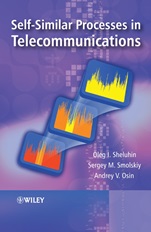
Self–Similar Processes in Telecommunications
ISBN 9780470014868
Autor: Oleg Sheluhin, Sergey Smolskiy, Andrew Osin
Wydawca: Wiley
Dostępność: 3-6 tygodni
Cena: 736,05 zł
Przed złożeniem zamówienia prosimy o kontakt mailowy celem potwierdzenia ceny.
ISBN13: |
9780470014868 |
ISBN10: |
0470014865 |
Autor: |
Oleg Sheluhin, Sergey Smolskiy, Andrew Osin |
Oprawa: |
Hardback |
Rok Wydania: |
2007-03-02 |
Ilość stron: |
334 |
Wymiary: |
249x177 |
Tematy: |
PB |
For the first time the problems of voice services self–similarity are discussed systematically and in detail with specific examples and illustrations.
‘Self–Similar Processes in Telecommunications’ considers the self–similar (fractal and multifractal) models of telecommunication traffic and efficiency based on the assumption that its traffic has fractal or multifractal properties (is self–similar). The theoretical aspects of the most well–known traffic models demonstrating self–similar properties are discussed in detail and the comparative analysis of the different models’ efficiency for self–similar traffic is presented.
This book demonstrates how to use self–similar processes for designing new telecommunications systems and optimizing existing networks so as to achieve maximum efficiency and serviceability. The approach is rooted in theory, describing the algorithms (the logical arithmetical or computational procedures that define how a task is performed) for modeling these self–similar processes. However, the language and ideas are essentially accessible for those who have a general knowledge of the subject area and the advice is highly practical: all models, problems and solutions are illustrated throughout using numerous real–world examples.
Adopts a detailed, theoretical, yet broad–based and practical mathematical approach for designing and operating numerous types of telecommunications systems and networks so as to achieve maximum efficiency
Places the subject in context, describing the current algorithms that make up the fractal or self–similar processes while pointing to the future development of the technology
Offers a comparative analysis of the different types of self–similar process usage within the context of local area networks, wide area networks and in the modeling of video traffic and mobile communications networks<
/ul>
Describes how mathematical models are used as a basis for building numerous types of network, including voice, audio, data, video, multimedia services and IP (Internet Protocol) telephony
The book will appeal to the wide range of specialists dealing with the design and exploitation of telecommunication systems. It will be useful for the post–graduate students, lecturers and researchers connected with communication networks disciplines.
Spis treści:
Foreword.
About the authors.
Acknowledgements.
1 Principal Concepts of Fractal Theory and Self–Similar Processes.
1.1 Fractals and Multifractals.
1.1.1 Fractal Dimension of a Set.
1.1.2 Multifractals.
1.1.3 Fractal Dimension D0 and Informational Dimension D1.
1.1.4 Legendre Transform.
1.2 Self–Similar Processes.
1.2.1 Definitions and Properties of Self–Similar Processes.
1.2.2 Multifractal Processes.
1.2.3 Long–Range and Short–Range Dependence.
1.2.4 Slowly Decaying Variance.
1.3 ‘Heavy Tails’.
1.3.1 Distribution with ‘Heavy Tails’ (DHT).
1.3.2 ‘Heavy Tails’ Estimation.
1.4 Hurst Exponent Estimation.
1.4.1 Time Domain Methods of Hurst Exponent Estimation.
1.4.2 Frequency Domain Methods of Hurst Exponent.
Estimation.
1.5 Hurst Exponent Estimation Problems.
1.5.1 Estimation Problems.
1.5.2 Nonstationarity Problems.
1.5.3 Computational Problems.
1.6 Self–Similarity Origins in Telecommunication Traffic.
1.6.1 User’s Behaviour.
1.6.2 Data Generation Data Structure and Its Search.
1.6.3 Traffic Aggregation.
1.6.4 Means of Network Control.
1.6.5 Control Mechanisms based on Feedback.
1.6.6 Network Development.
References.
2 Simulation Methods for Fractal Processes.
2.1 Fractional Brownian Motion.
2.1.1 RMD Algorithm for FBM Generation.
2.1.2 SRA Algorithm for FBM Generation.
2.2 Fractional G
aussian Noise.
2.2.1 FFT Algorithm for FGN Synthesis.
2.2.2 Advantages and Shortcomings of FBM/FGN Models.
in Network Applications.
2.3 Regression Models of Traffic.
2.3.1 Linear Autoregressive (AR) Processes.
2.3.2 Processes of Moving Average (MA).
2.3.3 Autoregressive Models of Moving Average, ARMAðp; qÞ.
2.3.4 Fractional Autoregressive Integrated Moving Average.
(FARIMA) Process.
2.3.5 Parametric Estimation Methods.
2.3.6 FARIMAðp,d,qÞ Process Synthesis.
2.4 Fractal Point Process.
2.4.1 Statistical Characteristics of the Point Process.
2.4.2 Fractal Structure of FPP.
2.4.3 Methods of FPP Formation.
2.5 Fractional Levy Motion and its Application to Network.
Traffic Modelling.
2.5.1 Fractional Levy Motion and Its Properties.
2.5.2 Algorithm of Fractional Levy Motion Modelling.
2.5.3 Fractal Traffic Formation Based on FLM.
2.6 Models of Multifractal Network Traffic.
2.6.1 Multiplicative Cascades.
2.6.2 Modified Estimation Method of Multifractal Functions.
2.6.3 Generation of Traffic the Multifractal Model.
2.7 LRD Traffic Modelling with the Help of Wavelets.
2.8 M/G/1Model.
2.8.1 M/G/1Model and Pareto Distribution.
2.8.2 M/G/1Model and Log–Normal Distribution.
References.
3 Self–Similarity of Real Time Traffic.
3.1 Self–Similarity of Real Time Traffic Preliminaries.
3.2 Statistical Characteristics of Telecommunication Real Time Traffic.
3.2.1 Measurement Organization.
3.2.2 Pattern of TN Traffic.
3.3 Voice Traffic Characteristics.
3.3.1 Voice Traffic Characteristics at the Call Layer.
3.3.2 Voice Traffic Characteristics at the Packet Layer.
3.4 Multifractal Analysis of Voice Traffic.
3.4.1 Basics.
3.4.2 Algorithm for the Partition Function SmðqÞ Calculation.
3.4.3 Multifractal Properties of Multiplexed Voice Traffic.
3.4.4 Multifractal Properties of Two–Component Voice Traffic.
3.5 Mat
hematical Models of VoIP Traffic.
3.5.1 Problem Statement.
3.5.2 Voice Traffic Models at the Call Layer.
3.5.3 Estimation of Semi–Markovian Model Parameters and the Modelling.
Results of the Voice Traffic at the Call Layer.
3.5.4 Mathematical Models of Voice Traffic at the Packets Layer.
3.6 Simulation of the Voice Traffic.
3.6.1 Simulation Structure.
3.6.2 Parameters Choice of Pareto Distributions for Voice.
Traffic Source in ns2.
3.6.3 Results of Separate Sources Modelling.
3.6.4 Results of Traffic Multiplexing for the Separate.
ON/OFF Sources.
3.7 Long–Range Dependence for the VBR–Video.
3.7.1 Distinguished Characteristics of Video Traffic.
3.7.2 Video Conferences.
3.7.3 Video Broadcasting.
3.7.4 MPEG Video Traffic.
3.7.5 Nonstationarity of VBR Video Traffic.
3.8 Self–Similarity Analysis of Video Traffic.
3.8.1 Video Broadcasting Wavelet Analysis.
3.8.2 Numerical Results.
3.8.3 Multifractal Analysis.
3.9 Models and Modelling of Video Sequences.
3.9.1 Nonstationarity Types for VBR Video Traffic.
3.9.2 Model of the Video Traffic Scene Changing Based on the.
Shifting Level Process.
3.9.3 Video Traffic Models in the Limits of the Separate Scene.
3.9.4 Fractal Autoregressive Models of p–Order.
3.9.5 MPEG Data Modelling Using I, P and B Frames Statistics.
3.9.6 ON/OFF Model of the Video Sequences.
3.9.7 Self–Similar Norros Model.
3.9.8 Hurst Exponent Dependence on N.
References.
4 Self–Similarity of Telecommunication Networks Traffic.
4.1 Problem Statement.
4.2 Self–Similarity and ‘Heavy Tails’ in Lan Traffic.
4.2.1 Experimental Investigations of Ethernet Traffic Self–Similar.
Structure.
4.2.2 Estimation of Testing Results.
4.3 Self–Similarity of WAN Traffic.
4.3.1 WAN Traffic at the Application Level.
4.3.2 Some Limiting Results for Aggregated WAN Traffic.
4.3.3 The Sta
Koszyk
Książek w koszyku: 0 szt.
Wartość zakupów: 0,00 zł
Informacje


Kontakt
Gambit
Centrum Oprogramowania
i Szkoleń Sp. z o.o.
Al. Pokoju 29b/22-24
31-564 Kraków
Siedziba Księgarni
ul. Kordylewskiego 1
31-542 Kraków
+48 12 410 5991
+48 12 410 5987
+48 12 410 5989
Subskrypcje
Administratorem danych osobowych jest firma Gambit COiS Sp. z o.o. Na podany adres będzie wysyłany wyłącznie biuletyn informacyjny.
Autoryzacja płatności

Informacje na temat autoryzacji płatności poprzez PayU.

© Copyright 2012: GAMBIT COiS Sp. z o.o. Wszelkie prawa zastrzeżone.
Projekt i wykonanie: Alchemia Studio Reklamy