


Wydawcy
Katalog tematyczny
- Archeologia (109)
- Ekonomia, finanse, business (13704)
- Filozofia (1445)
- Historia (3040)
- Języki i językoznawstwo (2356)
- Lifestyle, hobby i rozrywka (475)
- Medycyna (9704)
- Nauki humanistyczne (4)
- Nauki o Ziemi i środowisku (2638)
- Nauki ścisłe (20412)
- Nauki społeczne (8486)
- Nauki techniczne (13450)
- Prawo (1696)
- Publikacje informacyjne i interdyscyplinarne (1288)
- Religia i wierzenia (917)
- Technika komputerowa (4067)
- Zdrowie, relacje międzyludzkie i rozwój osobisty (657)





Informacje szczegółowe o książce
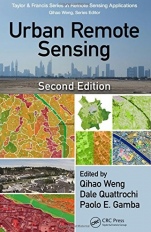
Urban Remote Sensing, 2nd Ed.
ISBN 9781138054608
Autor: Qihao Weng
Wydawca: CRC Press
Dostępność: 3-6 tygodni
Cena: 757,05 zł
Przed złożeniem zamówienia prosimy o kontakt mailowy celem potwierdzenia ceny.
ISBN13: |
9781138054608 |
ISBN10: |
1138054607 |
Autor: |
Qihao Weng |
Oprawa: |
Hardback |
Rok Wydania: |
2018-03-05 |
Numer Wydania: |
2 |
Ilość stron: |
315 |
Earth observation technology, in conjunction with in situ data collection, can be used to observe, monitor, measure, and model many of the components that comprise urban ecosystems cycles. Over the past decade, urban remote sensing has rapidly emerged as a new frontier in the Earth observation technology by focusing primarily on understanding the biophysical properties, patterns, and processes of urban landscapes, and mapping and monitoring of urban land cover and spatial extent. The second edition reflects new developments in satellite sensors, image processing methods and techniques, and the applications of urban remote sensing to meet societal and economic challenges at this time.
Review: "This volume is an indispensable update of the 1st edition. The inclusion of new sensors, state-of-the art image processing techniques and practical applications makes this a must-have for urban remote sensing scientists." - Karen C. Seto, Yale University, Connecticut, USA "This book provides a comprehensive overview of new developments in urban remote sensing, including novel techniques for image/signal processing applied to the monitoring of urban areas, and wider applications of urban remote sensing in order to meet societal and economic challenges. The book also covers other important aspects such as data, sensors, and systems for urban remote sensing, as well as applications for assessing and modeling urban landscape compositions, patterns, and structures. It is a fundamental reference for students, researchers, and practitioners interested in conducting in-depth studies and research on urban remote sensing." - Antonio J. Plaza, University of Extremadura, Caceres, Spain Remote sensing of urban areas is a very hot topic. This second edition of Urban Remote Sensing is both important and timely. It covers all major aspects of the field contributed by leading experts. -Jon Atli Benediktsson, University of Iceland
Author Biography: Dr. Qihao Weng is the Director of the Center for Urban and Environmental Change and a Professor of Remote Sensing and GIS at Indiana State University, and worked as a Senior Fellow at the National Aeronautics and Space Administration from December 2008 to December 2009. He received his Ph.D. degree in geography from the University of Georgia in 1999. Weng is currently the Lead of Group on Earth Observation (GEO) Global Urban Observation and Information Initiative, and serves as an Editor-in-Chief of ISPRS Journal of Photogrammetry and Remote Sensing and the Series Editor of Taylor & Francis Series in Remote Sensing Applications. He has been the Organizer and Program Committee Chair of the biennial IEEE/ISPRS/GEO sponsored International Workshop on Earth Observation and Remote Sensing Applications conference series since 2008, a National Director of American Society for Photogrammetry and Remote Sensing from 2007 to 2010, and a panelist of U.S. DOE's Cool Roofs Roadmap and Strategy in 2010. In 2008, Weng received a prestigious NASA senior fellowship. He received the Outstanding Contributions Award in Remote Sensing in 2011 from the American Association of Geographers in 2011 as well as the Willard and Ruby S. Miller Award in 2015 for his outstanding contributions to geography. In 2005 at Indiana State University, he was selected as a Lilly Foundation Faculty Fellow and in the following year, he also received the Theodore Dreiser Distinguished Research Award. In addition, he was the recipient of 2010 Erdas Award for Best Scientific Paper in Remote Sensing (1st place) and 1999 Robert E. Altenhofen Memorial Scholarship Award, which were both awarded by American Society for Photogrammetry and Remote Sensing. He was also awarded the Best Student-Authored Paper Award by International Geographic Information Foundation in 1998. Weng has been invited to give more than 90 talks by organizations and conferences held in U.S.A., Canada, China, Brazil, Greece, UAE, and Hong Kong, and is honored with distinguished/chair/guest professorship at eleven top universities in China which includes Peking University. Weng's research focuses on remote sensing applications to urban environmental and ecological systems, land-use and land-cover changes, urbanization impacts, environmental modeling, and human-environment interactions. Through a serial invention of innovative algorithms, techniques, methods and theories for urban remote sensing, he focuses research efforts on fostering the understanding of remote sensing in geographical applications and narrowing down the gap between geography and landscape ecology. Weng is the author of 206 articles (journal articles, chapters, and others) and 10 books. According to Google Scholar, as of July 2017, his SCI citation reached 11,568 (H-index of 49), and 28 of his publications had more than 100 citations each. Weng's research has been supported by funding agencies that include NSF, NASA, USGS, USAID, NOAA, National Geographic Society, European Space Agency, and Indiana Department of Natural Resources. Dr. Dale Quattrochi has been a geographer and senior research scientist with NASA since 1980. Dr. Quattrochi received his B.S. from Ohio University, his M.S. from the University of Tennessee, and his Ph.D. from the University of Utah, all in geography. As a member of the Applied Science Team, his research focuses on the applications of remote sensing to public health, thermal remote sensing for analysis of land surface energy fluxes, and remote sensing of the urban heat island effect. Dr. Quattrochi has received numerous awards including the NASA Medal for Exceptional Scientific Achievement, NASA's highest science award, the Association of American Geographers' Remote Sensing Specialty Group's Outstanding Contributions Award, and the Ohio University College of Arts and Sciences Distinguished Alumni Award. He has co-edited three books on remote sensing: Scale in Remote Sensing and GIS, Thermal Remote Sensing in Land Surface Processes, and Urban Remote Sensing. Dr. Paolo Gamba is Full Professor of Telecommunications at the University of Pavia, Italy, where he also leads the Telecommunications and Remote Sensing Laboratory. He received the Laurea degree in Electronic Engineering "cum laude" from the University of Pavia, Italy, in 1989, and the Ph.D. in Electronic Engineering from the same University in 1993. He is a Fellow of IEEE. He served as Editor-in-Chief of the IEEE Geoscience and Remote Sensing Letters from 2009 to 2013, and as Chair of the Data Fusion Committee of the IEEE Geoscience and Remote Sensing Society from October 2005 to May 2009. Currently, he is the Chair of the Chapters' Committee of the same Society. He has been the organizer and Technical Chair of the biennial GRSS/ISPRS Joint Workshops on "Remote Sensing and Data Fusion over Urban Areas" since 2001. He also served as Technical Co-Chair of the 2010 IEEE Geoscience and Remote Sensing Symposium, Honolulu, Hawaii, July 2010, and Technical Co-Chair of the 2015 IEEE Geoscience and Remote Sensing Symposium, in Milan, Italy. He has been the Guest Editor of special issues of IEEE Transactions on Geoscience and Remote Sensing, IEEE Journal of Selected Topics in Remote Sensing Applications, ISPRS Journal of Photogrammetry and Remote Sensing, International Journal of Information Fusion and Pattern Recognition Letters on the topics of Urban Remote Sensing, Remote Sensing for Disaster Management, Pattern Recognition in Remote Sensing Applications. He has been invited to give keynote lectures and tutorials in several occasions about urban remote sensing, data fusion, EO data and risk management. He published more than 130 papers in international peer-review journals and presented more than 250 research works in workshops and conferences.
Part I Data, Sensors, and Systems Considerations and Algorithms for Urban Feature Extraction. The Global Urban Footprint. Thomas Esch, Wieke Heldens, and Andreas Hirner Development of On-Demand Human Settlement Mapping System using Historical Satellite Archives. Hiroyuki Miyazaki and Ryosuke Shibasaki Morphological Building Index (MBI) and Its Applications to Urban Areas. Xin Huang and Tao Zhang Part II Assessing and modeling urban landscape compositions, patterns and structures. Stereo-Based Building Roof Mapping in Urban Off-Nadir VHR Satellite Images: Challenges and Solutions. Alaeldin Suliman and Yun Zhang Beyond Built-Up: The Internal Makeup of Urban Areas. Benjamin Bechtel, Martino Pesaresi, Aneta J. Florczyk, and Gerald Mills Urban Change Detection Utilizing High Resolution Optical Images Taken from Different Viewing-Angles and Different Platforms. Shabnam Jabari and Yun Zhang Part III Monitoring, analyzing, and modeling urban growth. Urbanisation in India: Patterns, Visualisation of Cities and Greenhouse Gas Inventory for Developing an Urban Observatory. Bharath Haridas Aithal, Maysore Chandrashekar Chandan, Shivamurthy Vinay, and T.V. Ramachandra Mapping Imperious Surface in the Greater Hanoi Area, Vietnam from Time Series Landsat Image, 1988 - 2015. Hung Q. Ha and Qihao Weng City in desert: Mapping subpixel urban impervious surface area in a desert environment using spectral unmixing and machine learning methods. Chengbin Deng and Weiying Lin Application of Remote Sensing and Cellular Automata Model to Analyze and Simulate Urban Density Changes. Santiago Linares and Natasha Picone Part IV Urban Planning and Socioeconomic Applications. Developing Multiscale HEAT Scores from H-Res Airborne Thermal Infrared Imagery to Support Urban Energy Efficiency: Challenges Moving Forward. Bharanidharan Hemachandran, Geoffrey J. Hay, Mir Mustafiz Rahman, Isabelle Couloigner, Yilong Zhang, Bilal Karim, Tak S. Fung, and Christopher D. Kyle Air Quality and Health Monitoring In Urban Areas Using EO and Clinical Data. Andrea Marinoni and Paolo Gamba Urban Green Mapping and Valuation. Stefan Lang, Thomas Blaschke, Gyula Kothencz, and Daniel Hoelbling
Koszyk
Książek w koszyku: 0 szt.
Wartość zakupów: 0,00 zł
Informacje


Kontakt
Gambit
Centrum Oprogramowania
i Szkoleń Sp. z o.o.
Al. Pokoju 29b/22-24
31-564 Kraków
Siedziba Księgarni
ul. Kordylewskiego 1
31-542 Kraków
+48 12 410 5991
+48 12 410 5987
+48 12 410 5989
Subskrypcje
Administratorem danych osobowych jest firma Gambit COiS Sp. z o.o. Na podany adres będzie wysyłany wyłącznie biuletyn informacyjny.
Autoryzacja płatności

Informacje na temat autoryzacji płatności poprzez PayU.

© Copyright 2012: GAMBIT COiS Sp. z o.o. Wszelkie prawa zastrzeżone.
Projekt i wykonanie: Alchemia Studio Reklamy