


Wydawcy
Katalog tematyczny
- Archeologia (109)
- Ekonomia, finanse, business (13704)
- Filozofia (1445)
- Historia (3040)
- Języki i językoznawstwo (2356)
- Lifestyle, hobby i rozrywka (475)
- Medycyna (9704)
- Nauki humanistyczne (4)
- Nauki o Ziemi i środowisku (2638)
- Nauki ścisłe (20412)
- Nauki społeczne (8486)
- Nauki techniczne (13450)
- Budownictwo lądowe (1045)
- Chemia przemysłowa (2258)
- Elektronika i telekomunikacja (3287)
- Energetyka (1122)
- Inne nauki stosowane (363)
- Inżynieria biochemiczna (507)
- Inżynieria transportu (232)
- Mechanika i materiały (3316)
- Nauka o środowisku (321)
- Rolnictwo (507)
- Technika, ogólnie (475)
- Prawo (1696)
- Publikacje informacyjne i interdyscyplinarne (1288)
- Religia i wierzenia (917)
- Technika komputerowa (4067)
- Zdrowie, relacje międzyludzkie i rozwój osobisty (657)





Informacje szczegółowe o książce
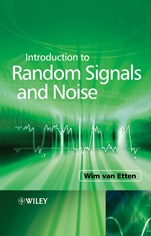
Introduction to Random Signals and Noise
ISBN 9780470024119
Autor: Wim C. Van Etten
Wydawca: Wiley
Dostępność: 3-6 tygodni
Cena: 596,40 zł
Przed złożeniem zamówienia prosimy o kontakt mailowy celem potwierdzenia ceny.
ISBN13: |
9780470024119 |
ISBN10: |
0470024119 |
Autor: |
Wim C. Van Etten |
Oprawa: |
Hardback |
Rok Wydania: |
2005-08-05 |
Ilość stron: |
270 |
Wymiary: |
249x177 |
Tematy: |
TJ |
Random signals and noise are present in many engineering systems and networks. Signal processing techniques allow engineers to distinguish between useful signals in audio, video or communication equipment, and interference, which disturbs the desired signal.
With a strong mathematical grounding, this text provides a clear introduction to the fundamentals of stochastic processes and their practical applications to random signals and noise. With worked examples, problems, and detailed appendices, Introduction to Random Signals and Noise gives the reader the knowledge to design optimum systems for effectively coping with unwanted signals.
Key features:Considers a wide range of signals and noise, including analogue, discrete–time and bandpass signals in both time and frequency domains.Analyses the basics of digital signal detection using matched filtering, signal space representation and correlation receiver.Examines optimal filtering methods and their consequences.Presents a detailed discussion of the topic of Poisson processes and shot noise.
An excellent resource for professional engineers developing communication systems, semiconductor devices, and audio and video equipment, this book is also ideal for senior undergraduate and graduate students in Electronic and Electrical Engineering.
Spis treści:
Preface.
1 Introduction.
1.1 Random Signals and Noise.
1.2 Modelling.
1.3 The Concept of a Stochastic Process.
1.4 Summary.
2 Stochastic Processes.
2.1 Stationary Processes.
2.2 Correlation Functions.
2.3 Gaussian Processes.
2.4 Complex Processes.
2.5 Discrete–Time Processes.
2.6 Summary.
2.7 Problems.
3 Spectra of Stochastic Processes.
3.1 The Power Spectrum.
3.2 The Bandwidth of a Stochastic Process.
3.3 The Cross–Power Spectrum.
3.4 Modulation of Stochastic Processes.
3.5 Sampling and
Analogue–To–Digital Conversion.
3.6 Spectrum of Discrete–Time Processes.
3.7 Summary.
3.8 Problems.
4. Linear Filtering of Stochastic Processes.
4.1 Basics of Linear Time–Invariant Filtering.
4.2 Time Domain Description of Filtering of Stochastic Processes.
4.3 Spectra of the Filter Output.
4.4 Noise Bandwidth.
4.5 Spectrum of a Random Data Signal.
4.6 Principles of Discrete–Time Signals and Systems.
4.7 Discrete–Time Filtering of Random Sequences.
4.8 Summary.
4.9 Problems.
5 Bandpass Processes.
5.1 Description of Deterministic Bandpass Signals.
5.2 Quadrature Components of Bandpass Processes.
5.3 Probability Density Functions of the Envelope and Phase of Bandpass Noise.
5.4 Measurement of Spectra.
5.5 Sampling of Bandpass Processes.
5.6 Summary.
5.7 Problems.
6 Noise in Networks and Systems.
6.1 White and Coloured Noise.
6.2 Thermal Noise in Resistors.
6.3 Thermal Noise in Passive Networks.
6.4 System Noise.
6.5 Summary.
6.6 Problems.
7 Detection and Optimal Filtering.
7.1 Signal Detection.
7.2 Filters that Maximize the Signal–to–Noise Ratio.
7.3 The Correlation Receiver.
7.4 Filters that Minimize the Mean–Squared Error.
7.5 Summary.
7.6 Problems.
8 Poisson Processes and Shot Noise.
8.1 Introduction.
8.2 The Poisson Distribution.
8.3 The Homogeneous Poisson Process.
8.4 Inhomogeneous Poisson Processes.
8.5 The Random–Pulse Process.
8.6 Summary.
8.7 Problems.
References.
Further Reading.
Appendices.
A. Representation of Signals in a Signal Space.
A.1 Linear Vector Spaces.
A.2 The Signal Space Concept.
A.3 Gram–Schmidt Orthogonalization.
A.4 The Representation of Noise in Signal Space.
A.5 Signal Constellations.
A.6 Problems.
B. Attenuation, Phase Shift and Decibels.
C. Mathematical Relations.
C.1 Trigonometric Relations.
C.2 Derivatives.
C.3 Indefinite Integrals.
C.4 Definite Integrals.
C.5 Series.
C.6 Logarithms.
D. Summary of Probability Theory.
E. Definition of a Few Special Functions.
F. The Q(.) and erfc Function.
G. Fourier Transforms.
H. Mathematical and Physical Constants.
Index.
Nota biograficzna:
Wim C. van Etten, University of Twente, Department of Electrical Engineering, Enschede, Netherlands
Wim Van Etten was appointed as a Full Professor of Telecommunications at the University of Twente, Enschede, the Netherlands, in 1994, where he heads a group on telecommunication engineering.
He is author or co–author of over eighty papers in international journals, conferences and symposia and his current interests comprise of optical communications, mobile communications, communication networks, detection, and simulation of communication systems.
He is also past–president of the NERG (Dutch Institute of Electronic and Radio Engineers) and Chairman of the executive committee of the IEEE Benelux joint Chapter on Communications and Vehicular Technology.
Okładka tylna:
Random signals and noise are present in many engineering systems and networks. Signal processing techniques allow engineers to distinguish between useful signals in audio, video or communication equipment, and interference, which disturbs the desired signal.
With a strong mathematical grounding, this text provides a clear introduction to the fundamentals of stochastic processes and their practical applications to random signals and noise. With worked examples, problems, and detailed appendices, Introduction to Random Signals and Noise gives the reader the knowledge to design optimum systems for effectively coping with unwanted signals.
Key features:Considers a wide range of signals and noise, including analogue, discrete–time and bandpas
s signals in both time and frequency domains.Analyses the basics of digital signal detection using matched filtering, signal space representation and correlation receiver.Examines optimal filtering methods and their consequences.Presents a detailed discussion of the topic of Poisson processes and shot noise.
An excellent resource for professional engineers developing communication systems, semiconductor devices, and audio and video equipment, this book is also ideal for senior undergraduate and graduate students in Electronic and Electrical Engineering.
Koszyk
Książek w koszyku: 0 szt.
Wartość zakupów: 0,00 zł
Informacje


Kontakt
Gambit
Centrum Oprogramowania
i Szkoleń Sp. z o.o.
Al. Pokoju 29b/22-24
31-564 Kraków
Siedziba Księgarni
ul. Kordylewskiego 1
31-542 Kraków
+48 12 410 5991
+48 12 410 5987
+48 12 410 5989
Subskrypcje
Administratorem danych osobowych jest firma Gambit COiS Sp. z o.o. Na podany adres będzie wysyłany wyłącznie biuletyn informacyjny.
Autoryzacja płatności

Informacje na temat autoryzacji płatności poprzez PayU.

© Copyright 2012: GAMBIT COiS Sp. z o.o. Wszelkie prawa zastrzeżone.
Projekt i wykonanie: Alchemia Studio Reklamy