


Wydawcy
Katalog tematyczny
- Archeologia (109)
- Ekonomia, finanse, business (13704)
- Filozofia (1445)
- Historia (3040)
- Języki i językoznawstwo (2356)
- Lifestyle, hobby i rozrywka (475)
- Medycyna (9704)
- Nauki humanistyczne (4)
- Nauki o Ziemi i środowisku (2638)
- Nauki ścisłe (20412)
- Astronomia (294)
- Biologia (5119)
- Chemia (6540)
- Chemia analityczna (361)
- Chemia fizyczna (346)
- Chemia nieorganiczna (137)
- Chemia organiczna (535)
- Krystalografia (27)
- Minerologia (46)
- Fizyka (3309)
- Matematyka (4574)
- Nauki ścisłe, ogólnie (503)
- Nauki społeczne (8486)
- Nauki techniczne (13450)
- Prawo (1696)
- Publikacje informacyjne i interdyscyplinarne (1288)
- Religia i wierzenia (917)
- Technika komputerowa (4067)
- Zdrowie, relacje międzyludzkie i rozwój osobisty (657)





Informacje szczegółowe o książce
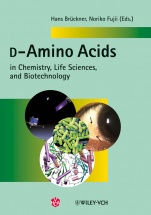
D–Amino Acids in Chemistry, Life Sciences, and Biotechnology
ISBN 9783906390659
Autor: Hans Brückner, Noriko Fujii
Wydawca: Wiley
Dostępność: 3-6 tygodni
Cena: 827,40 zł
Przed złożeniem zamówienia prosimy o kontakt mailowy celem potwierdzenia ceny.
ISBN13: |
9783906390659 |
ISBN10: |
3906390659 |
Autor: |
Hans Brückner, Noriko Fujii |
Oprawa: |
Hardback |
Rok Wydania: |
2010-12-15 |
Ilość stron: |
392 |
Wymiary: |
244x175 |
Tematy: |
PN |
Although still considered as exotic or unphysiological mirror images of the prevalentL–amino acids, D–amino acids in their free or conjugated forms actas neurotransmitters, and they are also involved in age–relatedprotein disorders and malfunctions. This field gains increasingimpact also in pharmaceutical chemistry including peptide–drugdesign, food science, natural product and biopolymer chemistry,recombinant protein technology, and it culminates in fundamentalquestions on the origin of biological chirality.
The rapidly emerging relevance of D–amino acids led to thefoundation of the D–Amino Acid Research Society inJapan a few years ago and resulted in the FirstInternational Conference on D–Amino Acid Research held in2009. In addition to the contributions to this conference, thisvolume contain further state–of–Art reviews and articles fromrenowned scientists in the field.
Part 1.Transpeptidation and Isomerization.
The Role of Protein L–Isoaspartyl/D–Aspartyl–AspartylO–Methyl–transferase (PIMT) in Interacellar Signal Transduction(T. Furuchi K. Sakurako, M. Katane, M. Sekine, H.Homma).
Modeling the Enolization of Succinimide Derivatives, a Key Stepof Raceminization of Aspartic Acid Residues: Importance of aTwo–H2O Mechanism (O. Takahashi, K. Kobayashi, A. Oda).
Molecular–Dynamics Simulations for Amyloid ß1–42Monomer with D–Aspartic Acid Residues Using Continuous Solvent(A. Oda, K. Kobayashi , O. Takashashi).
Accumulation of D–ß–Aspartic Acid–Containing Proteins inAge–Related Ocular Diseases (Y. Kaji, T. Oshika Y.Takazawa, M. Fukayama, N. Fujii).
Quantification of Structural Alterations of L–Asp and L–AsnResidues in Peptides Related to Neuronal Diseases by Reversed Phase high Performance Liquid Chromatography (Y.Sadakane, K. Konoha, M. Jawahara, K. Nakagomi).
SAXS and SANS Observations of Abnormal Aggregation of Humana–Crystallin (M. Sugiyama, N. Fujii, Y. Morimoto, K. Itoh, K.Mori, T. Fukunaga, N. Fujii).
Collapse of Homochirality of Amino Acids in Proteins fromVarious Tissues during Aging (N. Fujii, Y. Kaji, N. Fujii, T.Nakamura, R. Motoie, Y. Mori, T. Kinouchi).
Influence of Oxidative Stress on D–Aspartyl EndopeptidaseActivity (T. Kiniuchi, A. Matsuda, S. Kawakami, T. Shimizu, T.Shirasawa, N. Fujii).
Structural Consideration of Mammalian D–Aspartyl Endopeptidase(T. Kinouchi, N. Fujii).
Oxidative Stress Induces the Formation of D–Aspartyl Residues inthe Elastin Mimic Peptides (K. Kuge, K. Kitamura, K. Nakaoji, K.Hamada, N. Fujii, T. Saito, N. Fujii).
Part 2. D–Amino Acid (D–Aspartic Acid) Oxidase.
Indispensable but Insufficient Role of Renal D–Amino AcidOxidase in Chiral Inversion of NG–Nitro D–arginine(Y.F. Xin, X. Li, B. Hao, N. Gong, W.–Q. Sun, R. Konno, Y.–X.Wang).
Comparative Characterization of Three D–Aspartate Oxidases andOne D–Amino Acid Oxidase from Caeno–rhabditis elegans (M.Katane, Y. Saitoh, Y. Seida, M. Sekine, T. Furuchi, H.Homma).
D Aspartate Oxidase: The Sole Catabolic Enzymes Acting onFree D–Aspartate in Mammals (M. Katane, H. Homma).
Mutant Mice and Rats Lacking D–Amino Acid Oxidase (R. Konno,K. Hamase, R. Maruyama, K. Zaitsu).
Effects of D–Aspartate Treatment on D–Aspartate Oxidase,Suoeroxide Dismutase , and Capase 3 Activities in Frog (Ranaesculenta) Tissues (L. Buroone, M. Di Giovanni, M. M. Di Fiore,G. C. Baccari, A. Santillo).
Thyroid Hormones and D–Aspartic Acid, D–Aspartate Oxidase,D–Aspartate Racemase, H2O2 and ROS in Ratsand Mice (E. Topo, G. Fisher, A. Sorricelli, F. Errico, A.Usiello, A. D. Aniello).
Aberrant Control of Motoneuronal Excitability in AmyotrophicLateral Sclerosis: Excitatory Glutamate/D Serine vs. InhibitroryGlycine/ –Aminobutanoic Acid (GABA) (J. Sasabe and S.Aiso).
Part 3. D–Amino Acids Related to Nutrition and IndustrialApplications.
Origin, Microbiology, Nutrition, and Pharmacology of D–AminoAcids (M. Friedman).
Natural Occurrence and Industrial Applications of D–Amino Acids:An Overview (S. Martínez–Rodríquez, A. I.Martínez–Gómez, F. Rodríguez–Vico, J. M.Clemente–Jiménez, F. J. Las Heras–Vázquez).
Enzymes Responsible for the Conversion ofNa–[(Benzyloxy) carbonyl]–D–Lysine toNa–[Benzyloxy)–carbonyl]–D–aminoadipic Acid byRhodococcus sp. AIU Z–35–1 (K. Isobe, N. Fukuda, S. Nagasawa, K.Saitou).
New Biological Functions and Applications of High Molecular–Mass Poly– –glutamic Acid (H. Poo, C.Park. M.–S. Kwak, D,–Y. Choi, S.–P. Hong, I.–H. Lee, Y. T. Lim, Y.K. Choi, S.–R. Bae, H. Uyama, C.–J. Kim, M.–H. Sung).
Identification and Biochemical Chartacterization of MembranousShort–Chain Polyglutamate from Bacillus subtilis (T. Kamei, D,Yamashiro, T. Horiuchii, Y. Minouchi, M. Ashiuchi).
Part 4. Amino Acid Racemases and Peptide Isomerases.
Serine Racemase Knockout Mice (H. Mori, R. Inoue).
Site–Directed Mutagenesis of Rice Serine Racemase: Evidence ThatGlu219 and Asp225 Mediate the Effects if Mg2+ on theAcitivity (Y. Gogami, A. Kobayashi, T. Ikeuchi, T.Oikawa).
Detection and Function of the Intramolecular Disulfide Bond inArginine Racemase: An Enzyme with Broad Substrate Specificity(D. Matsui, T. Oikawa).
Mammalian Peptide Isomerase: Platypus–Type Activity Is Presentin Mouse Heart (J. M. S. Koh, S. J. P. Chow, B. Crossett, P. W.Kuchel).
Part 5. Racemization Mechanisms and Chemistry of D–AminoAcids.
Configurational Assignment of D– and L– Isovalines in Intact,Natural, and Synthetic Peptides by 2D–NMR Spectroscopy (M. DeZotti, E. Schievano, S. Manni, B. Kaptein, Q.B. Broxterman, S. B.Singhm H. Brückner, C. Toniolo).
Computational Insight into the Mechanism of Serine ResidueRacemization (O. Takahashi, K. Kobayashi, A. Oda).
Computational Modeling of the Enolization in a Direct Mechanismof Racemization of the Aspartic Acid Residue (O. Takahashi, K.Kabayashi, A. Oda).
Protein–Engineering Study of Contribution of ConceivableD–Serine Residues to the Thermostabilization of Ovalbumin underAlkaline Conditions (N. Takashashi, M. Maeda, M. Yamasaki B.Mikami).
Generation of Enantiomeric Amino Acids during Acid Hydrolysis ofPeptides Detected by the Liquid Chromatogaphy/Tandem MassSpectroscopy (T. Miyamoto, M. Sekine, T. Ogawa, M. Hidaka, H.Homma, H. Masaki).
Photolysis of rac–Leucine with Circularly Polarized SynchrotronRadiation (U. J. Meierhenrich, J.–J. Filippi, C Meinert, S. V.Hoffmann, J. H. Bredehöft, L. Nahon).
Amino Acid Ligand Chirality for Enantioselective Synthees (K.Mucskei, T. Patonary, L. Caglioti, G. Pályi).
Hydrophobicity of Peptides Containing D–Amino Acids (T.Munegumi).
Index.
Noriko Fujii was born in Tokyo, Japan, in 1951 and graduated fromMeiji University, Tokyo in 1974. In 1976, she obtained an M.S. fromTokyo University of Fisheries and then obtained a Ph.D. from TokyoMedical and Dental University in 1982. She became a lecturer in theChemistry Department, University of Tsukuba (1980–1991), and thenmoved to Takeda Chemical Industries as a Research Scientist(1991–1994). In 1994–1997, she was appointed to the position ofResearch Scientist in the Group of Field and Reaction, PrecursoryResearch for Embryonic Science and Technology (PRESTO), JapanScience and Technology Corporation (JST). In 1997, she became aResearch Scientist (COE) at the National Institute for AdvancedInterdisciplinary Research (NAIR) and moved to the Research ReactorInstitute, Kyoto University as an associate professor in 1998, andbecame a full professor (2002–present). Her research interests spanthe homochirality and life, the appearance of D–amino acids inprotein from aged tissues, the effects on higher order structure ofprotein of the formation of D–amino acid in living tissue. She ispresident of the ′D–Amino Acid Research Society′, Japan.
Hans Brückner was born in 1944 near Stuttgart, Germany. Afterseveral years employment as chemical engineer in synthetic peptidechemistry at Ciba in Basel/Switzerland, he graduated and receivedhis equivalents of MSc and PhD in chemistry at TübingenUniversity in 1979. After two years as research assistant at theInstitute of Chemistry and Institute of Microbiology atTübingen, he changed to the Institute of Food Technology atthe University of Hohenheim at Stuttgart. In 1985, he became docentof general food chemistry and technology, and in 1991 assistantprofessor and deputy of the professorship of dairy technology andhead of the dairy plant. He is recipient of the Ajinomoto Prize forAmino Acid Research. In 1995, he accepted a call as full professorfor food sciences at the Institute of Nutritional Science, locatedat the Interdisciplinary Research Centre (IFZ) at GiessenUniversity and held the professorship until his retirement in 2008.He is still active in writing research articles and reviews and asa member of the honorary editorial board of the journalChromatographia. His research topics cover isolation and sequencedetermination of peptide antibiotics, alterations of amino acidsand proteins in the course of food processing, development of newmethods for the chiral and non–chiral separation of amino acids,and relevance of D–amino acids in foodstuffs and life sciences ingeneral. Together with Prof. C. Toniolo, Padova, Italy, he wasguest editor of a topical issue of Chemistry & Biodiversity anda VHCA–Wiley book on peptide antibiotics (′Peptaibiotics′). Incollaboration with Prof. N. Fujii and an international board, heco–edited the 4 volumes anthology ′D–Amino Acids. Practical Methodsand Protocols′ and, together with Prof. N. Fujii, he wasguest–editor of a topical issue of Chemistry & Biodiversity onD–amino acid research. He is currently also appointed visitingprofessor at King Saud University, Riyadh, Saudi Arabia.
Koszyk
Książek w koszyku: 0 szt.
Wartość zakupów: 0,00 zł
Informacje


Kontakt
Gambit
Centrum Oprogramowania
i Szkoleń Sp. z o.o.
Al. Pokoju 29b/22-24
31-564 Kraków
Siedziba Księgarni
ul. Kordylewskiego 1
31-542 Kraków
+48 12 410 5991
+48 12 410 5987
+48 12 410 5989
Subskrypcje
Administratorem danych osobowych jest firma Gambit COiS Sp. z o.o. Na podany adres będzie wysyłany wyłącznie biuletyn informacyjny.
Autoryzacja płatności

Informacje na temat autoryzacji płatności poprzez PayU.

© Copyright 2012: GAMBIT COiS Sp. z o.o. Wszelkie prawa zastrzeżone.
Projekt i wykonanie: Alchemia Studio Reklamy