


Wydawcy
Katalog tematyczny
- Archeologia (109)
- Ekonomia, finanse, business (13704)
- Filozofia (1445)
- Historia (3040)
- Języki i językoznawstwo (2356)
- Lifestyle, hobby i rozrywka (475)
- Medycyna (9704)
- Nauki humanistyczne (4)
- Nauki o Ziemi i środowisku (2638)
- Nauki ścisłe (20412)
- Nauki społeczne (8486)
- Nauki techniczne (13450)
- Prawo (1696)
- Publikacje informacyjne i interdyscyplinarne (1288)
- Religia i wierzenia (917)
- Technika komputerowa (4067)
- Zdrowie, relacje międzyludzkie i rozwój osobisty (657)





Informacje szczegółowe o książce
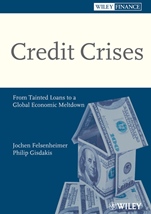
Credit Crises: From Tainted Loans to a Global Economic Meltdown
ISBN 9783527503759
Autor: Jochen Felsenheimer, Philip Gisdakis
Wydawca: Wiley
Dostępność: 3-6 tygodni
Cena: 313,95 zł
Przed złożeniem zamówienia prosimy o kontakt mailowy celem potwierdzenia ceny.
ISBN13: |
9783527503759 |
ISBN10: |
3527503757 |
Autor: |
Jochen Felsenheimer, Philip Gisdakis |
Oprawa: |
Hardback |
Rok Wydania: |
2008-05-14 |
Ilość stron: |
277 |
Wymiary: |
243x164 |
Tematy: |
KF |
The subprime crisis marked the end of an almost five–year long period of prosperity in financial markets. At the beginning of the crisis, the majority of market participants believed in a geographically limited impact on some specific segments; during the course of 2007 it became obvious that the subprime turmoil would reach the status of a fully fledged credit crisis. This put one of the most challenging topics back on the agenda of investors and monetary authorities, as well as academics: what are the transmission mechanisms during crises, how high are the related costs, and the question of whether crises are cyclical phenomena that hit the market from time to time. The authors try to find answers to these questions and show that there are many similarities between the credit crises that financial markets have experienced in the past. However, there are also some specific elements which occur during a crisis. In this book, the characteristics of the subprime crisis are described in detail to show the mechanism behind credit crises in general, especially the transmission mechanisms of so–called second–and third–round effects.
The book includes a comprehensive overview of the players in the credit market and the strategies implemented by these players, with a focus on the establishment of new vehicles (like Special Investment Vehicles (SIVs)) and innovative instruments, primarily out of the structured credit and credit derivatives universe. The book also includes an overview of historical credit crises, as this analysis is necessary to understand the basic mechanism behind crises, which is a prerequisite to discussing potential solutions. This brings us to a key wisdom with respect to financial market distortions: the question of how to avoid credit crises in the future.
Spis treści:
Foreword.
Preface.
Acknowledgements.
1. Prologue: Chronology of a Crisis.
1.1. The subprime turmoil included all ing
redients of a severe financial markets crisis.
1.2. An exemplary credit crisis.
1.3. The chronology of a crisis – The US subprime crisis.
2. Credit Instruments.
2.1. Bonds.
2.2. Loans.
2.3. Credit Default Swaps.
2.4. CDS Indices.
2.5. Tranches.
2.6. Securitization.
3. Credit Players.
3.1. Banks.
3.2. Fannie Mae and Freddy Mac.
3.3. Money Market Funds.
3.4. Central Banks.
3.5. Hedge Funds.
3.6. Bond Insurer.
3.7. Private Equity Sponsors.
4. Credit Strategies.
4.1. Leverage.
4.2. Leveraged Super Senior Tranches.
4.3. Constant Proportion Debt Obligations.
4.4. Structured Investment Vehicles.
4.5. Collateralized Debt Obligations.
4.6. Structured–Squared Madness.
5. The Anatomy of a Credit Crisis.
5.1. Introduction.
5.2. Crisis Classification.
5.3. A brief history of credit crises.
5.4. What can we learn from existing crises models?
5.5. The credit cycle.
6. Epilogue: How Can we Avoid Credit Crises in the Future?
Index.
Nota biograficzna:
Dr. Jochen Felsenheimer works in the Global Research department at Unicredit. He heads the Credit Strategy & Structured Credit Team. He holds a PhD degree in Economics from Ludwig–Maximilians–Universität München.
Dr. Philip Gisdakis works as a Senior Quantitative Credit Strategist at Unicredit. He studied Mathematical Finance at the University of Oxford and holds a PhD degree in Theoretical Chemistry from Technische Universität München.
Okładka tylna:
The subprime crisis marked the end of an almost five–year long period of prosperity in financial markets. At the beginning of the crisis, the majority of market participants believed in a geographically limited impact on some specific segments; during the course of 2007 it became obvious that the subprime turmoil would reach the status of a fully fledged
credit crisis. This put one of the most challenging topics back on the agenda of investors and monetary authorities, as well as academics: what are the transmission mechanisms during crises, how high are the related costs, and the question of whether crises are cyclical phenomena that hit the market from time to time. The authors try to find answers to these questions and show that there are many similarities between the credit crises that financial markets have experienced in the past. However, there are also some specific elements which occur during a crisis. In this book, the characteristics of the subprime crisis are described in detail to show the mechanism behind credit crises in general, especially the transmission mechanisms of so–called second–and third–round effects.
The book includes a comprehensive overview of the players in the credit market and the strategies implemented by these players, with a focus on the establishment of new vehicles (like Special Investment Vehicles (SIVs)) and innovative instruments, primarily out of the structured credit and credit derivatives universe. The book also includes an overview of historical credit crises, as this analysis is necessary to understand the basic mechanism behind crises, which is a prerequisite to discussing potential solutions. This brings us to a key wisdom with respect to financial market distortions: the question of how to avoid credit crises in the future.
Koszyk
Książek w koszyku: 0 szt.
Wartość zakupów: 0,00 zł
Informacje


Kontakt
Gambit
Centrum Oprogramowania
i Szkoleń Sp. z o.o.
Al. Pokoju 29b/22-24
31-564 Kraków
Siedziba Księgarni
ul. Kordylewskiego 1
31-542 Kraków
+48 12 410 5991
+48 12 410 5987
+48 12 410 5989
Subskrypcje
Administratorem danych osobowych jest firma Gambit COiS Sp. z o.o. Na podany adres będzie wysyłany wyłącznie biuletyn informacyjny.
Autoryzacja płatności

Informacje na temat autoryzacji płatności poprzez PayU.

© Copyright 2012: GAMBIT COiS Sp. z o.o. Wszelkie prawa zastrzeżone.
Projekt i wykonanie: Alchemia Studio Reklamy