


Wydawcy
Katalog tematyczny
- Archeologia (109)
- Ekonomia, finanse, business (13704)
- Filozofia (1445)
- Historia (3040)
- Języki i językoznawstwo (2356)
- Lifestyle, hobby i rozrywka (475)
- Medycyna (9704)
- Nauki humanistyczne (4)
- Nauki o Ziemi i środowisku (2638)
- Nauki ścisłe (20412)
- Nauki społeczne (8486)
- Nauki techniczne (13450)
- Prawo (1696)
- Publikacje informacyjne i interdyscyplinarne (1288)
- Religia i wierzenia (917)
- Technika komputerowa (4067)
- Zdrowie, relacje międzyludzkie i rozwój osobisty (657)





Informacje szczegółowe o książce
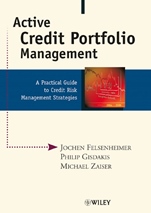
Active Credit Portfolio Management: A Practical Guide to Credit Risk Management Strategies
ISBN 9783527501984
Autor: Jochen Felsenheimer, Philip Gisdakis, Michael Zaiser
Wydawca: Wiley
Dostępność: 3-6 tygodni
Cena: 611,10 zł
Przed złożeniem zamówienia prosimy o kontakt mailowy celem potwierdzenia ceny.
ISBN13: |
9783527501984 |
ISBN10: |
3527501983 |
Autor: |
Jochen Felsenheimer, Philip Gisdakis, Michael Zaiser |
Oprawa: |
Hardback |
Rok Wydania: |
2005-12-13 |
Ilość stron: |
581 |
Wymiary: |
236x165 |
Tematy: |
KF |
The introduction of the euro in 1999 marked the starting point of the development of a very liquid and heterogeneous EUR credit market, which exceeds EUR 350bn with respect to outstanding corporate bonds. As a result, credit risk trading and credit portfolio management gained significantly in importance. The book shows how to optimize, manage, and hedge liquid credit portfolios, i.e. applying innovative derivative instruments. Against the background of the highly complex structure of credit derivatives, the book points out how to implement portfolio optimization concepts using credit–relevant parameters, and basic Markowitz or more sophisticated modified approaches (e.g., Conditional Value at Risk, Omega optimization) to fulfill the special needs of an active credit portfolio management on a single–name and on a portfolio basis (taking default correlation within a credit risk model framework into account). This includes appropriate strategies to analyze the impact from credit–relevant newsflow (macro– and micro–fundamental news, rating actions, etc.). As credits resemble equity–linked instruments, we also highlight how to implement debt–equity strategies, which are based on a modified Merton approach.
The book is obligatory for credit portfolio managers of funds and insurance companies, as well as bank–book managers, credit traders in investment banks, cross–asset players in hedge funds, and risk controllers.
Spis treści:
Foreword.
Introduction and Acknowledgements.
Part I Markets.
1 Market Structure.
1.1 Market Development.
1.2 Market Participants.
1.3 Issuing Debt from a Company’s Viewpoint.
1.4 Ratings and Rating Agencies.
1.5 Credit Classes.
2 Instruments.
2.1 Straight Bonds.
2.2 Bonds with Embedded Options.
2.3 Exotics.
2.4 Hybrid Bank Capital.
2.5 Single–Name Credit Derivatives.
2.6 Portfolio Credit Derivat
ives.
2.7 Outlook on Product Development.
3 Company and Debt Instrument Analysis.
3.1 Sovereign Risk and Government Support.
3.2 Business Risk.
3.3 Financial Risk.
3.4 The Rating Agencies’ Methodology.
3.5 Evaluation of Specific Debt Instruments.
3.6 Recovery Rate Estimates.
4 The Economics of Credit Spreads.
4.1 Macro Drivers.
4.2 Micro Drivers.
4.3 Credit Quality.
4.4 Equity–Debt Linkage.
4.5 Market Technicals.
Part II Models.
5 Fixed Income Basics.
5.1 Basic Valuation Concepts.
5.2 Obtaining the Term Structure of Interest Rates.
5.3 The Yield to Maturity.
5.4 Measurement of Interest Rate Risk.
6 Spread Measures.
6.1 Basic Considerations.
6.2 Yield Spreads.
6.3 Z–Spreads.
6.4 Asset Swap Spreads.
6.5 Spread Measures for Floaters.
6.6 Spreads and the Real Economy.
6.7 Conclusion.
7 Basics of Credit Risk Models.
7.1 The Components of Credit Risk.
7.2 A Single–Step, Two–Stage Model.
7.3 A Multi–Step Model for Zero Coupon Bonds.
7.4 The Multi–Step Model.
7.5 Continuous–Time Approach.
7.6 Recovery Treatment.
7.7 The Term Structure of Credit Spreads.
8 Single–Name Models.
8.1 Reduced–Form Models.
8.2 Structural Models.
8.3 Rating–Based Transition Matrix Models.
9 Portfolio Models.
9.1 The Loss Distribution and its Impact on Portfolio Derivatives.
9.2 Independent Defaults.
9.3 Default Dependency.
9.4 Term–Structure Effects.
9.5 Valuing First–to–Default Baskets.
9.6 Valuing CDO Tranches with the HLPGC Model.
9.7 Spread Dispersion.
9.8 Price Discovery versus Model Competition.
10 Valuation of Credit Derivatives.
10.1 Credit Default Swaps.
10.2 Options on Credit–Risky Instruments.
10.3 CDS Indices.
10.4 nth–to–Default Baskets.
10.5 Collateralized Deb
t Obligations.
10.6 Exotic Derivatives.
11 Portfolio Risk Measurement.
11.1 Risk Measures.
11.2 Credit Portfolio Models.
Part III Management.
12 Principles of Credit Portfolio Management.
12.1 The Role of ACPM in the Asset Allocation Process.
12.2 Management Styles: Passive or Active.
12.3 Quantitative and Fundamental Credit Research.
12.4 Diversification in Credit Portfolios.
12.5 Credit Risk Management in an ALM Environment.
12.6 Credits in the Global Asset Allocation.
12.7 Building Blocks of Credit Portfolio Management.
12.8 Key Portfolio Figures.
13 Portfolio Allocation.
13.1 Indices.
13.2 Sector Allocation in a Markowitz Framework.
13.3 Quality Allocation.
13.4 Tools to Derive the Optimal Allocation.
14 Performance Measures.
14.1 Tracking Error.
14.2 Sharpe Ratio and Treynor Ratio.
14.3 Information Ratio.
14.4 Summary.
15 Performance Analysis.
15.1 Return Accumulation.
15.2 Return Attribution Analysis.
16 Hedging Credit Risk.
16.1 Hedging on a Single–Name Level.
16.2 Hedging on a Portfolio Level.
17 Trading Strategies.
17.1 Trading Cash Bonds.
17.2 Trading Strategies with Single–Name CDS.
17.3 Portfolio Derivatives Trades.
17.4 Spread Options: Single and Complex Strategies.
17.5 CPPI Strategies Including iTraxx Indices.
17.6 Correlation Trading.
17.7 Capital Structure Arbitrage Trades.
17.8 Recovery Trades.
17.9 EDS versus CDS and the Role of DDS.
17.10 CDS–Cash–Repo Arbitrage.
18 Operational Issues: Accounting.
18.1 An Introduction to IAS 39.
18.2 IAS 39 Accounting for Credit Instruments.
19 Operational Issues: Basel II.
19.1 An Introduction to Basel II.
19.2 Basel II for Credit Instruments.
Part IV Appendix.
A.1 Analytics with Bloomberg and Reuters.
A.2 Default and Recovery Data from Rating Agencies.
Refer
ences.
Index.
Nota biograficzna:
Dr. Jochen Felsenheimer works for HVB Corporates & Markets and is currently heading the Credit & Credit Derivatives Strategy team, a department of HVB Global Markets Research. He holds a PhD in Economics from Ludwigs–Maximilians–Universität München.
Dr. Philip Gisdakis is a Quantitative Credit Strategist. He studied Mathematical Finance at the University of Oxford and holds a PhD degree in Theoretical Chemistry from Technische Universität München.
Michael Zaiser is a Credit Strategist at HVB Corporates & Markets. He studied Business Administration and Mathematics at Johann Wolfgang Goethe–Universität Frankfurt am Main.
Koszyk
Książek w koszyku: 0 szt.
Wartość zakupów: 0,00 zł
Informacje


Kontakt
Gambit
Centrum Oprogramowania
i Szkoleń Sp. z o.o.
Al. Pokoju 29b/22-24
31-564 Kraków
Siedziba Księgarni
ul. Kordylewskiego 1
31-542 Kraków
+48 12 410 5991
+48 12 410 5987
+48 12 410 5989
Subskrypcje
Administratorem danych osobowych jest firma Gambit COiS Sp. z o.o. Na podany adres będzie wysyłany wyłącznie biuletyn informacyjny.
Autoryzacja płatności

Informacje na temat autoryzacji płatności poprzez PayU.

© Copyright 2012: GAMBIT COiS Sp. z o.o. Wszelkie prawa zastrzeżone.
Projekt i wykonanie: Alchemia Studio Reklamy