


Wydawcy
Katalog tematyczny
- Archeologia (109)
- Ekonomia, finanse, business (13704)
- Filozofia (1445)
- Historia (3040)
- Języki i językoznawstwo (2356)
- Lifestyle, hobby i rozrywka (475)
- Medycyna (9704)
- Nauki humanistyczne (4)
- Nauki o Ziemi i środowisku (2638)
- Nauki ścisłe (20412)
- Astronomia (294)
- Biologia (5119)
- Chemia (6540)
- Fizyka (3309)
- Elektryczność i magnetyzm (90)
- Fizyka atomowa i molekularna (110)
- Fizyka cząstek elementarnych (36)
- Fizyka jądra atomowego (36)
- Fizyka kwantowa (210)
- Fizyka matematyczna (121)
- Fizyka relatywistyczna (36)
- Fizyka statystyczna (51)
- Fizyka stosowana (498)
- Mechanika klasyczna (186)
- Optyka i światło (133)
- Stany materii (202)
- Matematyka (4574)
- Nauki ścisłe, ogólnie (503)
- Nauki społeczne (8486)
- Nauki techniczne (13450)
- Prawo (1696)
- Publikacje informacyjne i interdyscyplinarne (1288)
- Religia i wierzenia (917)
- Technika komputerowa (4067)
- Zdrowie, relacje międzyludzkie i rozwój osobisty (657)





Informacje szczegółowe o książce
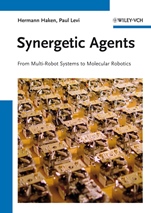
Synergetic Agents: From Multi–Robot Systems to Molecular Robotics
ISBN 9783527411665
Autor: Hermann Haken, Paul Levi
Wydawca: Wiley
Dostępność: 3-6 tygodni
Cena: 801,15 zł
Przed złożeniem zamówienia prosimy o kontakt mailowy celem potwierdzenia ceny.
ISBN13: |
9783527411665 |
ISBN10: |
3527411666 |
Autor: |
Hermann Haken, Paul Levi |
Oprawa: |
Hardback |
Rok Wydania: |
2012-09-12 |
Ilość stron: |
338 |
Wymiary: |
245x181 |
Tematy: |
PH |
T his book addresses both fields, multi robot systems and molecular robotics, from a unifying point of view, but without leaving aside typical particularities of both fields. The unifying aspect is based on the concept of information minimization whose precise formulation is the Haken–Levi–principle. Simultaneously, we introduce basic concepts of multi–component self–organizing systems such as order parameters and the slaving principle. Among explicit examples is the docking manoeuvre of two robots in two and three dimensions. The second part of the book deals with the rather recently arising field of molecular robotics. It is particularly here where nature has become a highly influential teacher for the construction of robots. The book introduces the reader to these topics, especially by a detailed theoretical treatment of the molecular mechanism of muscle contraction. The book concludes with a derivation of the quantum version of the Haken–Levi–principle and a detailed model of a molecular robot.
Preface XI Prologue I: Synergetic Agents: Classical XIII Prologue II: Synergetic Agents: Quantum XXIX Color Plates XLV Part One Classical Synergetic Agents 1 1 Introduction: In Search for General Principles 3 1.1 Physics: the Laser Paradigm – Self–Organization in Nonequilibrium Phase Transitions 4 1.2 Biology: Movement Coordination 7 1.3 Computer Science: Synergetic Computer as Neural Model 9 1.4 Synergetics Second Foundation 13 1.5 Concluding Remarks 19 References 20 2 Multirobot Action 23 2.1 Multirobot Systems and the Free Energy Principle: A Reminder of Chapter 1 23 2.2 Action Principle for a Multirobot System 26 2.3 Generation of Order Parameter Fields 27 2.4 Expected Final State of Total System 28 2.5 Determination of Absolute Position 29 2.6 How Can Robots Use the Information Provided by the Order Parameter Field? 30 2.7 What have the Order Parameters j (Laser) and V (Robots) in Common? 32 2.8 Is the Multirobot Potential V (x) an Order Parameter? A Critical Discussion 34 2.9 Information Field and Order Parameter Field 35 2.10 Robots Minimize their Information: Haken–Levi Principle 36 2.11 Information in Case of Several Modes of Action 43 2.12 Probability Distributions and Slaving Principle 43 2.13 Role of Information in Lévy Flights 45 2.14 Equations of Motion in the Field of a Superposition of Harmonic Potentials 48 2.15 Calculation of Restrictions from Local Information of Motion 64 2.16 System Information: Expectation Value of Local Information of Individual Agents 69 2.17 Docking of Robot at Object or Other Robot in Two Dimensions: Two Versions of a Case Study 76 2.18 Docking of Robot at Object or Other Robot in Two Dimensions. Center of Gravity Motion. Approach 3. Survey 82 2.19 Dynamics of Center of Gravity. Approach 3. Equations of Motion 86 2.20 Docking at an Object or Other Robot in Two Dimensions 90 2.21 Docking of Robot in Three Dimensions I 92 2.22 Docking of Robot in Three Dimensions II: Equations of Motion, Measurement of Position, and Determination of Desired Fixed Point 93 2.23 Overview: Total Equations of Motion in Three Dimensions based on Local Information 99 References 106 3 Multirobot Action II: Extended Configurations 107 3.1 Formation of Two–Dimensional Sheets 107 3.2 Pattern Recognition: Associative Memory 108 3.3 Pattern Recognition and Learning (Optical Arrangement) 108 3.4 Formation of Buildings 110 3.5 Macroscopic Locomotion and Movement 111 References 113 Part Two Quantum Synergetic Agents 115 Introduction: Molecular Robotics and Quantum Field Theory 115 4 Quantum Theory of Robotic Motion and Chemical Interactions 119 4.1 Coherent Action and Synchronization: the Laser Paradigm 119 4.2 Discussion 123 4.3 Representations 125 4.4 Molecules: The Nanolevel 128 4.5 Molecular Dynamics 132 4.6 The Explicit Form of the Heisenberg Equations of Motion: A ‘‘Menu’’ 137 4.7 The Complete Heisenberg Equations for the Coupling between a Fermi Field and a Bose Field, Including Damping, Pumping, and Fluctuating Forces 140 4.8 The Explicit Form of the Correlation Functions of Quantum Mechanical Langevin Forces 142 4.9 Heisenberg Equations of Motion for c(x) 146 4.10 Solution to the Heisenberg Equation for Operator Wave Functions: Wave Packets 148 4.11 Many–Particle Systems in Quantum Field Theory I: Noninteracting Particles 152 4.12 Many–Particle Systems in Quantum Field Theory II: Interacting Particles 153 References 154 5 Applications to Molecular Processes 157 5.1 Dynamics of the Transformation of a Molecule A into a Molecule B 157 5.2 Correlation Function for the Incoherent Parts 159 5.3 Dynamics of the Transformation of a Molecule A Into a Molecule B: the Initial State is a Coherent State 163 5.4 Dynamics of the Transformation of a Molecule A into a Molecule B: Coherent Driving 165 5.5 The Method of Adiabatic Elimination 167 5.6 Adiabatic Elimination: a Refined Treatment 168 5.7 Parametric Molecular Processes 172 5.8 Parametric Oscillator 176 6 Molecular Transport along One–Dimensional Periodic Structures 181 6.1 A Short Overview 181 6.2 Production and Transport of Molecules 191 6.3 Signal Transmission by Molecules 196 References 199 7 A Topic in Quantum Biology 201 7.1 Contraction of Skeleton Muscles 201 7.2 Details of the Movement Cycle 203 7.3 The Model and Its Basic Equations 203 7.4 Solution to Equations 7.7–7.15 206 7.5 The Steps (3) and (4) 210 7.6 Discussion of Sections 7.4–7.5 211 7.7 The Skeleton Muscle: a Reliable System Composed of Unreliable Elements 212 7.8 Detailed Derivation of (7.75) 216 References 217 8 Quantum Information 219 8.1 Introduction 219 8.2 The Maximum Information Principle 220 8.3 Order Parameters and Enslaved Modes 224 8.4 Haken–Levi Principle I: Quantum Mechanical 225 8.5 Haken–Levi Principle II: Quantum Mechanical 227 Reference 232 9 Molecular Robots 233 9.1 Construction Principles: The Basic Material 233 9.2 Mobile DNA Molecules 235 9.3 Goal (Road Map of the Following Chapter) 240 9.4 Quantum Field Theory of Motion of a Molecular Robot: a Model 240 9.5 The Question of Molecular Quantum Waves 270 References 271 Appendix: The Meaning of Expectation Values and Correlation Functions of Bose and Fermi Operators 273 List of Symbols 277 Index 281
Hermann Haken is Professor of the Institute for Theoretical Physics at the University of Stuttgart. He is known as the founder of synergetics. His research has been in nonlinear optics (in particular laser physics), solid state physics, statistical physics, and group theory. After the implementation of the first laser in 1960, Professor Haken developed his institute to an international center for laser theory. The interpretation of the laser principles as self organization of non equilibrium systems paved the way to the development of synergetics, of which Haken is recognized as the founder. Hermann Haken has been visiting professor or guest scientist in England, France, Japan, USA, Russia, and China. He is the author of some 23 textbooks and monographs that cover an impressive number of topics from laser physics to synergetics, and editor of a book series in synergetics. For his pathbreaking work and his influence on academic research, he has been awarded many–times. Among others, he is member of the Order "Pour le merite" and received the Max Planck Medal in 1990. Paul Levi is Full Professor for Informatics in the Institute for Parallel and Distributed Systems of the University of Stuttgart, Germany. He graduated in physics and computer science and became a senior research scientist in informatics and robotics, and Head of the Department of Technical Expert Systems and Robotics at the University of Karlsruhe. In 1988 he was appointed Professor at the Technical University of Munich, and scientific member of the Bavarian Center for Knowledge–Based Systems. Later on he served as Director of the Institute for Parallel and Distributed High Performance Computers at the University of Stuttgart. He is Member of the Management Board of the Centre for Computer Science (FZI) and Director of the Division Intelligent Systems and Production Engineering (ISPE), Karlsruhe, Germany. Paul Levi′s main research fields include computer vision, robotics, distributed AI and multi–agent systems. He has authored and co–authored both textbooks and monographs.
Koszyk
Książek w koszyku: 0 szt.
Wartość zakupów: 0,00 zł
Informacje


Kontakt
Gambit
Centrum Oprogramowania
i Szkoleń Sp. z o.o.
Al. Pokoju 29b/22-24
31-564 Kraków
Siedziba Księgarni
ul. Kordylewskiego 1
31-542 Kraków
+48 12 410 5991
+48 12 410 5987
+48 12 410 5989
Subskrypcje
Administratorem danych osobowych jest firma Gambit COiS Sp. z o.o. Na podany adres będzie wysyłany wyłącznie biuletyn informacyjny.
Autoryzacja płatności

Informacje na temat autoryzacji płatności poprzez PayU.

© Copyright 2012: GAMBIT COiS Sp. z o.o. Wszelkie prawa zastrzeżone.
Projekt i wykonanie: Alchemia Studio Reklamy