


Wydawcy
Katalog tematyczny
- Archeologia (109)
- Ekonomia, finanse, business (13704)
- Filozofia (1445)
- Historia (3040)
- Języki i językoznawstwo (2356)
- Lifestyle, hobby i rozrywka (475)
- Medycyna (9704)
- Nauki humanistyczne (4)
- Nauki o Ziemi i środowisku (2638)
- Nauki ścisłe (20412)
- Astronomia (294)
- Biologia (5119)
- Chemia (6540)
- Fizyka (3309)
- Elektryczność i magnetyzm (90)
- Fizyka atomowa i molekularna (110)
- Fizyka cząstek elementarnych (36)
- Fizyka jądra atomowego (36)
- Fizyka kwantowa (210)
- Fizyka matematyczna (121)
- Fizyka relatywistyczna (36)
- Fizyka statystyczna (51)
- Fizyka stosowana (498)
- Mechanika klasyczna (186)
- Optyka i światło (133)
- Stany materii (202)
- Matematyka (4574)
- Nauki ścisłe, ogólnie (503)
- Nauki społeczne (8486)
- Nauki techniczne (13450)
- Prawo (1696)
- Publikacje informacyjne i interdyscyplinarne (1288)
- Religia i wierzenia (917)
- Technika komputerowa (4067)
- Zdrowie, relacje międzyludzkie i rozwój osobisty (657)





Informacje szczegółowe o książce
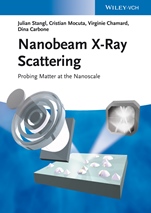
Nanobeam X–Ray Scattering: Probing Matter at the Nanoscale
ISBN 9783527410774
Autor: Julian Stangl, Cristian Mocuta, Virginie Chamard, Dina Carbone
Wydawca: Wiley
Dostępność: 3-6 tygodni
Cena: 564,90 zł
Przed złożeniem zamówienia prosimy o kontakt mailowy celem potwierdzenia ceny.
ISBN13: |
9783527410774 |
ISBN10: |
3527410775 |
Autor: |
Julian Stangl, Cristian Mocuta, Virginie Chamard, Dina Carbone |
Oprawa: |
Hardback |
Rok Wydania: |
2013-10-23 |
Ilość stron: |
284 |
Wymiary: |
251x177 |
Tematy: |
PH |
A comprehensive overview of X–ray scattering using nano–focused beams for probing matter at the nanoscale is presented. The monograph includes guidance on the design of nano–beam experiments and discusses various sources, including free electron lasers, synchrotron radiation and special laboratory sources. The rapid progress of this research area was initiated by the availability of brilliant well–collimated synchrotron X–ray sources and is strongly linked to the recent development of state–of–the art devices now capable to focus hard X–rays. Accordingly, several experimental methods have developed, such as nano–beam based scanning diffraction microscopy and spectroscopy, coherent diffraction imaging, etc. They are used in a broad range of applications in material science, from semiconductor nanostructures to biological specimen. It therefore seems a good time to give a first résumé on the achievements made, an overview on techniques and applications currently available, and based on that, an outlook on the potential of this approach. From the contents: • X–ray diffraction principles • X–ray focusing elements characterization • Nanobeam diffraction • Nanobeam diffraction setups • Spectroscopic techniques using focused beams • Coherent diffraction • Coherent limits • Future developments
Foreword IX Preface XI 1 Introduction1 1.1 X–ray Interaction with Matter 1 1.1.1 Transmission of X–ray 1 1.1.2 Diffraction of X–rays 2 1.1.3 X–ray Elemental Sensitivity 5 1.2 Diffraction at Different Lengthscales and Real–Space Resolution 5 1.2.1 How to Produce an X–ray Nanobeam 6 1.2.2 Experiments with Nanobeams 7 1.2.3 Coherence Properties of Small Beams 9 1.2.4 Side Issues ? 10 1.3 Future Developments 11 2 X–ray Diffraction Principles 13 2.1 A Brief Introduction to Diffraction Theory 13 2.1.1 Interference of X–ray Waves 13 2.2 Kinematic X–ray Diffraction Theory 17 2.2.1 The Structure Factor 19 2.2.2 The Form Factor 20 2.2.3 Reciprocal Lattice of Nanostructures 22 2.2.4 The Phase Problem 23 2.3 Reflectivity 24 2.4 Properties of X–ray Beams 27 2.5 A Note on Coherence 29 2.5.1 Longitudinal Coherence and Wavelength Distribution 29 2.5.2 Longitudinal Coherence Length 30 2.5.3 Transverse Coherence and Thermal Sources 31 2.5.4 Transverse Coherence Length 32 2.6 X–ray Sources 33 2.7 Diffraction Measurement: How to Access q in a Real Experiment 35 2.7.1 Diffraction Geometries 35 2.7.2 Lengthscales 37 3 X–ray Focusing Elements Characterization 39 3.1 Introduction and Context 40 3.2 Refractive X–ray Lenses 42 3.2.1 Characterization of Focusing Elements 44 3.2.2 Spherical Refractive X–ray Lenses 47 3.2.3 Parabolic Compound Refractive Lenses (CRL) 50 3.2.4 Kinoform Lenses 53 3.2.5 Characteristics of the Refractive Lenses 53 3.3 X–ray Mirrors. Reflection of X–rays at Surfaces 56 3.3.1 Reflective X–ray Optics (Kirkpatrick–Baez Mirrors) 56 3.3.2 Capillaries 61 3.3.3 Waveguides (Resonators) 62 3.3.4 Other Reflective Optical Elements 66 3.4 Diffractive X–ray Optics 66 3.4.1 Fresnel Zone Plates 67 3.4.2 Hologram of a Point Object 70 3.4.3 Quantities Characterizing a Binary Zone Plate 72 3.4.4 Multilevel Zone Plate 73 3.4.5 Getting a Clean and Intense Focused Beam with ZPs 74 3.4.6 Bragg–Fresnel Lenses 75 3.4.7 Multilayer Laue Lenses 76 3.4.8 Photon Sieves 77 3.4.9 Beam Compressors 77 3.5 Other X–ray Optics 80 3.6 Measuring the Size of the X–ray Focused Spot 81 3.7 Conclusion 83 4 Scattering Experiments Using Nanobeams 89 4.1 From the Ensemble Average Approach towards the Single Nanostructure Study 89 4.1.1 A Motivation for the Use of Small X–ray Beams 91 4.1.2 Required Focused Beam Properties 94 4.2 Scanning X–ray Diffraction Microscopy 98 4.3 Finite Element Based Analysis of Diffraction Data 103 4.4 Single Structure Inside a Device 110 4.5 Examples from Biology 117 4.6 Recent Experiments: The Current Limits 122 4.6.1 Strain Distribution in Nanoscale Ridges 123 4.6.2 Between Single Structure and Ensemble Average 127 4.7 Outlook 127 4.7.1 Experimental Developments 127 5 Nanobeam Diffraction Setups 131 5.1 Introduction 131 5.2 Typical X–ray Diffraction Setup 132 5.3 Nanodiffraction Setup Requirements 139 5.3.1 Diffractometer 140 5.3.2 Restriction of Setup 142 5.3.3 Stability: How to Keep the Beam on the Sample 143 5.3.4 Beating Drifts: More Solutions 147 5.4 Nanobeam and Coherence Setup 148 5.5 Detectors: Pixel and Time Resolution, Dynamical Range 149 5.6 Some Intrinsic Issues 151 5.6.1 Angular Divergence 151 5.6.2 Beam Damage 152 5.7 Sample Environment: Specific Solutions for Nanobeams? 152 6 Spectroscopic Techniques Using Focused Beams 155 6.1 Introduction and Context 155 6.1.1 Requirements of Spectroscopy Compared to Diffraction 161 6.2 Scanning X–ray Microscopy with Various Contrasts 163 6.2.1 Very Specific Contrast Signals 167 6.3 Soft X–rays Used for Imaging with Magnetic Contrast 169 7 Coherent Diffraction: From Phase Sensitivity to Phase Retrieval 177 7.1 Matter in the Light of Coherent X–rays 177 7.1.1 Coherent versus Incoherent Illumination 178 7.1.2 Formalism 179 7.1.3 Typical Coherent Nanofocusing Setup 182 7.1.4 Data Acquisition: From Fourier Space to Direct Space 184 7.2 Exploiting the Phase Sensitivity: Statistical Investigation of Defects in Matter 186 7.3 Encoding the Phase Directly: The Holographic Approach 188 7.3.1 Inline Holography 189 7.3.2 Off–axis Holography 190 7.3.3 Fourier Transform Holography 191 7.4 Support–based Phase Retrieval Coherent Diffraction Imaging 196 7.4.1 Principles 196 7.4.2 Phase Retrieval Algorithms 198 7.4.3 Imaging the Morphology of Nanomaterials 200 7.4.4 Imaging Strain in Nanocrystals 202 7.5 Fresnel Coherent Diffraction Imaging 208 7.6 Ptychography 210 8 Lensless Microscopy Imaging: Context and Limits 217 8.1 Resolution and Sensitivity 217 8.2 Experimental Design 219 8.2.1 Coherence and Flux 219 8.2.2 Sample Environment 222 8.2.3 Stability: Beam, Mechanics 222 8.3 How to Model: Defining the Physics Scheme 223 8.3.1 IlluminationWavefield 224 8.3.2 The Kinematics Approximation 224 8.3.3 Refraction Effects 225 8.3.4 Fresnel versus Far–field Regime 226 8.4 Phase Retrieval Strategies 226 9 Future Developments 231 9.1 Nanobeams: Hopes and Doubts 231 9.1.1 Smaller and Brighter Beams 232 9.1.2 Quality Control 233 9.1.3 Side Issues 234 9.2 Beamlines at Third–generation Synchrotron Sources 235 9.3 The Role of Free Electron Lasers 238 9.4 Conclusion 239 Abbreviation list 241 References 245 Index 265
Julian Stangl is working on the investigation of semiconductor nanostructures using x–ray scattering at Johannes Kepler University in Linz, Austria, where he also obtained his academic degrees. He has performed numerous experiments at synchrotron sources throughout Europe, and is developing nanobeam diffraction in collaboration with the European Synchrotron radiation facility in Grenoble, France. His received several scientific awards, including the Erich Schmid price of the Austrian Academy of Sciences. Cristian Mocuta is presently working at the French Synchrotron Facility, the ′Synchrotron SOLEIL′ and is in charge of the microbeam approaches and their development, for diffraction (µXRD) but also complementary analysis by fluorescence and absorption spectrosopies (µ–XRF and/or µ–XAS). His scientific interest resides in the study of the properties of materials at local scale (µm and below) using mostly x–ray diffraction technique. He obtained his academic degrees at the Joseph Fourier University in Grenoble, France, then joined as a scientist the European Synchrotron Radiation Facility (ESRF) where he was involved in the development of a micro– / nano–diffraction setup. Virginie Chamard is working on methodological developments of lens–less microscopy techniques at the Fresnel Institute in Marseille (France). Her concern is the imaging of nanocrystal structural properties at the local scale based on the inversion of intensity patterns obtained with coherent x–ray beams. After her academic degrees at the Grenoble University, she had some experiences at the European Synchrotron Radiation Facility and in Germany. Her CNRS position allowed her to successively work with different groups in France, in Grenoble and Marseille and to develop collaborations in the field of coherent x–ray scattering. Dina Carbone is currently working on the investigation of nanostructures using X–ray scattering techniques. After obtaining her degree at the Max–Plank–Institute for Metal–Research and the University of Stuttgart, Germany, she has started to work at the European Synchrotron Radiation Facility in Grenoble, France, where she is now contributing, as beamline scientist, to the development of nano–beam methods and their application in material science.
Koszyk
Książek w koszyku: 0 szt.
Wartość zakupów: 0,00 zł
Informacje


Kontakt
Gambit
Centrum Oprogramowania
i Szkoleń Sp. z o.o.
Al. Pokoju 29b/22-24
31-564 Kraków
Siedziba Księgarni
ul. Kordylewskiego 1
31-542 Kraków
+48 12 410 5991
+48 12 410 5987
+48 12 410 5989
Subskrypcje
Administratorem danych osobowych jest firma Gambit COiS Sp. z o.o. Na podany adres będzie wysyłany wyłącznie biuletyn informacyjny.
Autoryzacja płatności

Informacje na temat autoryzacji płatności poprzez PayU.

© Copyright 2012: GAMBIT COiS Sp. z o.o. Wszelkie prawa zastrzeżone.
Projekt i wykonanie: Alchemia Studio Reklamy