


Wydawcy
Katalog tematyczny
- Archeologia (109)
- Ekonomia, finanse, business (13704)
- Filozofia (1445)
- Historia (3040)
- Języki i językoznawstwo (2356)
- Lifestyle, hobby i rozrywka (475)
- Medycyna (9704)
- Nauki humanistyczne (4)
- Nauki o Ziemi i środowisku (2638)
- Nauki ścisłe (20412)
- Astronomia (294)
- Biologia (5119)
- Chemia (6540)
- Fizyka (3309)
- Elektryczność i magnetyzm (90)
- Fizyka atomowa i molekularna (110)
- Fizyka cząstek elementarnych (36)
- Fizyka jądra atomowego (36)
- Fizyka kwantowa (210)
- Fizyka matematyczna (121)
- Fizyka relatywistyczna (36)
- Fizyka statystyczna (51)
- Fizyka stosowana (498)
- Mechanika klasyczna (186)
- Optyka i światło (133)
- Stany materii (202)
- Matematyka (4574)
- Nauki ścisłe, ogólnie (503)
- Nauki społeczne (8486)
- Nauki techniczne (13450)
- Prawo (1696)
- Publikacje informacyjne i interdyscyplinarne (1288)
- Religia i wierzenia (917)
- Technika komputerowa (4067)
- Zdrowie, relacje międzyludzkie i rozwój osobisty (657)





Informacje szczegółowe o książce
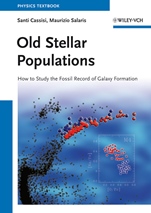
Old Stellar Populations: How to Study the Fossil Record of Galaxy Formation
ISBN 9783527410767
Autor: Santi Cassisi, Maurizio Salaris
Wydawca: Wiley
Dostępność: 3-6 tygodni
Cena: 702,45 zł
Przed złożeniem zamówienia prosimy o kontakt mailowy celem potwierdzenia ceny.
ISBN13: |
9783527410767 |
ISBN10: |
3527410767 |
Autor: |
Santi Cassisi, Maurizio Salaris |
Oprawa: |
Hardback |
Rok Wydania: |
2013-03-20 |
Ilość stron: |
538 |
Wymiary: |
241x175 |
Tematy: |
PH |
The book presents and discusses in depth a wide range of theoretical tools to decode the information gathered from photometric and spectroscopic observations of old stellar populations. These systems are the fossil record of galaxy formation and early evolution, and provide invaluable insights into the development of cosmic structures and the universe as a whole. The book starts with a detailed and up–to–date treatment of the evolution of low–mass stars, followed by a comprehensive discussion of a broad range of techniques to determine ages and initial chemical compositions – and more in general star formation histories – of resolved and unresolved old stellar systems. An extensive list of references is provided, together with examples of recent advances in our knowledge of the evolution of old stellar populations. A particularly representative case is the recent discovery of multiple stellar populations in Galactic globular clusters – one of the hottest topics in stellar and Galactic astrophysics – that is discussed in detail.
Preface XIII 1 Introduction1 1.1 Galaxy Formation 4 1.2 Decoding the Fossil Records: Photometric and Spectroscopic Diagnostics 6 1.3 Decoding the Fossil Record: the Tools 8 2 Low–MassStarPhysics 19 2.1 Basic Equations 19 2.2 The Thermodynamical Properties of Low–Mass Stars 30 2.3 Nuclear Energy Production and Nucleosynthesis 40 2.4 Radiative and Conductive Opacity 49 2.5 The Atmospheric Structure 58 2.6 Mass Loss 61 2.7 Diffusion Processes 65 2.8 Rotation 71 2.9 Internal Gravity Waves 75 2.10 Magnetic Fields 77 2.11 Thermohaline Mixing 78 3 From the Main Sequence to the Tip of the Red Giant Branch 83 3.1 Overview 83 3.2 Very Low–Mass Stars 84 3.3 The Main Sequence 94 3.4 The Standard Solar Model 103 3.5 Blue Stragglers 110 3.6 Subgiant Branch Evolution 121 3.7 Red Giant Branch Evolution 123 3.8 The Helium Flash 130 3.8.1 3D–Simulations of the Helium Flash 132 3.9 Theoretical Isochrones for the Hydrogen Burning Stages 134 4 Horizontal Branch and Red Clump 163 4.1 Overview 163 4.2 Mixing Processes 164 4.3 The Horizontal Branch Evolution 169 4.4 Extremely Hot Horizontal Branch and "Blue Hook" Stars 183 4.5 Low–Mass Pulsating Stars in the Core He–burning Stage 189 4.6 Red Clump Stars 206 4.7 The Effects of Non–canonical Processes on HB Evolution 213 5 Asymptotic Giant Branch 231 5.1 Overview 231 5.2 Early Asymptotic Giant Branch Evolution 232 5.3 The Thermally Pulsing Stage 236 5.4 Calibration of Evolutionary AGB Models 254 5.5 Synthetic AGB Stellar Models 257 5.6 Long Period Variables 260 5.7 Nucleocosmochronology 266 5.8 The End of the AGB and Post–AGB Evolution 268 6 White Dwarf Cooling Sequences 275 6.1 General Properties and Simple Models 278 6.2 Detailed Models 280 6.3 Colour–Magnitude Diagrams of WD Populations 294 6.4 Spectroscopic Classification of WDs 300 6.5 Low Mass CO– and He–core WDs 302 7 Resolved Old Stellar Populations in the Galaxy 305 7.1 Introduction 305 7.2 Old Star Cluster Distances 306 7.3 Old Star Cluster Ages 337 7.4 Ages of Old Field Stars from Photometry/Spectroscopy 352 7.5 Empirical Rotation/Activity–Age Relationships 358 7.6 Estimates of the Primordial Helium Abundance 362 7.7 Estimates of the Primordial Lithium Abundance 368 7.8 Multiple Stellar Populations in Galactic Globular Clusters 378 8 Resolved Composite Systems 399 8.1 Synthetic CMD–fitting 400 8.2 Multiple Isochrone–fitting 405 9 Unresolved Old Systems 411 9.1 Building Blocks of a SPSM 412 9.2 Low–Resolution Diagnostics 415 9.3 High–Resolution Diagnostics 455 9.4 Unresolved Composite Systems 473 9.5 Validation of Stellar Population Synthesis Techniques 475 References 481 Index 517
Santi Cassisi received his degree in physics from the University of Pisa, Italy, in 1991. He then spent a year at the Astronomical Observatory of Meudon–Paris, France, followed by a PhD–fellowship at the University of L′Aquila, Italy, from 1995 to 1997. In 1998, he accepted a post as staff researcher at the Collurania–Teramo–Observatory, a research unit of INAF. He currently holds a position as associate professor at the same institution. Professor Cassisi′s research focuses on theoretical stellar evolution and its application to the study of both galactic and extra–galactic stellar populations. He has authored about 210 scientific papers, 115 of them in peer–reviewed journals, and a monograph. Maurizio Salaris studied physics at the University of Rome ′La Sapienza′, and then worked at the Collurania–Teramo–Observatory, Italy, the Institut d′Estudis Espacials de Catalunya in Barcelona, Spain, the Max Planck Institute for Astrophysics in Garching, Germany, and the Astrophysics Research Institute of the Liverpool John Moores University, UK, where he currently holds the post of Professor of Stellar Astrophysics. He has published about 150 papers in peer–reviewed journals and books, plus a monograph, co–authored by Santi Cassisi. Professor Salaris′s scientific work focuses on theoretical stellar evolution, stellar population synthesis models, and the interpretation of photometric and spectroscopic observations of Galactic and extragalactic stellar populations.
Koszyk
Książek w koszyku: 0 szt.
Wartość zakupów: 0,00 zł
Informacje


Kontakt
Gambit
Centrum Oprogramowania
i Szkoleń Sp. z o.o.
Al. Pokoju 29b/22-24
31-564 Kraków
Siedziba Księgarni
ul. Kordylewskiego 1
31-542 Kraków
+48 12 410 5991
+48 12 410 5987
+48 12 410 5989
Subskrypcje
Administratorem danych osobowych jest firma Gambit COiS Sp. z o.o. Na podany adres będzie wysyłany wyłącznie biuletyn informacyjny.
Autoryzacja płatności

Informacje na temat autoryzacji płatności poprzez PayU.

© Copyright 2012: GAMBIT COiS Sp. z o.o. Wszelkie prawa zastrzeżone.
Projekt i wykonanie: Alchemia Studio Reklamy